
Category Archives: 1-By Laksh

All these articles are from Laksh’s desk

Website to Internet Stratgy:Microsoft dot com

>>>>

A corporate website has come a long way in terms of its utility and its overall perception to the stakeholders. Today corporate websites not only provides comprehensive information about the company but also play an important role in executing its business and sales models. What better an example to illustrate this point than Microsoft.com?

Phase I: Only Corporate Strategy, No Internet Strategy

When Microsoft got started on the web, it was a laggard of sorts, way behind Netscape.
Experts all over conceded that it took a while for Microsoft to figure out the Internet, and when it did, all it knew that it had to become No.1 in the browser market. So, its web presence was an extension of its corporate strategy—Go after Netscape.

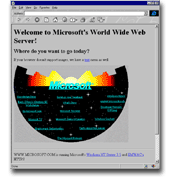
Microsoft.com in the initial years reflects this strategy where all its new versions had only one purpose; showcase the features of Internet Explorer and make it easy for internet users to get and start using it.  The period between 1996-1998 saw the website changing from a simple-gray-background-some-pages to a information-rich-yet-showcasing-the-new-features-IE (active X controls etc).

Phase II: In comes an Internet Strategy

Only when Microsoft’s IE made significant inroads into Netscape’s market, did it start asking the question “What should I do with Internet today?”

When it did, the ‘user’ took center stage and an internet strategy came to fore. Microsoft.com transformed into a site that does lot of things for the user than just be a showcase site for its products. Suddenly all the other components fell in place like that of MSDN, Support etc. The homepage not just informed the users but guided them to action.

Significantly, two things happened. One, the site became more user-friendly. Second, there was something for the users to do on the site as a part of their daily routine.

Suddenly the interest in Microsoft.com went up and the users grew exponentially.The period between the later half of the year 1998 to the year 2003, saw Micrsoft.com emerge as one of the world’s top visited sites in the world. Interestingly this also allowed the company to tout the capability of its Windows Server line of products, driving home the point—’If it is good for Micrsoft.com it is good enough for you’.

Phase III: Internet Strategy aligns with the Corporate Strategy.

Somewhere in the year 2003, Microsoft’s plans in the consumer products division started yielding results. Leading the pack was X-Box, a playstation rival. Since then, the website’s design reflects a certain enthusiasm, almost child like. It continues till date with over half of the home page real estate devoted to new consumer products. Every now and then, when Mr.Gates unveils new products at events like Comdex, the homepage is agog with such news.

The homepage is now a place of action with vibrant color images of games and gadgets. While the corporate strategy is dictating such design changes, its Internet strategy, which is centered on understanding and engaging the customer is intact.

Internet today plays an important role in Microsoft’s sales model and with its latest offering ‘Zune’ it might even be a part of its business model.

You might never know, if Microsoft.com becomes synonymous with the company or LIVE becomes the only way it would deliver its products. However, two things appear to be certain. One, its components of Internet strategy—Excite, Inform and Prompt to action—are here to stay. Two, Internet strategy is a part of its corporate strategy now.

Next article in this series: Apple’s Internet journey

Related links
A brief history of Microsoft on the web

Mein Hu Koun?

Don.. Don.. Don.

This is what Shah Rukh Khan and Farhan Akhtar would be hoping to hear from the audience, when their film hits the theaters worldwide in the festival season of Diwali-Eid. Infact, the louder the cheers get, the better it augurs for the success of their film. Here’s why. In the original movie ‘Don’, the song in question, sets in almost after two hours of narration, in the third act, so to speak. So, if the new version stays any true to the original (which Mr. Akhtar says it will, in the script department), then the response sure indicates that the audience is still engaged and might continue to do so, till the end of the movie. If that does happen, it must bring in a huge sigh of relief for the entire team of ‘Don’, Farhan and Shah Rukh in particular.

But is there a likelihood that it might not happen? Yes, if the audience answers the question ‘Mein Hu Koun’ as

Amitabh.. Amitabh.. Amitabh.

Yes, Shah Rukh would be fighting a super persona also known as Amitabh when his ‘Don’ releases shortly.

Amitabh’s ‘Don’ released in the year 1978, became a blockbuster thanks to an unconventional script and a tight screenplay by Salim-Javed, pulsating music and racy background score by Kalyanji-Anandji, vocals by inimitable Kishore Kumar and Asha Bhonsle, excellent cinematography by Nariman Irani and creditable performances from the lead cast. But it was Amitabh and his out-of-the-world portrayal that made this successful potboiler worth remembering decades after its first release and fetched an unprecedented re-run value at the box-office. The dream run simply carried forward to Television channels.

If you are a TV surfer, there is every chance that you crash into Amitabh’s ‘Don’, and get to hear some of the memorable dialogues of Salim-Javed. He grabs your attention with his dialogue delivery, at every stage, right from the seemingly innocuous question Kya tumhe maut se dar nahi lagta to a hint of swagger in Don ko pakadna mushkil hi nahin, namumkin hain. It is these subtle shades of characterization that Amitabh used to a good effect to make a negative character loveable and entertaining.

Another brilliant aspect of Amitabh’s acting that comes to fore is the ease with which he played the role of the ‘Don’. There were no strange mannerisms to show cruelty or queer looks to bring out the cunningness. He played it as if ‘Don’ were a character of a next-door person. He brought in believability to the character of ‘Don’ and then, sort of over-played the second character Vijay. This brought in the stark contrast needed for a double-role. As the two characters do not come face to face at any time, there were no rude shocks when the ever-cool Don gave way to a pan chewing Vijay and vice-versa. As Amitabh had no predecessor against whom he would be compared with, he played it the way he wanted to and the way he perceived the characters to be.

Alas! Shah Rukh has no such luxury. He has to create a ‘method’ that is different and yet stands tall in comparison to Amitabh’s portrayal. Unfortunately, such an effort has every reason to go to hay wire. Not because of Mr. Khan’s acting talents. In the past, Shah Rukh delivered noteworthy performances as a bad guy and he redeem himself as an actor yet again. But the problem comes from the audiences and their contrasting reference points. While the die-hard fans of Amitabh would like to see how different or similar he is to their idol, aficionados of Shah Rukh would check if his usual springing self were still intact when he plays a negative character sans the usual courtship romantic musical stuff.

Shah Rukh first has to crack this puzzle, either by being a devoted clone (which he cannot) or carve a new path (that could prove very difficult owing to his romantic hero image). As the loyal fans of two generation superstars, form the target audience for the movie, Shah Rukh in an effort to win over both might deliver a half-baked performance. Just imagine Shah Rukh trying hard to bring in the romance angle into Don or Vijay’s character. Well, to some extent, in the case of Vijay, he might succeed. But what if he does that to real Don? Hope he remembers the dialogue from the old version-Mujhe ladkiyo ke dil se koyi dilchasbi nahin, isi liye to ab tak zinda hun. Hmm..Shah Rukh, appears to be on a sticky ground.

If you compare with Shah Rukh’s confusion, Farhan Akhtar’s job is well etched out. All he has to do is create contemporary worlds for the real Don and his look-alike. Though this is easier said than done, Farhan might just pull it off. His mastery over all the crafts of filmmaking will definitely hold him in good stead during the making of this new version. Supported by a talented crew, he might even succeed in creating a milieu that draws inspiration from an overlap of a ‘Mission Impossible’ with a ‘Don Brosco’. Plus, he has already proven his mettle with ‘Lakshya’ where he designed the world of a soldier to the letter.

Farhan has chipped in a lot of other attractions already, with a host of stars making an item or glorified guest appearances, and Kareena Kapoor doing a Helen act. You never know…he might even have an ace up his sleeve, like a very special appearance by the legendary Amitabh himself dancing to the title song or an Abhishek Bachchan crooning the words ‘Don.. Don.. Don’ for that matter. At the end of it, the overall result might even endear the film to a new set of audience other than the fans of Amitabh or Shah Rukh.

Though it is easy to get carried away by Farhan’s plans, let’s make no mistake. ‘Don’ is essentially a Shah Rukh film. The spotlight is on him for sure. It is only when he starts ruling their minds, that the audience would move on to savor the rest of Farhan’s assorted menu.

But, the movie is bound to generate great openings with the three sets of crowds flocking in-fans of Amitabh, fans of Shah Rukh and the regular moviegoers-as the movie offers something for all of them. The success and the range of it would though depend on the word of mouth and the acceptance of Shah Rukh in Amitabh’s shoes. So, the movie will ride heavily on the shoulders of the intended target audience.

Irrespective of the fate of the new ‘Don’ at the box-office, and the lingering ‘Mein Hu Koun’ question, one thing is for certain. More and more people would like to see the original, either before the movie or after its release. Marketing team at Sony Max, the channel that holds the telecast rights, would have already repackaged the old ‘Don’ and hiked the sponsor’s rates. Eagle, the company that holds the video rights should be thinking of a commemorative DVD, unless Farhan Akhtar’s contract bars them from doing so.

While wishing all the success to Shah Rukh and Farhan, here is the last word from a die-hard fan of Amitabh. When the dust has settled and the movie has had its run at the box-office, we might just end up having more number of people revisiting the old version and joining the chorus of ‘Amitabh.. Amitabh.. Amitabh’, albeit with the singer Shaan. Amen!

A tribute to Hrishida

Filmmaking is both an art and craft. The percentage of each of it in a film depends entirely on the filmmaker and what inspired him to begin with and continues to do throughout the film making process. While for some filmmakers the source of inspiration might be other media like books, theatre or Television, for others it might be films. With remakes doing the round and inspiration touching the zone of imitation, you could say some of the most successful filmmakers today take the second approach. They spend lot of time on indianizing/regionalizing the existing movie content and churn out new films. For most of them, designing a shot is more important than conceiving a scene. Infact, they seem to work backwards—shots to scene, scenes to screenplay, screenplay to a plot. If you do not mind the software lingo, it is like writing the code and then thinking of a design that fits:)

Well, this is not to take away any thing from their success or their mastery over the craft, but it is time to get nostalgic as we are going to talk about Hrishikesh Mukherjee (Hrishida), a filmmaker of the first approach. Our tribute to him probably lies in acknowledging the school he belonged to, how it came to fore through his films and his unobtrusive style that never made him greater than his films. While at it, let’s underscore certain points that are very relevant for even today’s filmmakers as well.

Hrishida always made films that had a script developed in the traditional process so to speak. It appears that his film making process is often kicked in by a novel idea/theme, which is then taken through the route of treatment-screenplay-dialogues-drafts-final version. The structure was not that important, as the emphasis was on the substance.  Infact, the substance is so good, that you could simply ‘conduct’ the script. And, interestingly, the script made choices for the important crafts like music, cinematography etc and not the filmmaker. Hence there are no ego trips or foreign jaunts.

Let’s look at two of his successful, contrasting, yet, his kind of films—Anand and Golmaal. Both of them are set in his typical middle class milieu with the protagonists struggling to survive—rather literally.

Anand is about a terminally ill patient and his last days in this world in the company of a doctor. The novelty factor sets in through the philosophy of the main character— ‘Death might seize my next moment, but this one is mine’. This philosophy becomes the central theme and it is carried through out the film. The story moves forward as Anand enjoys his moments with the people around him. All the characters that Anand interacts cannot believe that someone who can enjoy life so much is about to die shortly. Throughout the film, Hrishida never loses sight of this main theme and when finally Anand does leave the world, he leaves a lot of memories and his spirit is immortalized. This once again, reinforces the central theme—’when moments are lived in full, they become everlasting memories’.
 
When a storyteller stays so committed to his central idea, the film speaks for itself. Marketing of such a film becomes very easy, as the communication objective is made very clear from the word go. Now, if you look at the amount of money that is spent in marketing a movie today, it is primarily to tell the audience what the film is all about and how different it is from rest of the pack. Hrishida managed them at the script stage itself, thus precluding a lot of effort during the later stage.

If the movie Anand dealt with an unusual philosophy, Golmaal is a sweet nonsense kind of film. You could say, P.G. Wodehouse and his British humor inspired Golmaal, specially the characters of Jeeves and Uncle Dynamite.  Golmaal is essentially woven around a central theme of ‘surviving at any cost’ by legal means. The film takes a fairy tale route with the life a happy go lucky guy ending up in getting everything—job, girl and riches. All he had to do was to engage in a Golmaal, enact a double role and tame his would be father-in-law.

Once again, Hrishida succeeds in conveying the main theme throughout, right from the title song by R.D.Burman. Infact, the title song is a theme song of sorts and sets the mood of the film. And whenever the characters engage in Golmaa’, title song plays in the background. It is the script that calls the craft of music and the music that blends into the movie. If you were to go by the current trend of music videos popularizing the film, Golmaal title song had all ingredients to make it big, even though the film is several decades old.

So, here is the take away from Hrishida’s films and his filmmaking school. Let art drive the craft. If there is a something novel to say and if the script stays true to this idea, the idea takes the entire film making process forward. The novelty or the differentiation factor, which is so important these days when the film is marketed, is already there, by the time is ready for release. This is something worth pondering for today’s filmmakers, who are forced to spend exorbitant amounts on marketing their films, while their ideas and scripts are half cooked. 

Also featured in

Related links
    A tribute to Hrishida