Category Archives: Google AI Studio

A Million Lights, One Offering: The Heart of Devotion at Kotideepotsavam

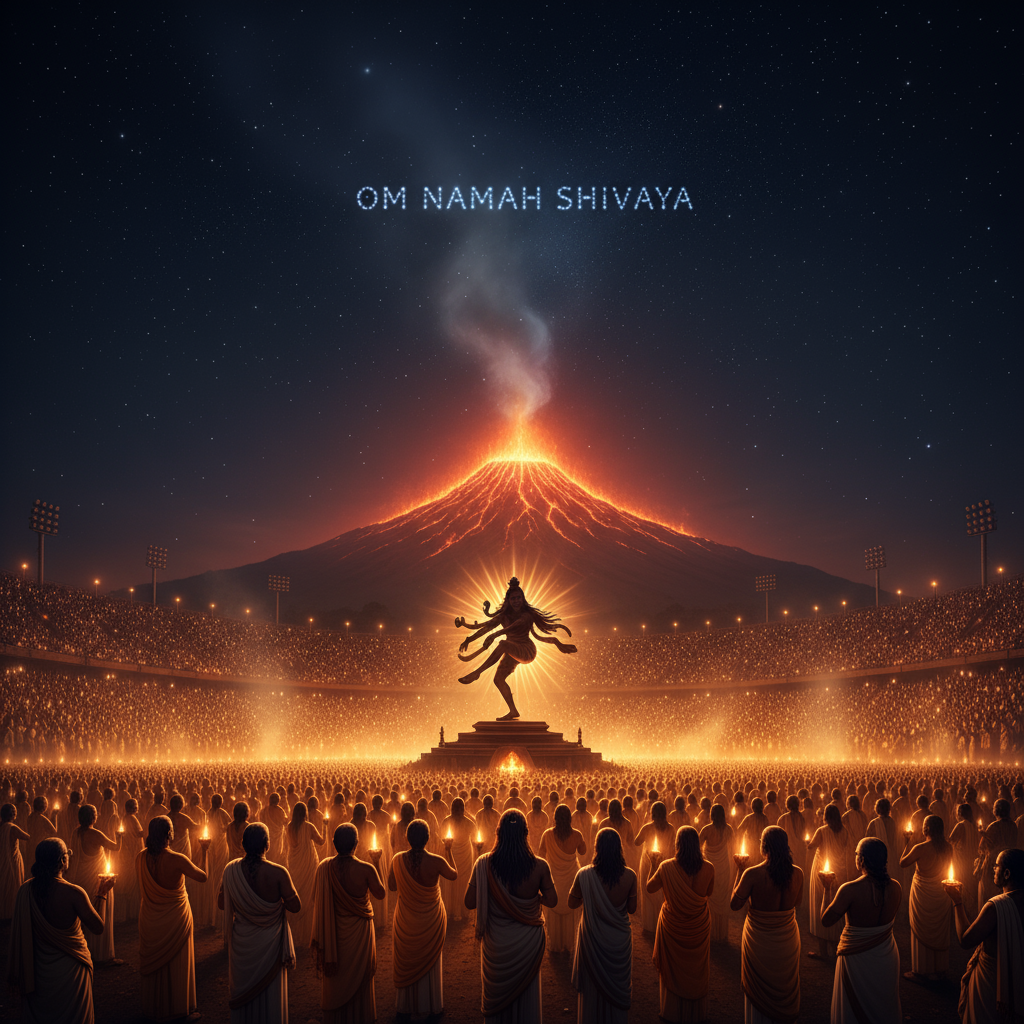
image by author, grok and perplexity.ai

Imagine a space as vast as a stadium, transformed into a celestial galaxy on Earth. A sea of humanity, their faces glowing with reverence, sit before a million flickering lamps. Each flame, a tiny prayer; together, a roaring testament to unwavering faith. This is the breathtaking spectacle of Bhakthi TV’s Kotideepotsavam, a divine celebration that immerses one in the profound spiritual energy of Lord Shiva.

But what does it truly mean to worship the Lord of the Universe? What can we, as mere mortals, offer to a being who is the source of all creation? This question has been explored for centuries by saints, poets, and sages. Two of the most powerful answers come from two very different, yet spiritually aligned poets: a profound philosopher of ancient India and a court poet who valued devotion above all earthly power.

The Philosopher’s Renunciation: A Lesson from Bhartṛhari

Long before the grand courts of medieval India, in the 5th century, lived a mind of immense intellectual and spiritual depth: Bhartṛhari. A master grammarian and one of the most important philosophers of language in Indian history, he authored the seminal text Vākyapadīya, which explores the deep connection between consciousness and language.

Yet, Bhartṛhari was not just a scholar of the abstract. Born in Ujjain and associated with the court of Valabhi, his life story is a powerful tale of inner conflict and ultimate spiritual victory. Legend paints him as a man who, despite possessing immense wealth and power, was repeatedly confronted with the bitter realities of human attachment and impermanence. After struggling to fully detach from worldly pleasures, he finally succeeded, renouncing his courtly life to live as a yogi in Ujjain until his death.

From this crucible of experience, he gifted the world the Śatakatraya—three brilliant collections of 100 verses on love, ethics, and, most powerfully, renunciation (Vairāgya). In his Vairāgya Śatakam, he crystallizes the ultimate goal of a devotee by describing the ideal ascetic, Lord Shiva:

The Shloka:

भिक्षाशनं तदपि नीरसमेकवारं,शय्या च भूः परिजनो निजदेहमात्रम् |वस्त्रं विशालकुशलं जलपानपात्रं,यस्यास्ति चेति वपुषा किमु तस्य कृत्यम् ||

Bhiks̱āśanaṁ tadapi nīrasamēkavāraṁ,śayyā ca bhūḥ parijanō nijadēhamātram |vastraṁ viśālakauśalaṁ jalapānapātraṁ,yasyāsti cēti vapuṣā kimu tasya kr̥tyam ||

The Meaning:

Bhartṛhari describes the ultimate state of detachment, embodied by Lord Shiva. He who has:

  • Food from begging (bhiksha), and that too, tasteless and only once a day;
  • The bare earth as his bed;
  • Only his own body as his attendant;
  • The vast expanse of the sky as his clothing;

…what need does such a person have for any other worldly possession?

This verse powerfully illustrates that Lord Shiva embodies ultimate freedom from material wants. For a devotee, this poses a profound question: if the Lord I worship desires nothing, what can I possibly give Him?

The Poet’s Devotion: The Unwavering Cry of Dhurjati

Centuries later, in the glorious court of Sri Krishnadevaraya, lived the poet Dhurjati. Though a celebrated member of the royal court, his heart belonged only to Lord Shiva of Kalahasti. His magnum opus, Sri Kalahasti Mahatyam, is a testament to his profound and unshakeable devotion. In one of his most famous verses, he makes his priorities crystal clear:

The Verse:

రాజ్యాంగ భోగములు రమణీమణుల కౌగిలింతలున్,రాజ్యాంగమందు భోగ సౌఖ్యములు కోరను నేనునీ పాద సేవయును, నిత్యము నీ నామ స్మరణయునునాకు దయచేయుమయా శ్రీకాళహస్తీశ్వరా!

Rājyāṅga bhōgamulu ramaṇīmaṇula kaugiḷintalun,Rājyāṅgamandu bhōga saukhyamulu kōranu nēnuNī pāda sēvayunu, nityamu nī nāma smaraṇayunuNāku dayacēyumayā Śrīkāḷahastīśvarā!

The Meaning:

Dhurjati declares to his Lord:

  • “I do not desire the pleasures of kingship, nor the embraces of beautiful women, nor any comforts that royalty can offer. All I ask for, O Lord of Sri Kalahasti, is the blessing to serve at your feet and the grace to chant your name eternally!”

Like Bhartṛhari, Dhurjati places divine service above all worldly treasures. He understands that the joy of devotion far surpasses the fleeting pleasures of the material world.

A Modern Echo: Kotideepotsavam and the Ultimate Offering

This timeless stream of devotion, flowing from ancient philosophers to medieval poets, found its vibrant, modern expression at the Kotideepotsavam. The event itself was a pilgrimage through the sacred geography of Shaivism. The audience was taken on a spiritual journey to the Panchabhuta Kshetras, the five holy sites where Lord Shiva is worshipped in the form of the five elements:

  • Water (Jala Lingam): Jambukeswaram
  • Sky (Akasha Lingam): Chidambaram
  • Earth (Prithvi Lingam): Kanchipuram
  • Wind (Vayu Lingam): Srikalahasti
  • Fire (Agni Lingam): Arunachalam (Tiruvannamalai)

The theme of the evening was centered around the magnificent Arunachalam, the abode of the Agni Lingam. The celestial wedding (Kalyanotsavam) of Lord Arunachaleswara and Goddess Apeethakuchambika Devi was performed, a sight that left the tens of thousands of devotees in a state of spiritual bliss.

The philosophical heart of the event was the profound discourse by the revered Padma Shri Dr. Garikapati Narasimha Rao. He eloquently answered the very question posed by our poets, titling his talk “Sivudiki Manaki Ram Ram”—a look at the unique relationship between the devotee and Lord Shiva.

He drew upon two powerful shlokas from Adi Shankaracharya’s Sivananda Lahari:

  1. The Devotee’s Dilemma: Dr. Garikapati explained that a devotee is at a loss for what to offer Shiva. How can one offer wealth to Him when He holds the golden Mount Meru in His hand and His closest friend is Kubera, the treasurer of the gods? How can one offer precious gems when His very abode is adorned with Chintamani (the wish-granting jewel), or fine silks when He is served by Kalpavriksha (the wish-granting tree)? Realizing this, the devotee concludes that the only unique, personal thing he can offer—something the Lord doesn’t already possess—is his own mind.
  2. Shiva’s “Offerings”: In return, what can the devotee ask for? Dr. Garikapati humorously pointed out that Shiva’s possessions are of little use to us. His food is deadly poison, His ornaments are slithering snakes, His clothes are animal hides, and His vehicle is an old bull. Therefore, the devotee does not ask for these. Instead, he makes a simple, profound request: “I have given you my mind. In return, please fill it with unwavering devotion (Bhakti) for your lotus feet.”

This beautiful exchange is the essence of true devotion. It is not a transaction of material goods but a surrender of the ego, the mind, in exchange for divine grace and love.

The Kotideepotsavam, with its million lights and massive gathering, is a physical manifestation of this very principle. Each lamp lit is a symbol of the devotee offering their inner light, their consciousness, to the Supreme. It’s a powerful reminder that beyond all rituals and grandeur, the greatest offering we can ever make is a heart full of pure, unshakeable devotion.

Om Namah Shivaya.

References:

కోటి దీపోత్సవంలో గరికిపాటి గారి ప్రవచనామృతం| Garikipati Narasimha Rao | Koti Deepotsavam| NTV Telugu

Igniting the Soul: The Profound Wisdom of Koti Deepotsavam

image by author and nano google

Under a vast night sky, amidst the shimmering glow of countless lamps, a sea of devotees gathered for the sacred Koti Deepotsavam. The atmosphere was thick with devotion, but it was the profound wisdom shared from the stage that truly illuminated the evening. A revered seer from the illustrious Sringeri Sharada Peetham delivered a discourse that transformed the beautiful ritual into a deep spiritual lesson, guiding every soul present from outer light to inner awakening.

Here are the key insights from his enlightening address.

The True Meaning of the Lamp

The seer began by reminding everyone of the special significance of the holy Karthika month, a time dedicated to spiritual practices. He explained that the act of lighting a lamp, or Deepam, is far more than a mere tradition. It is a powerful symbol.

“The lamp’s flame,” he elaborated, “dispels the physical darkness around us. In the very same way, the light of knowledge (Jnana) dispels the inner darkness of ignorance (Ajnana).” This timeless practice, a cornerstone of Sanatana Dharma, serves as a constant reminder of our life’s purpose: to journey from the shadows of confusion to the brilliant light of self-realization.

The Two Lights: The Lamp in Your Hand and the Light Within You

The discourse beautifully distinguished between the external lamp (Bahya Deepam) and the internal one (Antara Deepam). While we celebrate by lighting countless lamps in the physical world, the ultimate goal is to kindle the lamp of wisdom within our own hearts.

This inner light is the knowledge of our true nature. It is the flame that burns away doubt, fear, and ego, revealing the eternal truth that lies within. The Koti Deepotsavam, therefore, is an annual inspiration for us to begin this inner journey and make our human birth meaningful.

The Unquenchable Flame of Adi Shankaracharya

A significant portion of the discourse was dedicated to the enduring legacy of Jagadguru Sri Adi Shankaracharya, whom the seer described as an incarnation of Lord Shiva himself. Over 1200 years ago, Shankaracharya traveled the length and breadth of India, reviving Sanatana Dharma and establishing four great centers of learning, the Amnaya Peethams, to ensure its eternal protection.

The seer explained that the vibrant traditions we witness today, from the grand Kumbh Mela to the very Koti Deepotsavam event, thrive on the strong spiritual and philosophical foundation laid by Shankaracharya. He was the one who lit an unquenchable lamp of knowledge that continues to guide humanity.

“Who Are You?” A Simple Path to a Profound Truth

Perhaps the most captivating part of the speech was a simple yet profound explanation of Advaita (non-dualism) philosophy, drawn from Adi Shankaracharya’s “Eka Sloki Prakaranam” (A Treatise in a Single Verse). The seer narrated the enlightening dialogue between a Guru and his disciple:

  • Guru: “What is the light by which you see?”
  • Disciple: “The sun during the day, and a lamp at night.”
  • Guru: “What is the light that allows you to see even the sun and the lamp?”
  • Disciple: “My eyes.”
  • Guru: “And when your eyes are closed, what is your light?”
  • Disciple: “My intellect, which allows me to think and perceive.”
  • Guru: “But what is the light that knows your intellect and its thoughts?”
  • Disciple: (After a moment of deep introspection) “I am.

This “I am” is the Atman, the Self—the ultimate, self-luminous consciousness that is the witness to everything, including our own mind. The seer explained that this is the final destination of all spiritual seeking, the ultimate light that needs no other light to be seen.

A Mantra for a Blessed Life

To help the devotees carry this wisdom in their hearts, the seer concluded with a powerful blessing and a simple mantra:

“Namah Shankaraya”
(Salutations to Shankara)

He explained that “Shankara” means “the one who bestows auspiciousness and well-being.” By chanting this mantra 108 times daily, he said, one can invoke the grace of both the divine and the great Jagadguru Adi Shankaracharya, clearing the path to spiritual progress and worldly peace.

The Koti Deepotsavam is a breathtaking spectacle, but as the seer so eloquently reminded us, its true beauty lies not just in the lights we see, but in the light it inspires us to find within ourselves. It is a call to honor our tradition, seek true knowledge, and realize the divine flame that is our eternal essence.

References
1. శృంగేరి శారదా పీఠం జగద్గురు శ్రీశ్రీశ్రీ విధుశేఖర భారతి స్వామి వారి అనుగ్రహ భాషణం..! #bhakthitv

The Art of the Fall: Lessons in Resilience from a Man Who Calls Failure His “Sweetest Moment”

Introduction: The Paradox of a Sweet Failure

పడిలేచే కెరటం; image by author and Nano Google

In a world obsessed with success, we are taught to fear failure—to see it as an end, a mark of shame, a final verdict on our worth. But what if our most profound moments of growth are not found on the winner’s podium, but in the depths of our most spectacular falls? This is the startling philosophy of Akella Raghavendra, an educator and mentor who describes the two biggest setbacks of his life—failing his final civil services exam and a debilitating accident that left him bedridden—as his “sweetest moments.”

His story is that of a padi lechina keratam—a wave that crashes only to rise again, stronger and with greater purpose. It is a masterclass in resilience, a powerful testament to the idea that adversity is not an obstacle to be avoided but a crucible in which our true purpose is forged. This journey reveals how we can reframe our greatest disappointments, find strength in unexpected places, and turn the raw material of failure into a foundation for a more meaningful life. It reminds us of a fundamental truth about perspective:

“It’s only after we’ve lost everything that we’re free to do anything.” – Fight Club

Let’s explore the arc of a man who had to lose his dream to discover his destiny.

1. The Dream That Wasn’t Meant to Be

Youthful ambition is a powerful catalyst. It gives us a direction, a North Star to navigate the chaotic early years of our careers. Even when that star leads us to a dead end, the journey itself imparts invaluable lessons. For Akella Raghavendra, this journey began in his tenth-grade year when he set his sights on one of three prestigious paths: becoming an IAS officer, a journalist, or working in cinema.

He poured himself into the first of these dreams, dedicating four years to preparing for the grueling Indian Administrative Service (IAS) exams. His hard work paid off, carrying him all the way to the final interview stage in 1999. But his ambition was cut short just shy of the finish line—he missed the mark by a mere 12 marks. Faced with this setback, he pivoted to his second goal, joining the renowned Eenadu School of Journalism. Yet, after three years in the field, a difficult truth emerged. He realized he wasn’t suited for the profession, acknowledging that he lacked the necessary public relations skills to truly thrive. This period of searching led him to a profound self-awareness, a principle that would guide his future endeavors.

“My strength is knowing my weakness. I know what I cannot do better than what I can do.”

This honest self-assessment closed the door on his initial ambitions but, unknowingly, cleared the path for him to stumble upon his true calling.

2. Stumbling Into Destiny

Life’s most significant opportunities often emerge not from meticulous plans but from the quiet hum of happy accidents. While our carefully constructed blueprints may crumble, destiny has a way of revealing itself in the rubble. For Raghavendra, this revelation came in a form he never anticipated. The study notes he had diligently prepared for his own IAS attempt were published as a series of books by Vijetha Competitions, a popular magazine for aspirants.

Though he had moved on to a career in journalism, his work began to take on a life of its own. In a pivotal turn of events, successful candidates who had used his books started crediting him by name in their post-result interviews. Soon, coaching centers took notice and began inviting him to deliver guest lectures. He stepped into a classroom for the first time, not as a student, but as a guide. In that moment, everything clicked.

“The first day I taught a class, my friend, I knew why I was born. I realized, ‘Oh, so this is what I am meant to do.'”

It was a moment of profound clarity, where the accumulated knowledge from a “failed” dream found its true purpose. He hadn’t just found a new job; he had discovered his reason for being, a feeling that echoes the timeless wisdom on finding one’s path.

“Your focus determines your reality.” – Qui-Gon Jinn, Star Wars: The Phantom Menace

However, this newfound purpose would soon be tested by a series of trials that would demand more resilience than he could have ever imagined.

3. Forged in Fire: The “Sweetest” Setbacks

Profound adversity has a unique way of shaping character. It strips away the non-essential, clarifies our values, and reveals a depth of strength we never knew we possessed. For Raghavendra, setbacks were not obstacles to be overcome but crucibles that forged his identity. He identifies two major crises as his life’s “sweetest moments,” viewing them not as curses but as gifts.

  1. The Accident (2002): Just four days before his birthday, a severe accident left him bedridden for six months. In the hospital, distraught by his condition, a doctor offered him a life-altering perspective. She told him that based on his injuries, he should have lost his eyes. “Your eyes were supposed to be lost,” she said, “you are lucky to have only broken a leg.” This reframing transformed his perception of the event from a tragedy into a fortunate escape.
  2. The Career Collapse (2007-08): Years later, after establishing a successful coaching career, the chairman of the Andhra Pradesh Public Service Commission (APPSC) made a sweeping change: he removed optional subjects from the exam syllabus. These subjects were the very core of what Raghavendra taught. In his own words, the decision “cut the branch he was sitting on.” This forced him into a period of professional exile, which he refers to as his agnathavasam (అజ్ఞాతవాసం). The term, drawn from the Mahabharata, refers to the year the Pandava princes had to live in incognito exile—a period of hidden struggle essential for their future victory.

He believes these periods of forced inactivity were gifts from nature. They gave him the time and space for deep self-reflection, forcing him to reinvent himself and broaden his skills. He learned to embrace a philosophy of turning pain into power, beautifully captured in a line by the legendary Telugu lyricist Veturi.

“Wounds must become songs.” (గాయాలే గేయాలై పలకాలి / Gaayale geyalai palakali)

His resilience framework is also built on a startlingly counterintuitive principle: gratitude for his enemies. He believes that friends offer comfort, but adversaries provide the friction necessary for growth. They keep him alert, reveal strengths he never knew he had, and ignite a powerful drive (kasi) to work harder. For him, “betrayals and taunts are the foundational sources for accolades” (చీత్కారాలే… సత్కారాలు పొందడానికి ఆది మూలాలు). During these difficult times, he leaned on two other foundational pillars for support: mentorship and literature.

4. The Anchors in the Storm: Mentorship and Literature

During life’s inevitable storms, having intellectual and emotional anchors is not a luxury but a strategic necessity. They provide the stability needed to navigate uncertainty and the wisdom to see beyond the immediate crisis. For Raghavendra, these anchors were a revered mentor and the timeless solace of Telugu literature.

4.1. The Guru’s Words

In 2001, in a moment of serendipity, Raghavendra secured a rare interview with the legendary lyricist Sirivennela Seetharama Sastry, who would become his guru. The meeting was only possible because a colleague’s brother, the film director V.N. Aditya, put in a good word for him. During his periods of struggle, Sastry offered him advice that was both simple and profound, cutting through the fog of self-doubt and confusion with clarifying force.

“You are fighting a war for yourself. If you do it, you gain; if you don’t, you lose. So stop the confusion and just get to work.”

This no-nonsense wisdom helped Raghavendra reframe his struggles not as victimhood but as a personal battle he was uniquely equipped to win. His admiration for Sastry was so deep that he later named his daughter Sirivennela and authored a book analyzing the philosophical depth of his mentor’s songs.

4.2. The Poet’s Solace

When faced with business betrayals and severe financial hardship, Raghavendra found his ultimate refuge in the pages of Telugu literature. During periods of intense pain, when he felt backstabbed by those he trusted, poetry became his primary emotional survival mechanism. He believes that classical texts offer a unique form of companionship, providing solace and perspective that transcends the need for external validation. Engaging with literature, he argues, is a powerful tool for personal development.

  • Improved memory and pronunciation, as the intricate meters and sounds of poetry train the mind.
  • Increased self-confidence, stemming from a mastery of language and a connection to a rich intellectual tradition.
  • A deeper connection to culture and history, providing a sense of belonging and perspective.
  • The strength to endure hardship, as the stories and philosophies within the texts offer timeless lessons in resilience.

“Words are, in my not-so-humble opinion, our most inexhaustible source of magic.” – Albus Dumbledore, Harry Potter

Armed with the wisdom of his mentor and the strength drawn from literature, Raghavendra developed a professional philosophy that was as unique as his personal journey.

5. Redefining Success: A Counterintuitive Coaching Philosophy

The world of competitive exam coaching is a high-stakes, high-pressure industry often driven by aggressive marketing and the promise of guaranteed success. Akella Raghavendra’s approach stands in stark contrast to this conventional wisdom, prioritizing integrity and the student’s long-term well-being over commercial metrics. Each of his principles is a direct lesson from his own life.

  1. Knowledge Over Ranks: His core belief is that sincere preparation yields one of two positive outcomes: you either become an IAS officer, or you become a knowledgeable citizen equipped to contribute to society in other meaningful ways. Having seen his own IAS knowledge become the foundation for a new career, he knows firsthand that sincere effort is never wasted.
  2. Honesty in Advertising: In a striking departure from industry norms, he has never used photographs or testimonials of his successful students in marketing materials. He believes this practice creates false promises and refuses to sell a dream he himself was denied.
  3. A Focus on the Fallen: On the day exam results are announced, his first priority is not to celebrate the winners but to support those who didn’t make the list. Having known the sting of falling short himself, his first instinct is to comfort those who share that experience. He releases a video specifically for the students who failed, offering them encouragement and perspective.
  4. The Self-Declaration Form: Before joining his institute, every student is required to sign a unique self-declaration form. In it, they explicitly acknowledge that Raghavendra does not promise a rank and that their success is ultimately dependent on their own hard work. This reflects his own hard-won understanding that true growth comes from self-reliance, not external guarantees.

This ethical framework redefines success not as a rank, but as the sincere pursuit of knowledge and personal growth. It’s a philosophy that extends beyond the classroom into his broader message for navigating the complexities of modern life.

6. The Final Lesson: Staying Human in a Digital World

In an age of overwhelming technology and information overload, the challenge is no longer just about succeeding, but about staying grounded and maintaining our humanity. Raghavendra believes that as we become more technologically connected, we risk becoming more personally disconnected—from ourselves, from each other, and from the simple principles that define a well-lived life. He offers three powerful recommendations for parents and children alike to navigate this new world.

  1. Disconnect to Reconnect: He advocates for practicing a “Silent Sunday” or dedicating regular, intentional time away from all technology. This digital detox is essential for fostering self-reflection, encouraging genuine human connection, and quieting the external noise so we can hear our own inner voice.
  2. Find a Mentor: With an infinite sea of information at our fingertips, the need for a trusted guide has never been greater. A mentor or coach can help navigate the overwhelming choices, filter the noise, and provide the personalized wisdom that algorithms cannot offer.
  3. Practice Being Human: He deconstructs “humanity” into a series of simple, conscious acts that separate us from our primal instincts. This includes offering a smile to a stranger, using refined and respectful language, and understanding the appropriate context for our behavior—whether it’s our dress, our etiquette, or our communication. It is in these small, daily choices that we affirm our humanity.

His final piece of advice is a poignant reminder of this ongoing effort, drawing from a Telugu rendering of a verse by the poet Ghalib that speaks volumes about the human condition.

“Everything is not easily achieved; how difficult it is for a man to be human.”

In the end, Akella Raghavendra’s story is not just about bouncing back from failure. It is about falling with grace, rising with purpose, and learning that the sweetest victories are often found on the other side of our greatest defeats.

References:

Akella Raghavendra Interview with Madhusudhan