
Category Archives: OTT

The Playlist: One Company, Six Points of View

There is one company at the centre of The Playlist, and the series tells its story six times. Each episode hands the telling to a different person, so the same events keep returning, seen from a different chair.

I just finished the six episodes on Netflix. It is a dramatization, not a documentary: Netflix presents it as fiction, and it was inspired by the book Spotify Untold by Sven Carlsson and Jonas Leijonhufvud. I watched it as a story about building something, and what it gave me was a lot to think about: entrepreneurship, leadership, management and, most of all, different points of view.

A Startup Story in Six Seats

The Vision follows Daniel Ek, a self-taught coder who takes on the music industry’s piracy problem. The Industry moves to Per Sundin, a label executive watching the Pirate Bay copyright trial and wondering whether his own side’s pushback is helping the thing it fights. The Law follows a young lawyer, Petra Hansson, who leaves a top firm to deal with Spotify’s licensing and the major labels.

The Coder is about Andreas Ehn, a programmer who shares Daniel’s vision of access and joins to solve the technical problems. The Partner is told by co-founder Martin Lorentzon, looking back on the first five years of what the episode calls bankrolling Daniel’s mistakes. The Artist brings in Bobbi T, a musician who argues that the business model exploits artists, and who faces Daniel in a hearing the series stages.

Entrepreneurship Is Not One Person’s Story

Most startup stories I know are told from the founder’s chair. The Playlist does that in the first episode and then keeps going. By the time the series reaches the lawyer, the programmer and the investor, the founder is one person in a larger group of people who each carry part of the work.

The idea may start with one person, but the series keeps showing that it takes law, licensing, engineering and money to move it forward, and that each of those is its own job with its own pressures.

Leadership and Management, Seen From Both Sides

Leadership looks different depending on where you stand. The label executive in The Industry is also leading, and also under pressure. The series gives him his own episode instead of treating him only as an obstacle. Management shows up in the quieter material: negotiations, legal structure, team building, and partners who have to trust each other over years.

That makes it more than a straight success story. It keeps asking the same question from different sides: what does this decision look like to the person who has to live with it?

Why the Points of View Matter

This is the part that matters most to me. A story told once feels like a verdict. A story told six times feels like a set of questions. Whether you are on the founder’s side, the industry’s side or the artist’s side changes what counts as progress and what counts as damage.

It reminded me of other stories about building something, Pirates of Silicon Valley among them. That is the 1999 TV film about Steve Jobs and Bill Gates, narrated by Steve Wozniak.

One Caution

Because it is dramatized, I would not treat its scenes or dialogue as the historical record. The hearing in the final episode, for example, is the series’ own staging. I enjoy it for the questions it raises, and I would check the facts elsewhere before repeating them.

Key Takeaways

  1. Entrepreneurship: a founder’s idea needs law, licensing, engineering and money, and the series gives each its own episode.
  2. Leadership: people on the other side of the table are also leading, and also under pressure.
  3. Management: partnerships and structure take years of work that rarely looks dramatic.
  4. Points of view: telling the story from six chairs turns a verdict into a set of questions.
  5. A dramatization is not the record. Enjoy it, then check the facts.

Where to Watch

The Playlist (2022, six episodes, Swedish original) is on Netflix.

Featured image: AI-generated.
Outer Range Season 1: A Beautiful Void That Sometimes Stares Too Long

Rating: 3.5 / 5 Stars

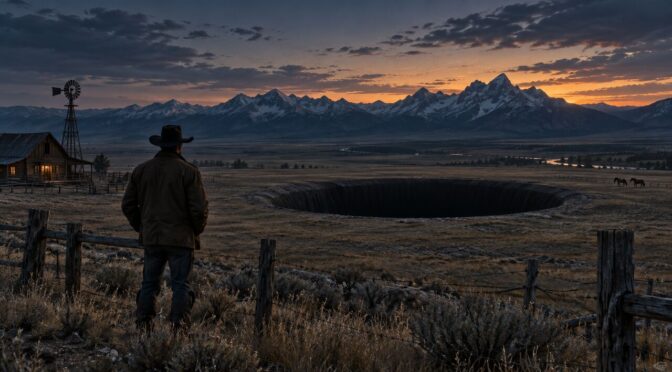
There is a giant hole in the middle of a Wyoming ranch, and Outer Range spends eight episodes asking us to look into it.

That sounds like science fiction. But Season 1 works best when the hole is not treated as a puzzle to be solved, but as a disturbance. It arrives in the middle of land disputes, a missing wife, a dead Tillerson, a rodeo dream, and a family already carrying more grief than it knows how to discuss.

I finished the season intrigued, impressed by its atmosphere, and occasionally impatient with the way it protects its mysteries. In other words, the show pulled me in, but did not always reward the distance it asked me to travel.

A Western With a Tear in Reality

Royal Abbott (Josh Brolin) runs a ranch with his wife Cecilia (Lili Taylor), sons Perry (Tom Pelphrey) and Rhett (Lewis Pullman), and granddaughter Amy. The neighbouring Tillerson family is trying to claim part of the Abbott land. Perry’s wife Rebecca has disappeared. Then Royal finds the impossible: a perfectly dark void sitting in the west pasture.

A drifter named Autumn (Imogen Poots) arrives around the same time and asks to camp on the ranch. She is fascinated by the land, by Royal, and by whatever sits below that black surface. Very quickly, the familiar grammar of a ranch drama begins to come apart.

The easy description is Yellowstone meets Twin Peaks. It is not inaccurate, but it also makes the show sound more derivative than it feels. Outer Range has its own rhythm: solemn, strange, sometimes funny, and willing to let a beautiful landscape become threatening simply by holding the camera on it a few seconds longer.

Where It Worked for Me

Josh Brolin is the anchor. Royal is not written as a man who explains himself. Brolin makes the silences do the work. His dinner-table prayer, which turns into an argument with God, is the season in miniature: faith, anger, fear, and a man demanding an answer from something that refuses to give one.

Lili Taylor is equally good in a quieter register. Cecilia’s faith is not decorative; it is the structure through which she understands her family. When that structure begins to crack, Taylor makes the damage feel personal rather than philosophical.

The land itself is the other major performance. The wide frames, cold light, unusual sound design, and long stretches of darkness create a genuine sense that Wyoming has opened its mouth. The show looks expensive without constantly trying to prove that it is expensive.

I also liked that the supernatural element does not replace the human drama. The void may bend time, but it cannot make grief disappear. Perry still has to live with Rebecca’s absence. Rhett still has to choose whether family duty will consume his own life. Deputy Sheriff Joy (Tamara Podemski) still has a murder to solve while navigating a town that would prefer certain truths to remain buried.

At its best, the series uses science fiction the way a good western uses weather: not as the story, but as pressure on everyone inside it.

Where the Mystery Became a Shield

The problem with a mystery box is not that it withholds answers. The problem begins when withholding becomes the main dramatic act.

Outer Range has enough material for several shows: a land dispute, a murder cover-up, time travel, a missing woman, a crisis of faith, a rodeo romance, Indigenous history, and the spectacularly odd Tillerson family. Some threads deepen the central story. Others feel as if they are waiting for a later season to justify the time spent on them.

That affects the pacing. The first three episodes build tension beautifully. In the middle, the show starts circling the void instead of moving through it. Strange things happen, characters stare, the score warns us that something matters, and we wait for the meaning to catch up.

Autumn is the clearest example. Imogen Poots gives her a nervous, unpredictable energy, but the writing often mistakes eccentricity for depth. Her confrontations with Royal should generate electricity. Sometimes they do. At other times, she feels less like a person and more like a season-finale reveal walking around in human form.

The Tillersons are entertaining, especially Will Patton’s Wayne, who appears to have made a private agreement with madness. But Billy’s singing, the sudden tonal turns, and the family’s heightened behaviour do not always belong to the same show as the Abbotts’ restrained grief. The contrast is intentional. It is not always controlled.

The Question Behind the Questions

The show repeatedly returns to faith. What do people do when the world stops obeying the rules on which they built their lives?

Royal responds by trying to control the void. Cecilia prays. Autumn worships possibility. Wayne Tillerson treats the unknown like property he was always meant to own. Everyone sees the same rupture and turns it into a version of themselves.

This is more interesting than the mechanics of where the hole leads. Time travel can be explained with a diagram. What fear does to a family cannot.

That is why I was willing to forgive some of the season’s delays. The series is reaching for something larger than plot. But ambition is not the same as completion, and Season 1 sometimes uses atmosphere to cover the places where the writing has not fully connected its ideas.

The Verdict

Outer Range Season 1 is a flawed but compelling piece of television. It has an excellent Josh Brolin performance, a strong ensemble, striking images, and a premise that remains genuinely unsettling. It also has too many subplots, a sagging middle, and a habit of treating confusion as if it were automatically profound.

Still, I would rather watch a show risk being strange than settle for being efficient and forgettable.

The finale gives enough away to reframe what came before, but not enough to make Season 1 feel complete on its own. That may frustrate viewers who need the puzzle pieces to lock firmly into place. I was frustrated too, but not finished with it.

Watch it for Brolin, the landscape, and the uneasy collision of family drama with the impossible. Be patient with the middle. Do not expect the hole to return every answer you throw into it.

Where to Watch

Outer Range Season 1 is available on Prime Video.

Agni Devan: A Journey Through Relationships and Leadership

Agni Devan is a character drama film that explores the leadership of a family newspaper by two brothers with contrasting opinions on how it should be run. One brother approaches the newspaper with a business mindset while the other (Mohanlal) prioritizes passion in his approach. This conflict reflects their ideological and attitudinal differences and creates tumult in family relationships.

Revathy plays a female cousin in the film who becomes caught up in the troubles between the two brothers. Her role as a bold and confident woman is characteristic of her acting abilities. The film is a treat for those who enjoy dialogue-centric dramas with well-defined characters. The interactions between Mohanlal and Revathy’s characters are particularly noteworthy and are executed with grace and depth.

One of the key features of the film is its sense of nativity and the cohesive identity of its setting and locality, which is a common characteristic of many Malayalam films from this period. The film has a few crude moments of physical scuffle, but overall, it is a well-crafted character drama that should appeal to those who appreciate strong characterizations and dialogue-driven narratives.