
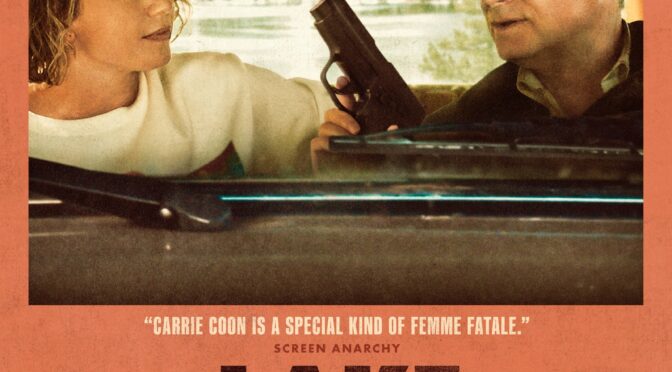
Spoiler warning: This review discusses the ending of Lake George in detail.
There is a moment early in Lake George when the film quietly tells us what sort of crime story it is going to be. Don, newly out of prison and almost completely out of options, is handed a gun and told to kill Phyllis. He abducts her, drives her into the desert, and discovers that he simply cannot pull the trigger.
In most thrillers, that would be the hero’s moral victory. Here, it is only the beginning of a much messier problem.
Jeffrey Reiner’s film is a neo-noir, a road movie, a black comedy and, beneath all that genre machinery, an oddly tender story about two middle-aged people who have become strangers to ordinary life. It is not especially original in plot. It is original in where it places its attention. The money, guns and bodies matter less than the small, unstable connection between two people who are both lying, but not always about the same things.
My verdict is simple: Lake George is a very good little film, and Shea Whigham gives the performance that makes it more than a clever genre exercise. Carrie Coon supplies the spark, but Whigham supplies the ache.
A patsy who knows he is a patsy
Don used to be an insurance adjuster. Gambling and fraud led him into business with Armenian gangster Armen, and he has just completed a ten-year prison sentence. His old contacts are gone. His family wants nothing to do with him. Armen owes him money, but converts that debt into one last job: kill Phyllis, the former girlfriend and business partner who knows too much.
Don is not a hard man pretending to be soft. He is a soft man who has spent years in a hard system and has mistaken endurance for strength. Whigham understands this distinction perfectly. He plays Don with the posture of someone apologising for occupying space. Panic arrives before action. Shame arrives before speech. Even when he has a weapon, he looks like the least powerful person in the room.
That inversion is the film’s best idea. Classic noir often gives us a man who thinks he is in control until the femme fatale proves otherwise. Don knows almost immediately that Phyllis is smarter, faster and more dangerous than he is. He follows her plan anyway because the alternative is to admit there is no plan left for his life.
The film makes its lineage obvious. Don is an insurance man and the woman is named Phyllis, a deliberate salute to Billy Wilder’s Double Indemnity. But Reiner does not merely copy Walter Neff and Phyllis Dietrichson. He ages the structure. These are not glamorous people discovering corruption. They are tired people trying to improvise one last exit from lives already damaged by corruption.
Carrie Coon plays energy as a weapon
Phyllis talks because talk is how she takes possession of a situation. She can move from victim to conspirator to killer before Don has finished processing the first version of her story. Coon makes this funny without turning the character into a cartoon. Her physical confidence is almost comic in contrast with Don’s hesitation. The staged burial, the home invasions and the sudden bursts of violence all work because she behaves as if the absurd next step is perfectly reasonable.
She also keeps insisting that she is a good person. The line grows funnier and darker each time because Phyllis does not seem to use morality as a measure of conduct. For her, goodness is closer to a self-description, something she can preserve even while snapping fingers, killing obstacles and pocketing the money.
Yet I do not think the film asks us to diagnose her as a monster. It asks us to notice that survival has become her only coherent ethic. Don freezes because he still imagines a moral account that must eventually be settled. Phyllis keeps moving because she refuses to open the account.
Their chemistry is strong precisely because the film does not force it into conventional romance. There is affection, dependence and perhaps love, but hardly any sexual charge. That choice feels adult. Two lonely people can become necessary to each other without the screenplay rewarding us with a kiss. Their imagined future together matters because it is never secure enough to become a plan.
Sunshine noir and the geography of failure
Most noir hides rot in shadows. Lake George exposes it in California daylight.
The route moves through Glendale, anonymous motels, suburban safe houses, desert roads and finally the eastern Sierra. Tod Campbell’s widescreen photography gradually opens the frame as Don and Phyllis move farther from Los Angeles. The irony is sharp: the landscape becomes freer while their choices become narrower.
This is where Reiner’s television experience helps. He does not oversell atmosphere. The locations carry the mood, while the camera gives the actors room to make the tonal turns believable. A robbery can become slapstick, then violence, then regret without announcing a change of genre.
There are traces of Elmore Leonard in the mundane criminals and their wounded egos, and a touch of the Coen brothers in the way incompetence produces bloodshed. Reiner has cited Don Siegel’s The Killers as a tonal reference, and you can feel that taste for behaviour that is funny because it is slightly wrong for the scene. But Lake George is less cool than any of those comparisons suggest. Its criminals are not icons. They are people with bad knees, panic attacks, grudges and poor contingency plans.
The dialogue occasionally sounds too pleased with itself. A few exchanges feel written rather than overheard, and the chain of robberies in the middle could be tighter. The plot also depends on Don making choices whose foolishness is visible from a distance. But Whigham protects the film from this weakness. Don is not stupid. He is desperate for one decision to mean that he has not wasted his whole life.
That is why he returns to Armen when escape is still possible. On the level of plot, it is maddening. On the level of character, it is exact. Don needs the debt acknowledged. He wants the world to admit that his ten years bought something. Noir exists to punish that kind of wish.
The ending: real, imagined, or emotionally true?
After Phyllis kills Armen and takes the money, Don leaves some cash for his estranged family. It is probably the cleanest thing he does, even though the money itself is dirty. He and Phyllis seem ready to reach the cabin at Lake George, the modest paradise they have talked into existence.
Then Don wakes to find that she has gone. She leaves him one gold bar and a gun. Harout catches up with him. Don finally kills, but he is shot in the struggle. Wounded, he drives on alone and reaches Lake George.
Phyllis appears beside him in the final scene.
Did she return, or is Don seeing what he needs as he dies? Reiner deliberately refuses to settle it. The director and the actors have spoken about having different readings, and the scene is built to support both. Phyllis feels physically present, but her arrival also has the calm logic of a dying man’s last consolation.
I read it as a hallucination, but not as a trick. Don does not get the new life he wanted. He gets, for a moment, freedom from the belief that he is entirely alone. The distinction between fact and fantasy matters less than the emotional fact: Phyllis has become the form his hope takes.
The comparison to Sergio Leone’s Once Upon a Time in the West makes sense most specifically through Cheyenne’s death. Cheyenne has already been mortally wounded, but he does not collapse in the violence. He rides away from Sweetwater, stops with Harmonica in the quiet, and chooses the terms of his final moments. Don does something similar: shot in the struggle with Harout, he keeps driving until he reaches Lake George, the peaceful place he had imagined as an escape, and dies or comes close to death with Phyllis beside him, whether she is real or a final vision. In both films, a wounded man leaves the scene of violence and travels toward stillness, as if choosing where death will find him. I would call that a strong emotional echo, not a proven homage. Reiner has named John Ford and Anthony Mann as visual influences, but I found no evidence that he cited Leone or Cheyenne’s death specifically.
The visual and emotional rhyme is real. The meaning is different. Leone closes a mythic chapter of the West; Reiner closes one failed man’s private fantasy of beginning again. I would not call it a quotation, and I found no evidence that Reiner intended that specific reference. His stated visual influences include classic Western directors such as John Ford and Anthony Mann, so the Western feeling is not accidental. The exact Leone parallel belongs to the viewer, but it is a good reading.
A closer noir relation is High Sierra, another story in which a doomed criminal moves toward mountain country as if altitude and beauty might offer moral escape. And the insurance-man/Phyllis pairing makes Double Indemnity unavoidable. Yet Lake George earns its own ending by replacing fatal attraction with something sadder: fatal companionship.
What storytellers can learn from it
The film’s central lesson is that familiar plot machinery can still feel fresh when the emotional transaction changes.
Reiner does not reinvent the mob debt, the reluctant hitman, the femme fatale or the stolen-money road trip. He changes what the two central characters are buying from each other. Phyllis buys time, muscle and legitimacy. Don buys the possibility that someone can still see him as useful and good. Their bargain becomes moving because neither says its real terms aloud.
The second lesson is about casting. On the page, Phyllis could become exhausting and Don could become inert. Coon turns momentum into character; Whigham turns stillness into conflict. Their performances do not decorate the screenplay. They solve it.
The third is that ambiguity works only when the alternatives express the same theme. If Phyllis really returns, Don is cared for. If she is imagined, he dies feeling cared for. The factual answers differ, but both complete his emotional journey. That is why the ending invites debate without feeling empty.
Key Takeaways
- Lake George is a character-first sunshine noir, not a plot-first thriller.
- Shea Whigham’s defeated, vulnerable Don is the film’s centre; Carrie Coon’s Phyllis gives it danger and comic velocity.
- The Double Indemnity reference is explicit, while High Sierra, Elmore Leonard and off-kilter crime comedy are useful comparisons.
- The final scene does echo Once Upon a Time in the West through landscape, death and the unreachable idea of home, but it is not a proven homage.
- The ending works because both readings complete the same emotional arc.
Rating: 4/5