All posts by admin

High and Low; Inkaar

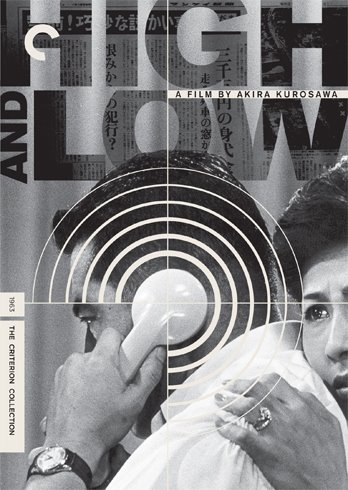
High and Low (1963) is another masterpiece from Akira Kurosawa. It is about a businessperson who has to pay a huge ransom and stake everything he has built so far.

The movie has three parts, with a Prologue and Epilogue.

  • Prologue: The set-up of rich vs. poor (right from the titles), Mr.Gondo’s (Toshiro Mifune) entry and his hilltop villa, his nature, his beliefs and value systems, and the point where he has to take some bold steps to revive his professional fortunes. (Here we get to see an aggressive and successful businessperson who is all for doing what is necessary to win in a war. There is a lovely scene of wife (Kyōko Kagawa) chiding Mr.Gondo about his change of heart after success.)
  • Part 1: The inciting incident that of kidnap, his mental turmoil, his relationship with his wife and kid, the importance of them in his life, and finally his good nature forcing him to pay the ransom to save his driver’s child.  (Here we get to see a mellowed Mr.Gondo, who empathizes with a fellow worker, as he himself came up the hard way and gives in to the feelings of his wife and kid.)
  • Part 2: Here we get to see the process of paying the ransom and the start of downward progression in Mr.Gondo’s life.(The other characters from police department–Tatsuya Nakadai as Inspector Tokura, Kenjiro Ishiyama as Chief Detective ‘Bos’n’ Taguchi– introduced in Part 1 start getting their due in terms of story progression.)
  • Part 3: The investigation based on the video footage and clues from driver’s child, all lead to seizing the culprit (Tsutomu Yamazaki). (Here we get to see the police characters driving the show and a master class in direction from the great Akira Kurosawa)
  • Epilogue: Here we get to see the showdown between Mr.Gondo (who is now starting all over again, working at a different firm) and the kidnapper (who is awaiting his death sentence) and the rich vs. poor theme.

Akira Kurosawa’s masterful direction is all in its splendor and there are several videos and articles on the internet about the story telling and shot making. (A few mentioned below in related links).

In summary, High and Low is not a typical feel good movie even though the plot and characters reach their logical conclusion (Mr.Gondo gets back his ransom, the culprit is hanged, the police solve the case, the kids unite etc). The fact that Mr.Gondo doesn’t win his company back or the epilogue in which the kidnapper tries to justify his crime, gives us a feeling that the director wanted the grays to be intact instead of a plain vanilla, happy-ever-after ending. It is as if he is telling us, that the two main characters are the not the same after this crisis and their lives are changed forever. While one will be dead soon, the other is back to square one, inspite of all the goodwill he earned from the public due to his noble act. This again is a reflection of the writer’s perspective, that no matter what the world’s representation of you might be, one has to face the harsh reality and move ahead.
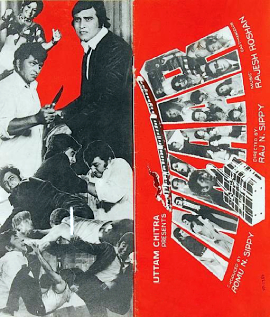
In contrast, Inkaar (1977) goes for a happy conclusion, where in all the characters get what they want and result in predictable outcomes. The grays are tossed out of the window for a wider appeal. The police character becomes the main hero (Vinod Khanna) while the businessperson (Dr.Shriram Lagoo) becomes a character actor. In addition, the main criminal (Amjad Khan) is an ex-worker in the factory and a mad-killer on loose, who dies in the end. Therefore, the hero gets the girl, the businessperson saves his house from auction in time, the kids are reunited, and the wife is no better than she was earlier, the driver even more faithful than before.

Having said that Raj.N.Sippy’s Inkaar still is a different commercial film in its times and does a decent job, with able support from music and sound department (Rajesh Roshan, Robin Chatterjee and Mangesh Desai). It isn’t a magnificent seven of Seven samurai, or A Fistfull of dollars of Yojimbo, but manages to weave it in a form palatable to the audiences in 70s and movie aficionados of all time.

Tailpiece: The scene in The Fugitive (1993) where Tommy Lee Jones spots an overhead train in a sound tape, is a straight lift from the trolley-sound scene in High and Low.

Related Links
High and Low Analysis
High and Low: Full Movie on Internet Archive
High and Low Review
The Morality of High and Low
Blocking moments in High and Low
Akira Kurosawa’s High and Low — What Makes This Movie Great?
‘Unsung hero, Pope of sound’: A documentary resurrects legendary mixing engineer Mangesh Desai.
Robin Chatterjee music composer
Engineered in India…with love and dedication.

..with love and dedication.

On Page 201, the author quotes an incident from the company’s early days in HUDA Maitrivanam building in Hyderabad, and his shock when he sees a woman employee walking up the stairs to their 6th floor office. (Having worked in the same building in 1995-96, in another software company I had firsthand experience of this issue, where the elevator would go out of service at the drop of a hat.)

The following paragraph sums up the attitude of a Founder-CEO who takes every problem head on and in the process keeps building the character of his company.

“There was no way I would allow an expectant mother in my employ to endanger herself and her future child walking up and down six floors! I took the matter to the Director, STP (Software Technology Park) Hyderabad, J.A Chowdary. Apparently, he was not equipped to deal with it at his level either, but he raised it with the Secretary, Department of Electronics (now Ministry of Electronics and Information Technology), Government of India, who helped us resolve the issue. It took weeks of chasing, but the building finally had a functional elevator!”

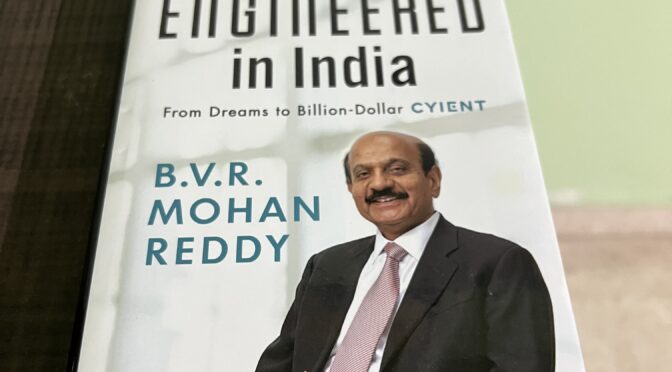
The success story of Cyient (erstwhile Infotech) had to be told, as many companies that started digitization services in the 90s folded in due course or failed to scale or pivot. And, who better to tell it all, than the Founder of Cyient himself—Sri.B.V.R.Mohan Reddy.

‘Engineered in India’ is part memoir and part business and management book, as the author himself mentions in the introduction.

  • Part 1 paints a detailed journey of a middle class boy who falls in love with mathematics at an early age, becomes an engineer, gains work experience (ala craftsman mindset in Cal Newport ‘So Good, they can’t ignore you’) and transforms into a highly successful first generation technopreneur. 
  • Part 2 does a brilliant job of taking important business themes and mapping most of the incidents/milestones from Part 1. 

In a way the first part of the book is like an epic movie and the second, the making of the movie featurette, spanning across the crafts, which in this case, the important aspects of a business. The second part covers significant attributes of a successful and sustainable company:  pursuit of excellence, customer centricity, quality and process orientation, people development, strategy and business transformation, money management, crisis management and institution building. (A timeline of events/milestones mapped to these attributes, as an appendix would have been nice as a cross-reference, while reading Part 2)

In the last chapter on institution building, he highlights his belief in ‘Clock building and not time telling’ (From Jim Collins ‘Built to Last’) and his methodical succession planning exercise.

Any first generation entrepreneur’s book is a necessary read as one gets to pick up learning across the functions of a business, as he/she is so involved in every aspect. (This book calls for taking extensive notes, mine exceeded 10 pages).  What makes ‘Engineered in India’, even better is the fact that Sri.B.V.R. Mohan Reddy, though being a very successful person was satisfied to remain in the shade rather than bask in its glory, stuck to his engineering ethos and when the time came, he did not hesitate to hang in his shoes for the new generation to take over. While his individual story takes a new turn, the story of the company he founded continues.

Related Links
Lakshonline on Built to Last

Lakshonline on So Good, they can’t ignore you

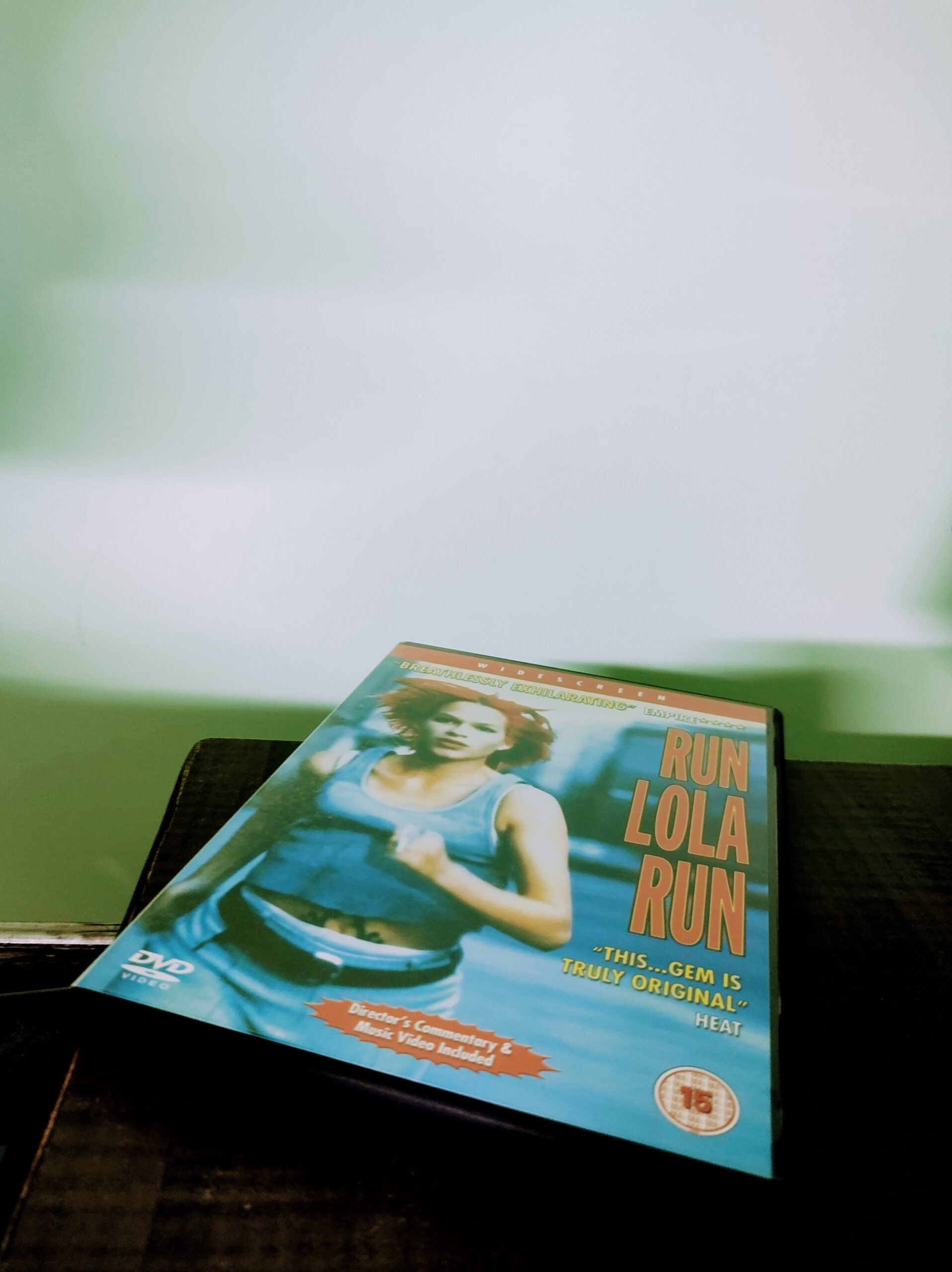
Run Lola Run

Run Lola Run is a German thriller film written and directed by Tom Tykwer. The story follows a woman named Lola (Franka Potente) who needs to obtain 100,000 Deutschmarks in twenty minutes to save the life of her boyfriend Manni (Moritz Bleibtreu).

The film touches on themes such as free will vs. determinism, the role of chance in people’s destiny, and obscure cause-effect relationships. Through brief flash-forward sequences of still images, Lola’s fleeting interactions with bystanders are revealed to have surprising and drastic effects on their future lives, serving as concise illustrations of chaos theory’s butterfly effect, in which minor, seemingly inconsequential variations in any interaction can blossom into much wider results than is often recognized. The film’s exploration of the relationship between chance and conscious intention comes to the foreground in the casino scene, where Lola appears to defy the laws of chance through sheer force of will, improbably making the roulette ball land on her winning number with the help of a glass-shattering scream.

Source: Wikipedia

The film explores the concept of alternate reality where each set of choices Lola makes pushes her and the people she encounters in that reality, onto a different path. However, she can still influence the outcome to the extent possible as per her capability/volition. The taking and presentation of the film, gives it a dreamy look, with audience having to decide if the first two versions of reality actually happened or she thought about it in her head, and may be the last one (with the happy ending one) is the version that actually happened. (In films like ‘Groundhog Day’ and ‘Edge of Tomorrow’, the main character is conscious of the previous versions, and to some extent, Lola also does. But in Run Lola Run there is a lot more ambiguity.)

On the other hand, one can also imagine a scene/reality from the past and try to make amends. This brings us to a famous dialogue from ‘The Shawshank redemption’, during Red (Morgan Freeman)’s parole hearing.

Red : There's not a day goes by I don't feel regret. Not because I'm in here, because you think I should. I look back on the way I was then: a young, stupid kid who committed that terrible crime. I want to talk to him. I want to try to talk some sense to him, tell him the way things are. But I can't. That kid's long gone, and this old man is all that's left. I got to live with that. Rehabilitated? It's just a bullshit word. So you go on and stamp your form, sonny, and stop wasting my time. Because to tell you the truth, I don't give a shit.

Overall, Run lola Run is a must watch.

Tailpiece: Tapsi Pannu’s ‘Loop Lapeta’ is an official remake of Run Lola Run, and available on Netflix.