I got introduced to Neil Patrick Harris in the early 90s, through his first TV show ‘Doogie Howser, M.D.”, which was one of my favorite shows. Later I did not track his career seriously , but read about his recent shows like ‘How I met your mother’ and spotted him in a small cameo in the recent blockbuster hit ‘Gone Girl’.
So, it was good to see him host the 2015 Oscars show. Overall, an ok performance.
Here are a few things that caught my attention.
The opening songs were pretty decent and the shadows play was neat.
Video projection/laser base door entry along with ushers, for the presenters was cool.
Transition effect used to show oscar nominiess in makeup category worked well
John Travolta with a wig…hmm!!!!
The set and the background projection used for the song ‘Glory’ performance was very good.
Tailpiece: I first saw Oscar Awards live telecast in 1988. As it was my first ever viewing (not sure if it were the first on Indian TV), I even recorded it on a VCR. Since then, barring a few misses here and there, I ended up watching the awards ceremony very year. Doordarshan, Star Movies, ABC etc, TV channels changed, but the ritual remained.
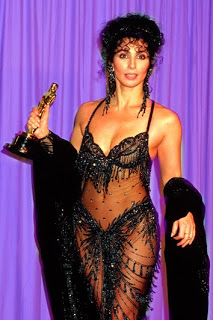
Cher, at the 1988 Oscars, with her ‘Best Actress’ Oscar for ‘Moonstruck’.
So, what did I remember the most about my first i.e.60th Academy awards function…Cher, of course 🙂
Most often successful people are defined by their professional achievements and financial metrics. But there are few successful people who manage to relegate their quantum of success and let their human side come to the fore. This by no means is a small challenge, but people like Sri D Ramanaidu knew how to overcome it.
It is no wonder then, that many of the people who interacted with him, remember his personal nature more than his professional accomplishments. May be the word ‘mogul’ has never appeared more human, as in reference to him.
I just had a few fleeting interactions with the ‘movie mogul’. But I was privileged enough to know quite a bit about him from people who had interacted with him first hand, including my father, Sri Agastya Sastry.
Sri Agastya Satry interviewing Sri Ramanaidu for the first Telugu show on Zee
My father first got in touch with Sri Ramanaidu in the late 80s when Ramanaidu Studios was just in its infancy. He would often tell me about his on-the-ground-managment and his attention to details. And of course, his generosity in discounting the price for the usage of the facilities 🙂
Swayamkrutham- A TV episode shot partly in Ramanaidu Studios
Here are a few important points related to leadership and management, I picked up from my father and various sources.
1) Vision and execution: Sri Ramanaidu had a grand vision but had his eyes on the execution all the time. His punctuality on the movie sets was legendary. Even at the peak of his success, with a locked script in hand, he would never lose the on-the-ground management approach. He would often communicate the vision in simple terms. For instance, his simple statement–‘producer should come with a script and leave with a print’ — translated into a huge effort involving hundreds of employees and partners.
2) Driving Growth: He set goals to facilitate growth and expansion. For instance, making films in all Indian languages etc. This also helped him to divide responsibility among the family members.
3) Clock building: According to Collins and Porras, the authors of ‘Built to last’, They (great business leaders) concentrate primarily on building an organization — building a ticking clock — rather than hitting a market just right with a visionary product idea and riding the growth curve of an attractive product life cycle.” Sri Ramanaidu is definitely one such business leader who created a business that could flourish irrespective of his presence at the top. He did everything right under the corporate management umbrella…business process management, division of responsibilities, fiscal discipline, succession planning etc…he did it all. This was visible in simple and big changes. For instance, when his elder son Mr.Suresh debuted as the producer in 1990, a simple change was proposed in movie titles from then on; movies produced by Mr.Suresh to have ‘D. Ramanaidu presents’ and his films to have ‘D Suresh babu presents’. Simple things like these bring great clarity in execution and also help tremendously in intra-group transactions. Speaking of which, I heard that, during the same time, he divided his businesses into independent profit centers to be headed by individuals from the family. Super thinking to let the fire burning and keep everyone on their toes.
4) Returning the favor: Apparently Jack Lemmon used to say, “You’ve got to send the elevator back down,’. Sri Ramanaidu undertook several initiatives for the welfare of others, through various vehicles, in his film and political career. He even produced films to divert the profits to his employees (Ex:’Prema’ or ‘Dharmachakram’?). Most of his studio assets were created during a low or non-existent real-estate market, as his way of giving back to the film industry where he prospered. Infact, the biggest contribution an entrepreneur makes to the society is through job creation. Sri Ramanaidu did that and also helped others to achieve their dreams; he introduced several new movie directors (B.Gopal etc) and giving a second chance to not to so successful directors (E.V.Satyanarayana etc).
Tailpiece: “Ahana pellanta”, is one of the very well known films of Suresh Productions. Incidentally, it was Sri Ramanaidu who was responsible for green-lighting Brahmanandam for the role, which by no means a small contribution to Telugu cinema 🙂
Cop films–with cops as heroes or villains– are not new to cinema.
In Indian cinema, right from Amitabh’s ‘Zanjeer’ to the latest Tarak’s ‘Temper’, film makers have attempted some variations but essentially retained the fight-against-the-system theme intact. Filmmaker Puri Jagannath and script writer Vakkantham Vamsi, add an element of ‘redemption’. This theme though takes some time to kick in, breathes life into what otherwise would have been a routine film. Tarak’s screen presence and his inspired performance, gives something for the audience to latch on to, when the movie treads a predictable path and or gets mired into sub plots. Rest of the support cast, do their bit, with Posani dominating the pack.
The movie’s purpose would have been served better if the melodrama was toned down a bit. For some strange reason, all the lead actors believe more in shouting than acting even when they are just a few meters from each other. Perhaps the only understated scene is where a teary eyed Tarak realizes his mistake and interestingly, that’s the most crucial scene in the film.
Here are a few Movies and TV Shows, I was reminded of and something on them.
“Gangaajal (2003)”, “The Perfect Murder (1988)” and Udaan (1989) : Cops have tremendous power at their disposal, but they also need to adhere to a lot of procedure. Both these movie celebrate the procedure aspect. Naseeruddin Shah attaches a studious-by-the-book layer to an investigative cop character, and goes about his job as a professional, while his Swedish counterpart marvels at it. Ajay Devgan, without hitting a high decibel, makes it look heroic, even when he asks his constable to give him a statement as to why he should not be suspended for the road-side corrupt acts. Udaan is a terrific portrayal of a woman police officer and her rise in the police force. Excerpt from Wikipedia on Udaan…”It was so refreshing to see a lady IPS (Indian Police Service) officer in Kavita Choudary’s role that was not only humble, but also wanted to perform her work in letter and spirit by going to the public and placing the public’s needs ahead of everything else, in the true spirit of a public servant”.
“Zanjeer (1973)”, “The Untouchables (1987)”, “Ankusham (1990)”, “Ardh Satya (1983)”, “Rakshana (1993), “Drohkaal (1994)”, “Shool (1999)” and “Vikramarkudu (2006)”: These films play on the anger and angst in the honest-loner cops when they are pitted against a corrupt system, often with little support from the department they work in. In “The Untouchables” a motley bunch of cops take on the might of Al Capone with an ageing constable leading the way, brilliantly played by Sean Connery who turns in an Oscar worthy performance. While Amitabh and Om Puri are easily the best of the lot in the Indian films, other actors like Dr.Rajasekhar, Nagarjuna, Manoj Bajpai and Ravi Teja, deliver noteworthy performances. Ravi Teja deserves a special mention, with his nonchalant yet fiery performance as the honest cop.
“Jaitra Yatra (1991)”, “Abhilasha (1983)”, “Training Day (2001)”, “Pokiri (2006)” and “Avineethini Arikadadam (1987/88)”: Quite a few movies have dealt with Inspector/constable, Expert/Rookie kind of relationship. In Jaitra Yatra, an honest constable is driven to the point of action by his superior’s cruelty. Both “Pokiri” and “Training Day” explore the expert/rookie situations to take the story forward. In one of the episodes of my father’s TV show ‘Avineethini Arikadam”, a new constable takes on a corrupt superior at the behest of his wife. In Yandamuri’s “Abilasha”, a constable in the jail becomes a close friend to the hero and rescues him.These threads in a varied form make way into ‘Temper’ as well 🙂