
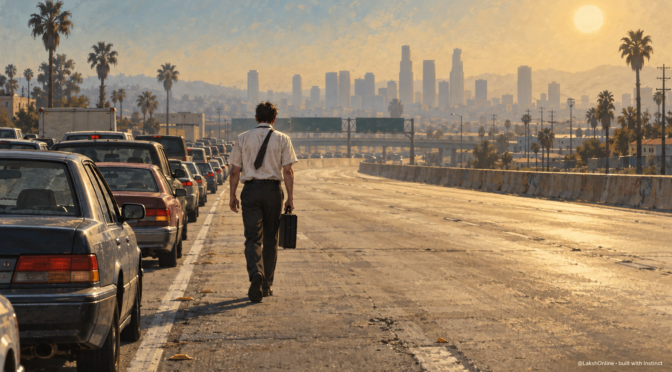
I watched Falling Down again, and I still think it is a terrific film. The idea is simple: follow the downward slide of an apparently ordinary American over a single day. What makes it work is the screenplay, the performances of Michael Douglas and Robert Duvall, and Joel Schumacher's direction. They keep that simple idea from becoming a simple film.
Released in 1993 and written by Ebbe Roe Smith, Falling Down follows William Foster, played by Douglas, after he abandons his car in a Los Angeles traffic jam. He wants to get to his daughter's birthday. The walk across the city becomes a series of confrontations, each taking him further from the ordinary world he believes he represents.
One day, a life coming apart
The single-day structure gives the film its force. There is no long interval between an irritation, a confrontation and its consequences. Foster keeps moving, and the screenplay keeps tightening the situation around him.
The encounters can be darkly funny, particularly when everyday rules and petty frustrations become matters of enormous importance. But the violence changes what those scenes mean. Recognising the frustration does not mean accepting his response to it.
That distinction matters. This is not a decent man made dangerous by one traffic jam. His broken marriage, his behaviour towards his family and the life he has concealed are part of the story too. The day brings an existing collapse into the open.
Michael Douglas and Robert Duvall
Douglas gives Foster a recognisable surface: the white shirt, the tie, the briefcase, the insistence that he is being reasonable. The performance becomes disturbing because that insistence survives even as his behaviour becomes indefensible. He is losing control without giving up his claim to be the sensible person in the room.
Duvall's Prendergast gives the film a different rhythm. A policeman on his last day before retirement, he pieces together the disturbances while dealing with pressures of his own. His quieter performance is essential. Without it, the film could become a succession of increasingly violent episodes centred entirely on Douglas.
The two characters give the screenplay its strongest contrast. Both experience frustration and humiliation. What separates them is what they do with it.
Direction that holds it together
Schumacher keeps the city present throughout: the stalled traffic, the shops, the streets and the uneasy encounters between strangers. Los Angeles is the space Foster must cross, but it is also the world he increasingly treats as an opponent.
The direction holds together black comedy, menace and sadness without allowing the central performance to overwhelm the story. There is movement and incident, yet the real progression is downward. Covering more ground does not bring Foster closer to putting his life back together.
Key Takeaways
- The single-day structure turns a walk across Los Angeles into a steadily tightening drama.
- Douglas and Duvall make the contrast between losing control and retaining it the centre of the film.
- Ebbe Roe Smith's screenplay and Joel Schumacher's direction give the familiar frustrations a disturbing shape.
Falling Down remains a terrific film about a man who keeps moving while his life comes apart. The screenplay, the acting and the direction make that downward slide worth watching again.
Featured image: AI-generated illustration inspired by Falling Down (1993), not a film still.