Category Archives: TV

Outer Range Season 1: A Beautiful Void That Sometimes Stares Too Long

Rating: 3.5 / 5 Stars

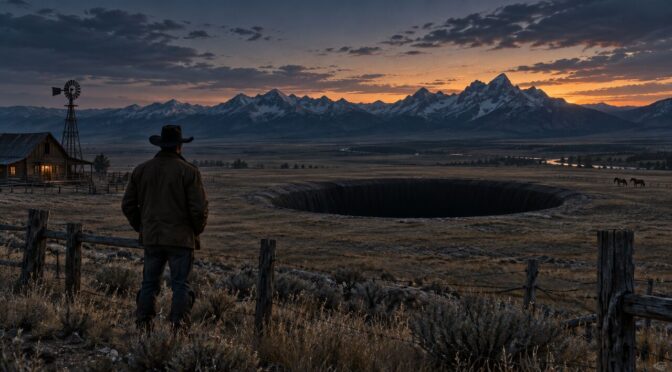
There is a giant hole in the middle of a Wyoming ranch, and Outer Range spends eight episodes asking us to look into it.

That sounds like science fiction. But Season 1 works best when the hole is not treated as a puzzle to be solved, but as a disturbance. It arrives in the middle of land disputes, a missing wife, a dead Tillerson, a rodeo dream, and a family already carrying more grief than it knows how to discuss.

I finished the season intrigued, impressed by its atmosphere, and occasionally impatient with the way it protects its mysteries. In other words, the show pulled me in, but did not always reward the distance it asked me to travel.

A Western With a Tear in Reality

Royal Abbott (Josh Brolin) runs a ranch with his wife Cecilia (Lili Taylor), sons Perry (Tom Pelphrey) and Rhett (Lewis Pullman), and granddaughter Amy. The neighbouring Tillerson family is trying to claim part of the Abbott land. Perry’s wife Rebecca has disappeared. Then Royal finds the impossible: a perfectly dark void sitting in the west pasture.

A drifter named Autumn (Imogen Poots) arrives around the same time and asks to camp on the ranch. She is fascinated by the land, by Royal, and by whatever sits below that black surface. Very quickly, the familiar grammar of a ranch drama begins to come apart.

The easy description is Yellowstone meets Twin Peaks. It is not inaccurate, but it also makes the show sound more derivative than it feels. Outer Range has its own rhythm: solemn, strange, sometimes funny, and willing to let a beautiful landscape become threatening simply by holding the camera on it a few seconds longer.

Where It Worked for Me

Josh Brolin is the anchor. Royal is not written as a man who explains himself. Brolin makes the silences do the work. His dinner-table prayer, which turns into an argument with God, is the season in miniature: faith, anger, fear, and a man demanding an answer from something that refuses to give one.

Lili Taylor is equally good in a quieter register. Cecilia’s faith is not decorative; it is the structure through which she understands her family. When that structure begins to crack, Taylor makes the damage feel personal rather than philosophical.

The land itself is the other major performance. The wide frames, cold light, unusual sound design, and long stretches of darkness create a genuine sense that Wyoming has opened its mouth. The show looks expensive without constantly trying to prove that it is expensive.

I also liked that the supernatural element does not replace the human drama. The void may bend time, but it cannot make grief disappear. Perry still has to live with Rebecca’s absence. Rhett still has to choose whether family duty will consume his own life. Deputy Sheriff Joy (Tamara Podemski) still has a murder to solve while navigating a town that would prefer certain truths to remain buried.

At its best, the series uses science fiction the way a good western uses weather: not as the story, but as pressure on everyone inside it.

Where the Mystery Became a Shield

The problem with a mystery box is not that it withholds answers. The problem begins when withholding becomes the main dramatic act.

Outer Range has enough material for several shows: a land dispute, a murder cover-up, time travel, a missing woman, a crisis of faith, a rodeo romance, Indigenous history, and the spectacularly odd Tillerson family. Some threads deepen the central story. Others feel as if they are waiting for a later season to justify the time spent on them.

That affects the pacing. The first three episodes build tension beautifully. In the middle, the show starts circling the void instead of moving through it. Strange things happen, characters stare, the score warns us that something matters, and we wait for the meaning to catch up.

Autumn is the clearest example. Imogen Poots gives her a nervous, unpredictable energy, but the writing often mistakes eccentricity for depth. Her confrontations with Royal should generate electricity. Sometimes they do. At other times, she feels less like a person and more like a season-finale reveal walking around in human form.

The Tillersons are entertaining, especially Will Patton’s Wayne, who appears to have made a private agreement with madness. But Billy’s singing, the sudden tonal turns, and the family’s heightened behaviour do not always belong to the same show as the Abbotts’ restrained grief. The contrast is intentional. It is not always controlled.

The Question Behind the Questions

The show repeatedly returns to faith. What do people do when the world stops obeying the rules on which they built their lives?

Royal responds by trying to control the void. Cecilia prays. Autumn worships possibility. Wayne Tillerson treats the unknown like property he was always meant to own. Everyone sees the same rupture and turns it into a version of themselves.

This is more interesting than the mechanics of where the hole leads. Time travel can be explained with a diagram. What fear does to a family cannot.

That is why I was willing to forgive some of the season’s delays. The series is reaching for something larger than plot. But ambition is not the same as completion, and Season 1 sometimes uses atmosphere to cover the places where the writing has not fully connected its ideas.

The Verdict

Outer Range Season 1 is a flawed but compelling piece of television. It has an excellent Josh Brolin performance, a strong ensemble, striking images, and a premise that remains genuinely unsettling. It also has too many subplots, a sagging middle, and a habit of treating confusion as if it were automatically profound.

Still, I would rather watch a show risk being strange than settle for being efficient and forgettable.

The finale gives enough away to reframe what came before, but not enough to make Season 1 feel complete on its own. That may frustrate viewers who need the puzzle pieces to lock firmly into place. I was frustrated too, but not finished with it.

Watch it for Brolin, the landscape, and the uneasy collision of family drama with the impossible. Be patient with the middle. Do not expect the hole to return every answer you throw into it.

Where to Watch

Outer Range Season 1 is available on Prime Video.
House of the Dragon Season 3: The Throne That Corrupts Absolutely

I wrote a while back about how Yellowstone is The Godfather on horseback — a story about what an empire does to the people defending it. House of the Dragon Season 3 just did the same trick with dragons, and did it more deliberately than any season of this franchise so far.

Season 3 wrapped on August 9, 2026, eight episodes after it began, and it is the best-reviewed run House of the Dragon has had — a Certified Fresh 95% on Rotten Tomatoes (its highest of the three seasons, matching the two best seasons of the original Game of Thrones), a 76/100 “generally favorable” on Metacritic, and a premiere block that set IMDb episode-rating records for the franchise (9.2 for episode one, 9.4 for episode two). The numbers back up what watching it feels like: this is the show finally being precise about what it’s always been about.

⚠️ SPOILER ALERT: everything below assumes you’ve finished the season, including the finale. Turn back now if you haven’t.

What the season is actually about

Every season of this show gestures at power and its costs. Season 3 is the first one that says it outright. Showrunner Ryan Condal has confirmed the season was built around Lord Acton’s 1887 line — power tends to corrupt, and absolute power corrupts absolutely — and around a single driving question he kept asking the writers’ room: what does the throne actually do to you, the closer you get to it?

That’s not a subtext I’m reading into it. It’s the stated brief. And the season stages the answer methodically, mostly through one character.

Rhaenyra’s fall is the whole season

Rhaenyra opens Season 3 the way she’s opened every season — deliberate, principled, trying to prove a woman can rule without ruling like the men before her. She ends it ordering deaths, spiraling when Aegon II turns up alive with Sunfyre, and asking Alicent — her oldest friend turned oldest enemy — to help kill Alicent’s own son, Aemond. Condal has since compared her trajectory directly to Daenerys Targaryen’s fall in the original series: a leader convinced she’s owed the throne by right, backed by overwhelming force, running out of people willing to tell her no.

The hinge is Helaena’s death partway through the season. Emma D’Arcy has described Helaena as “the only character who has proximity to power but remains kind of uncontaminated” — close enough to see everything, corrupted by none of it. Her death is the moment, per D’Arcy and Condal both, that “condemns Rhaenyra to the path she’s chosen.” There’s no version of the finale where Rhaenyra comes back from that, because there’s no one left in the room whose disappointment still costs her anything.

Then Aegon survives. The killing that was supposed to settle things settles nothing, and that failure — not a villain twist, just the plan not working — is what tips her into the “unhinged tyranny” the finale is built around.

The court fractures right along with her

The detail I liked most, on a rewatch: D’Arcy and Condal have both said Rhaenyra’s three closest relationships — Daemon, Mysaria, Alicent — function as externalized pieces of her own splintering judgment across the season. Daemon is force. Mysaria is cunning. Alicent is restraint. Instead of integrating the three into one decision, she starts acting on whichever voice got to her most recently.

Which sets up the season’s best structural swerve: Daemon — established across two seasons as the impulsive Rogue Prince — becomes, by the midpoint, the calmest, most clear-eyed person on Team Black, exactly as Rhaenyra absorbs the volatility he used to carry. They basically swap temperaments. It’s a smarter piece of writing than “the reckless one finally grows up” — it plays more like stability is a role the system needs filled, and it just relocated to whoever was steadiest that week.

Aemond and Alicent: proximity without the actual seat

Aemond spends most of the season parked at Harrenhal — a deliberate echo of Daemon’s own Season 2 exile there — which is also the season’s most-criticized pacing choice; a lot of reviews wanted more of him and got Alys Rivers instead. He resurfaces alive in the finale, dragon intact, glimpsed on the Iron Throne in a flash-forward clearly meant for Season 4.

Alicent’s arc is messier by design, and critics are right that some of it plays abrupt — her ride to Harrenhal to move against her own son is the most-argued-about beat of the back half. But there’s a reading of it that’s more interesting than “bad plotting”: three seasons adjacent to the throne, never quite holding it, and when the legitimate channels run out, she acts unilaterally and badly. That’s what influence without an actual seat tends to do, eventually.

What worked and what didn’t

What worked:

  • Condal finally states the thesis instead of implying it, and the season is sharper for having one clear question to answer
  • Emma D’Arcy’s performance carries the entire back half — Rhaenyra’s unraveling never once feels like a plot mechanic
  • The Daemon/Rhaenyra role reversal is genuinely clever writing, not just a twist for its own sake
  • Three real set pieces (the Battle of the Gullet, the Storming of the Dragonpit, the Battle of Tumbleton) that each escalate the argument instead of just being spectacle

What didn’t:

  • Aemond gets sidelined at Harrenhal for most of the season, and the show knows it — several reviews single this out as the season’s biggest pacing problem
  • Alicent’s turn against Aemond needed another episode or two of setup; it reads as sudden even when the underlying logic holds up
  • Helaena’s death, however thematically necessary, is dispatched with less weight than a moment that important deserved

My verdict: 8.5/10. The most purposeful season of this show yet — it knows exactly what it’s arguing and proves it scene by scene, even where the plotting gets ahead of itself.

What’s next

Season 4 is confirmed as the final chapter, expected in 2028. Given where this one left Rhaenyra — and given Condal is openly inviting the Daenerys comparison — I’d bet the endgame is less “who wins the Dance of the Dragons” and more “what’s left of her by the time it ends.” Worth staying for.

Have you finished Season 3 yet? Curious whether you’re Team Rhaenyra-had-no-choice or Team she-lost-the-plot-completely — drop it in the comments.


Sources: Deadline, Variety, ScreenRant, Collider, MovieWeb, Forbes, Rotten Tomatoes, Metacritic, The Bull’s Eye.

Categories: 1-By Laksh, ET, Movies, TV

Blood, Land, and Legacy: Why Yellowstone is The Godfather on Horseback

When Taylor Sheridan unleashed Yellowstone onto our screens, it was billed as a modern Western—a gritty, spectacular look at the ranchers, developers, and Native American reservations battling over the soul of Montana. But peel back the Stetson hats, the sweeping vistas, and the rodeo montages, and a distinctly different narrative skeleton emerges. Yellowstone isn’t just a Western; it is a meticulous, sprawling retelling of Francis Ford Coppola’s The Godfather.

The parallels are not just thematic; they are structural, psychological, and profoundly tragic. Both sagas are obsessed with the corruption of the American Dream, the impossible weight of legacy, and the violent lengths to which a family will go to protect its empire from the encroaching modern world.

The sprawling empire: Beautiful, vast, and soaked in blood.

The Aging Emperor: Vito Corleone and John Dutton

At the center of both dynasties sits a patriarch who operates with absolute, almost feudal authority. Vito Corleone and John Dutton are men out of time. They built their power in an era of different rules and now find themselves playing defense against a world that wants to carve up their legacy.

Both men possess a quiet, menacing gravity. They prefer to negotiate, holding violence as a strategic tool rather than an emotional release. Most importantly, both men fundamentally view themselves as righteous. Vito insists he is not a murderer, but a man protecting his family in a country that refused to protect him. John Dutton insists he is not a tyrant, but a steward of the land, protecting it from the concrete-paving greed of coastal billionaires.

The Reluctant Heir: Michael Corleone and Kayce Dutton

If the patriarchs mirror each other, the sons are exact reflections. Michael Corleone is a decorated Marine, a war hero who returns home determined to stay out of the “family business.” Kayce Dutton is a former Navy SEAL who marries an Indigenous woman, Monica, and exiles himself to the reservation to escape his father’s toxic empire.

Yet, the central tragedy of both stories is the inescapable pull of blood. Just as Michael is drawn into the mafia to protect his father after an assassination attempt, Kayce is continuously pulled back to the Yellowstone ranch by crises that only his lethal military skillset can solve. The audience watches in heartbreak as both men compromise their souls, turning from honorable outsiders into the very ruthless enforcers they once swore they would never become.

The seat of power: Where deals are made and enemies are condemned.

The Hotheads and Outsiders: Sonny, Beth, and Jamie

The supporting family structures map perfectly onto one another. Sonny Corleone is explosive, hyper-masculine, and fiercely loyal, but his temper is his ultimate downfall. In Yellowstone, Beth Dutton channels Sonny’s destructive, blinding loyalty, though she replaces his physical violence with financial and psychological brutality. Rip Wheeler, the fiercely loyal enforcer, serves as a modern-day Luca Brasi—an unstoppable force of violence completely devoted to the Don.

Then there is the tragic outsider. Tom Hagen was the adopted son, the lawyer who was in the family but never truly of the family. Jamie Dutton fills this exact void. An attorney manipulated by his father to serve the ranch’s legal interests, Jamie desperately seeks the patriarch’s approval but is constantly reminded that he lacks the true “blood” of the empire, eventually driving him toward betrayal.

A Dying Way of Life

Ultimately, both The Godfather and Yellowstone ask the same haunting question: Can an empire built on violence and moral compromise ever truly be secured? For the Corleones, the threat was narcotics and rival families. For the Duttons, it is hedge funds, airports, and the relentless march of capitalism.

While the horses have replaced the Cadillacs, and the canyons have replaced the crowded streets of New York, the song remains the same. Yellowstone is a masterpiece of modern television precisely because it taps into the ancient, Shakespearean tragedy that The Godfather perfected: A man who gains the whole world, only to lose his soul—and his family—in the process.