Category Archives: 1-By Laksh

All these articles are from Laksh’s desk

Devotional Hymns: An agnostic’s view…

Hymns or sthothrams, are an integral part of Hindu culture. While most of them are associated with ‘physical’ worship of the deity in a certain prescribed manner, in the last few decades,  just listening to them has gained popularity, thanks to the ubiquity of electronic media and personal audio players.

My exposure to devotional hymns happened at a very early age. Both my grandfathers were plugged into the devotional aspect of hymns and would make it a part of their daily routine. My paternal grandfather was very particular about the daily ‘Sandhya Vandanam’ and the associated hymns like Aditya Hrudayam etc. My maternal grandfather was into Devi worship and he could easily recite most of the hymns (He would even use some of the stanzas as lullabies, repeating them for good effect).

Interestingly, both had tales to support the effect of reciting or listening to these hymns or performing the associated rituals. Once when I mentioned that I was afraid to take the road near the  burial ground, my paternal grandfather assured me it was the abode of Lord Siva and referred to a stanza in one of the hymns. He quickly recalled how he would cycle his way through the snake infested fields in late evenings, with the thoughts of Lord Siva. My maternal grandfather would narrate small incidents like how a hymn of Goddess Raja Rajeshwari came to his rescue when a bull attacked him on the road.

I sampled quite a many of the devotional hymns on the radio first and then followed them across all the new technologies and devices. But for some reason, I could never really whole-heartedly get involved in the ‘physical’ worship aspect of these hymns and stuck to the listening part. And, as I continued to feed my mind it with books of all kind, specially the ones on the Western philosophy and the Western perspective of Hinduism (minus ISKCON), I became an observant person, instead of a devout person. This in a way, shaped my perspective of Hindu religion as well. I remained an agnostic all throughout, with a few bursts of no-mind faith or strong devotional feelings.

But my interest in music of all kinds, specially the Indian classical music, brought out about a different sense of affinity to these hymns. Over the years, I managed to sneak in a few moments of immersion, even with a very busy mind digging into the meaning or the musical sense of these hymns.

In a few articles I will attempt to present my perspective about a few hymns that stayed with me over the years. Let me begin with my favorite of all–Kanakadhara Stothram.

…To be continued
 

Thor: The Dark World

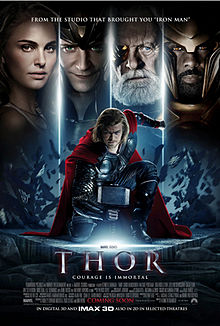
The first installment of ‘Thor’ that was released in 2011 makes a pretense of a story (around step-son and real son rivalry), aided by spectacles. ‘Thor: The Dark World” comes out of this inhibition and focuses primarily on scale and special effects. And it delivers on these counts.

Each and every aspect of of ‘Thor: The Dark World’, from gigantic scale of the action and the sophistication of the visual effects to the production design and costumes, plays to the IMAX and 3D crowds.  With action shifting between the world of gods to that of homo sapiens, or ‘realms’ as the movie puts it, all the crafts come together well, to deliver a visual spectacle that keeps the audience interested throughout.

Accomplished senior actors like Anthony Hopkins and Rene Russo, manage to make their presence felt, with a few scenes thrown in just for that. Tom Hiddleston gets to play a character that has a blend of several archetypes, notably that of the Shapeshifter and the Shadow. He does well. Chris Hemsworth is adequate as he was in the first Thor. Natalie Portman?

In the end, one has to wonder at the ability of Marvel Studios to churn out one blockbuster after other, centered on comics-bred superheroes.

Here is an excerpt from a Forbe’s article on Marvel

It’s hard to think of anything in the history of Hollywood that compares to what Marvel is doing right now. The scope of the company’s film and TV world just expanded with an announcement that Netflix has bought four live-action series and a miniseries to air starting in 2015. That’s on top of a string of films, including The Avengers, which have grossed almost $5 billion at the global box office over the last five years. Marvel’s latest film, Thor: The Dark World, has already earned $110 million overseas and is expected to top the box office in the U.S. when it opens this weekend with $90 million, according to Exhibitor Relations.

Here is the link to the complete article. Marvel’s Magnificent Money-Making Machine


‘ENDER’s game’: From a gENius to a LeaDER…

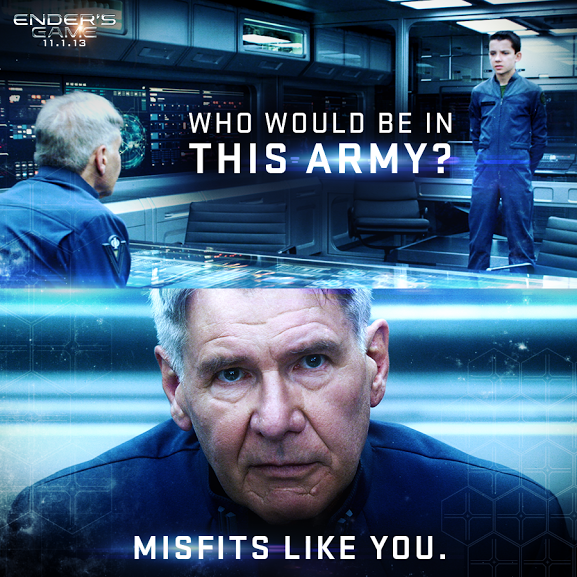
Enders game is based on eponymous novel by Orson Scott Card, which is set in Earth’s future, where the military prepares for attacks from an alien species. The military recruits and trains child prodigies to thwart a third invasion.

Enders game takes us through the journey of Ender Wiggin, who has to succeed in several difficult games including some in zero gravity, and hone his leadership skills by working with unruly peers, highly competitive fellow teams and mentors who want nothing but best out of him.  But most  important, he has to bear the cross of being a genius and the ostracization that it brings.

Asa Butterfield as Ender delivers a poignant performance, and carries the audience with him in his travails and successes. His evolution from a introverted troubled genius to a leader who finds his mission, is pretty neat.  Harrison Ford as Colonel Graff, who believes in winning is all that matters, and Ben Kingsley as Mazer Rackham, who almost annihilated the aliens in previous attack, bring the solidity that the movie requires.

The movie scores big time on special effects and a haunting music score (‘Battle room’ and ‘mind game’ are my picks; Steve Jablonsky’s score is available here on iTunes for Rs.120). It succeeds in building and integrating the themes of leadership, military training, war strategy, child prodigies, and most importantly the political/social perspective of  wars.

Understandably, the movie becomes a little heavy towards the end, when Ender ‘thinks’ beyond war and realizes his true mission. But may be that’s what true leaders do. When they conquer, they don’ rest on laurels or get carried away by other’s opinions. They ponder, and seek another mission. King Ashoka?