
All posts by admin

Unpacking Management Lessons from “Take it Easy”

Created by the author and DALL.E 3

Introduction

Today, we embark on a melodic journey to uncover profound management insights hidden within the classic rock anthem, “Take it Easy,” performed by the iconic band, Eagles. Much like a timeless film, this song resonates across time and space, offering us lessons in leadership, teamwork, and navigating the often chaotic road of life.

Setting the Stage

“Well, I’m running down the road Tryin’ to loosen my load”

These opening lines set the scene for the busy, fast-paced world we often find ourselves in, both in life and in the corporate arena. The narrator’s journey mirrors the daily grind of managers tasked with overseeing various responsibilities and projects. It’s a vivid reminder that leaders are, in essence, constantly on the move, handling their own load of tasks.

The Sound of Wisdom

“Don’t let the sound of your own wheels Drive you crazy”

In the corporate landscape, leaders can easily become ensnared by the cacophony of their own thoughts and the day-to-day noise. This line urges us to find equilibrium, to avoid overthinking, and to let go of the stress that often stems from excessive self-reflection. In management, being able to balance reflection and action is key.

Key Takeaways

Let’s delve into the practical management lessons hidden within “Take it Easy”:

1. Delegation is the Key to Success: Learn to delegate effectively to ‘loosen your load’ and ensure you’re not overwhelmed by a mountain of tasks.

2. Keep Perspective: In the corporate whirlwind, it’s easy to lose sight of the bigger picture. Don’t let the minutiae of the daily grind drive you ‘crazy’. Maintain perspective to make well-informed decisions.

3. Embrace Flexibility: Just as life’s road can be unpredictable, so too can business. Adaptability and flexibility are essential for success.

4. Build a Strong Team: Much like the song suggests, ‘Take it easy’ but never alone. Foster a cohesive and supportive team, as they can help shoulder the load and make the journey more enjoyable.

5. Emotional Intelligence: Understand that in the world of management, emotional intelligence is a powerful tool. Knowing how to read and respond to your team’s emotions can lead to better outcomes.

Inspirational Quotes

Let’s draw wisdom from both music and cinema:

  • “A wise man can learn more from his enemies than a fool from his friends.” – Rush (2013)
  • “The key to this job is personal relationships.” – Jerry Maguire (1996)

The Harmony of Leadership

In this fusion of music and management, we’ve learned that there’s more to the lyrics than meets the ear. “Take it Easy” not only encourages us to enjoy life’s journey but also provides valuable management lessons on how to navigate it successfully. As Tony Stark wisely said in Avengers: Endgame, “Part of the journey is the end.” Let’s ensure our journey is as harmonious as the melodies we listen to.

Leadership in Action: Valuable Insights from a Cherished Mentor

Every so often in our professional journey, we cross paths with individuals whose wisdom leaves a lasting impact. For me, that beacon of guidance shone brightly during my time at Satyam, where I was privileged to learn from a mentor whose teachings went beyond the usual.

Central to his teachings was the principle that ‘respect is earned, not demanded.’ In a world where titles and positions often overshadow genuine merit, this lesson was a grounding force. It underscored that in the realm of business, especially in the unique dynamics of proprietor-driven firms, it’s one’s character, competence, and conduct that truly command respect. This insight was invaluable, reminding me that while titles might offer authority, genuine respect is a byproduct of consistent actions and unwavering integrity.

Equally impactful was the lesson on ‘walking the talk.’ Authenticity is a cornerstone of effective leadership, and my mentor embodied this through and through. I vividly recall moments when, despite his seniority, he would engage with colleagues with the same attentiveness and respect as he would with top-tier clients. This wasn’t a practiced routine; it was a genuine reflection of his belief in the intrinsic value of every interaction. Such humility served as a daily reminder that leadership isn’t about elevating oneself but about lifting others, prioritizing the collective goal over individual accolades.

These insights have profoundly shaped my approach to leadership, instilling in me values that I carry and champion to this day. They serve as timeless reminders that true leadership is less about the position one holds and more about the positive influence one imparts.

In a world awash with varying definitions of leadership, it’s these foundational lessons that stand the test of time, guiding professionals like me in our quest to lead with authenticity and impact.


Kurukshetram: An Audacious Endeavor Falling Short

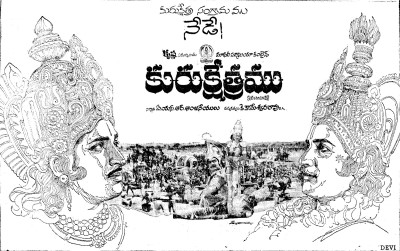
The movie ‘Kurukshetram’ (1977) is a mixed bag. On one hand, it encapsulates a condensed version of the epic Mahabharata, which is commendable. The film successfully portrays significant events from the Mahabharata, such as the division of the kingdom, Subhadra and Arjuna’s marriage, the Rajasuya sacrifice, and the great battle of Kurukshetra. The director, Kamalakara Kameswara Rao, deserves credit for bringing these key episodes to life.

However, despite its ambitious scope, ‘Kurukshetram’ failed to click at the box office. It struggled to attract audiences and gain commercial success. Interestingly, another film titled ‘Dana Veera Soora Karna’ was released at the same time and turned out to be a hit. This contrast in reception highlights the challenges faced by ‘Kurukshetram’ in capturing the audience’s attention and interest.

While ‘Kurukshetram’ may have fallen short in terms of box office success, it still holds value for its attempt to condense the vast narrative of the Mahabharata into a single film. It serves as a visual representation of the epic, allowing viewers to witness key moments and episodes from this ancient tale. For enthusiasts of the Mahabharata, ‘Kurukshetram’ can be an intriguing watch despite its commercial shortcomings.

In terms of the Mahabharata parvas, ‘Kurukshetram’ primarily focuses on the Adi Parva, Sabha Parva, Vana Parva, Udyoga Parva, Bhishma Parva, and Sauptika Parva. These parvas encompass the major events leading up to and during the Kurukshetra war. However, it’s worth noting that the film does not delve into the other parvas, such as Virata Parva, Drona Parva, Karna Parva, Shalya Parva, and so on. This selective approach may have contributed to the film’s lackluster performance at the box office.

No. Mahabharata Adhyayas/Parvas Summary Highlights ‘Kurukshetram’ Movie Plot Aspects
1 Adi Parva The Adi Parva introduces the main characters and sets the stage for the grand narrative, including the birth and early life of the Pandavas and Kauravas. Main characters introduction, Birth of Pandavas and Kauravas Subhadra Arjuna Kalyanam (Marriage)
2 Sabha Parva Sabha Parva revolves around the royal assembly, showcasing the dice game that leads to the Pandavas’ exile. Dice game, Pandavas’ exile, Rajasuya Sacrifice Division of kingdom, Rajasuya Yagnam (Rajasuya Sacrifice), Dice game
3 Vana Parva Vana Parva narrates the twelve-year exile of the Pandavas in the forest following the dice game. Twelve-year exile, Forest life Pandava Exile
4 Virata Parva Virata Parva covers the year the Pandavas spend incognito, serving the royal family of Virata. Incognito year, Service to Virata None
5 Udyoga Parva Udyoga Parva portrays the preparations for the great war of Kurukshetra, with various attempts at negotiations and alliances. War preparations, Negotiations, Alliances None
6 Bhishma Parva Bhishma Parva unfolds the first ten days of the war of Kurukshetra, focusing on Bhishma’s leadership in the battle. First ten days of war, Bhishma’s leadership Initial stages of Kirukshetra war
7 Drona Parva Drona Parva centers on the next fifteen days of war under the command of Drona. Fifteen days of war, Drona’s command None
8 Karna Parva Karna Parva delves into the two days of war led by Karna, and his eventual fall. Two days of war, Karna’s fall None
9 Shalya Parva Shalya Parva encapsulates the last days of war, leading to the demise of most key warriors. Last days of war, Demise of warriors None
10 Sauptika Parva Sauptika Parva recounts the night raid by Ashwatthama, leading to the massacre of the remaining Pandava army. Night raid, Ashwatthama’s massacre None
11 Stri Parva Stri Parva mourns the dead and reflects on the consequences of war through the eyes of the bereaved women. Mourning the dead, Consequences of war None
12 Shanti Parva Shanti Parva is a discourse of peace, with Bhishma providing insights on dharma and governance on his deathbed. Discourse of peace, Bhishma’s insights None
13 Anushasana Parva Anushasana Parva continues with Bhishma’s discourses on various subjects until his passing. Continued discourses, Bhishma’s passing None
14 Ashwamedhika Parva Ashwamedhika Parva describes the Ashwamedha sacrifice conducted by Yudhishthira to atone for the war’s sins. Ashwamedha sacrifice, Atonement None
15 Ashramavasika Parva Ashramavasika Parva narrates the later life of the Pandavas and Dhritarashtra’s retirement to the forest. Later life, Dhritarashtra’s retirement None
16 Mausala Parva Mausala Parva depicts the later days and the eventual demise of Krishna. Later days, Demise of Krishna None
17 Mahaprasthanika Parva Mahaprasthanika Parva narrates the Pandavas’ final journey towards the Himalayas and their ascent to heaven. Final journey, Ascent to heaven None
18 Swargarohanika Parva Swargarohanika Parva concludes the epic with the Pandavas’ ascent to heaven and the eternal dharma’s restoration. Pandavas’ ascent to heaven, Dharma’s restoration None