
Good Will Hunting gave us two young men from South Boston with everything to prove. The Rip gives us the same two men — thirty years later, wiser, more weathered, and considerably more dangerous — with everything to lose.
There is a particular kind of on-screen chemistry that cannot be manufactured. You can cast two talented actors, give them a sharp script and a gifted director, and sometimes it works, and sometimes it doesn’t, and the difference is almost impossible to explain. What Matt Damon and Ben Affleck have had since that Cambridge apartment where they wrote Good Will Hunting is something rarer — a friendship so lived-in, so thoroughly tested by time and fame and failure and reinvention, that when the camera finds them together, you are not watching two actors play partners. You are watching two men who actually know each other, and that knowledge charges every scene they share.
The Rip — directed by Joe Carnahan and now streaming on Netflix — understands this. It is not a complicated film. It does not need to be. Its primary asset is that chemistry, and it has the intelligence to trust it.
What the Film Is
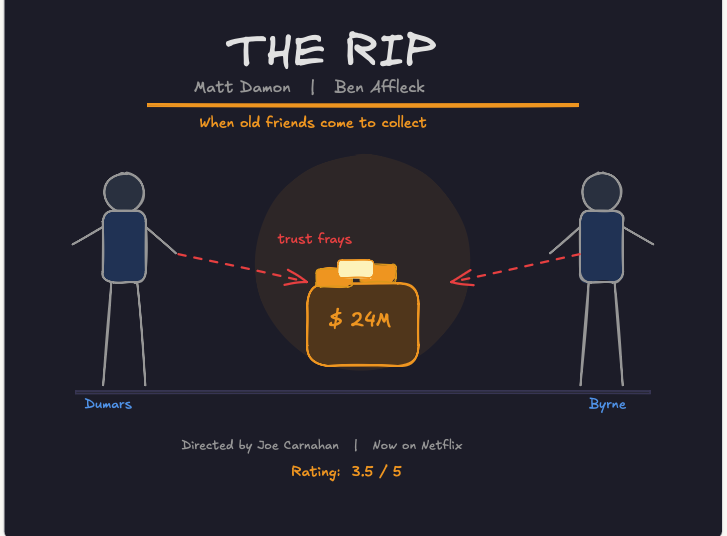
Damon plays Lieutenant Dane Dumars, and Affleck plays Detective Sergeant J.D. Byrne — partners in a Miami-Dade narcotics unit that works what they call “the dope game,” seizing cash from drug operations. When a tip about a $300,000 stash house turns out to be hiding $24 million — the kind of money that rewrites the arithmetic of a life — the team is required by law to stay and count it. The night that follows is the film.
Carnahan has spoken openly about his inspirations — Serpico, Prince of the City, and Michael Mann’s Heat are his touchstones — and you can feel all three in the film’s DNA. The moral corrosion of good institutions, the loyalty that money systematically dismantles, the way a single extraordinary circumstance reveals who a person actually is beneath the uniform and the procedure. He calls The Rip “a deeply personal” project, inspired by the real story of his friend, Miami-Dade Police Captain Chris Casiano, whose 2016 raid uncovered $20 million in a stash house.
The result is a crime film that earns its tension the old-fashioned way — through character, not spectacle.
What Works, and Why
The first two acts are close to exemplary for this genre. Carnahan establishes the claustrophobic logic of the situation with precision — the stash house becomes a pressure cooker, and as outside forces learn about the money, the trust inside the team begins its slow, almost chemical dissolution. Who made the call? Who benefits? Who is already compromised? These are not complex questions philosophically, but the film makes them feel genuinely urgent, which is a directorial achievement.
Damon, playing the more controlled of the two leads, does what he has always done best — he internalizes. Dumars is a man with a secret, and Damon carries that secret the way a good poker player carries a bad hand: absolutely still, slightly too careful, giving nothing away while giving you just enough to suspect. Affleck, as Byrne, gets to be the more ebullient and readable of the two — open, instinctive, fiercely loyal — and it is the contrast between them that generates most of the film’s dramatic heat. Affleck told interviewers that Damon “is so understated, so real and so honest — it’s the opposite of a showy performance.” He is right, and watching the two of them work in the same frame, you see what thirty years of genuine friendship does to a screen partnership. They don’t perform trust. They don’t perform doubt either. They simply are two men navigating both.
The supporting cast earns its place. Steven Yeun brings quiet menace to a role that could have been a stock antagonist. Kyle Chandler, playing a DEA agent, operates in his natural register — contained authority that might tip either way. Teyana Taylor as Detective Baptiste gets the film’s sharpest subordinate arc.
Where It Stumbles
The third act is where The Rip loosens its grip. The film has spent ninety minutes carefully building psychological pressure, and then it resolves that pressure with action set pieces that feel borrowed from a different, noisier film. The climax is competent but generic — the kind of finale that satisfies the contractual requirements of the thriller genre without satisfying the specific emotional promise this particular story has made to its audience. Several reviewers noted this, and they are not wrong.
There is also a Netflix fingerprint on the whole enterprise that is worth naming. Damon himself, in an interview, described how streaming viewing habits shaped the edit — noting that Netflix wanted the plot reiterated “three or four times in the dialogue because people are on their phone while they’re watching” — a candid window into how the platform quietly influences the craft. You can occasionally feel it in scenes that explain what a sharper edit would have trusted the audience to understand.
But here is the thing about crime films: you forgive a weak third act more readily than in almost any other genre, because the pleasure is so much in the journey. The Rip is a film you lean into from its opening sequence and remain leaned in for most of its runtime, and that is not a small achievement.
The Bigger Picture
What is most interesting about The Rip is what it represents beyond the film itself. Damon and Affleck founded Artists Equity in 2022 precisely to create a different kind of production model — one where the people who make the film share in its success. The deal they negotiated with Netflix for The Rip includes a profit-sharing bonus for all 1,200 crew members if the film hits performance benchmarks in its first 90 days. It debuted at number one on Netflix globally and stayed there. In its first week alone, it suggested it might join the all-time most-watched list.
That is not just a box office story. It is a statement about what the industry might look like if the people who write the scripts, light the sets, and mix the sound were included in the upside. Two men who came from nothing in Cambridge, Massachusetts, won an Oscar together at twenty-something, built parallel careers across three decades, and are now trying to change how the economics of filmmaking actually work — that story is at least as interesting as anything in The Ripitself.
Verdict
The Rip is not trying to be Heat. It knows it isn’t Heat. What it is trying to be is a well-made, grown-up crime thriller that takes its characters seriously and trusts the chemistry of its two leads to carry the weight — and on those terms, it succeeds comfortably. The first two acts are taut, intelligent and genuinely tense. The third act trades depth for noise. The film as a whole is exactly what it promises: a good evening’s watch with two men who know each other the way only time can teach.
There is a line in Good Will Hunting where Will tells Sean, “You’re the only one who knows what I’m going through.” Will Hunting was speaking about isolation. Dane Dumars and J.D. Byrne, standing in a Miami stash house with $24 million between them and every reason in the world to stop trusting each other, are speaking about something harder — the choice to remain loyal when loyalty is expensive.
The Rip is, at its best, a film about that choice. Go watch it.
Rating: 3.5 out of 5
Streaming now on Netflix.
Lakshmi Narayana is the founder of Directing Business Consulting and Advisory and author of “Directing Business: Movies and Management Lessons for Dreamers.” He writes at the intersection of cinema, leadership, and the art of human judgment. Find him at lakshonline.com