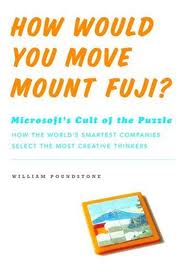
How Would You Move Mount Fuji?

This book by William Poundstone takes the title from a puzzle question, the likes of which are a common feature in job interviews in and around Silicon Valley.

The book traces the history of the interviews based on puzzles right from the days of William Shockley to the recent Bill Gates. While at it, the book touches topics such as intelligence tests for employment, the origins of Silicon Valley, the culture of Microsoft and Wall Street.

The book is essentially divided into three parts. First, deals with the history of puzzles in interviews and the efficacy of the same in silicon valley and Wall Street. Second, gives some tips and guidance for the interview process both for interviewees and interviewers. Third, solves the puzzles that feature in the first and second parts.

While the first part sure does make an interesting reading with several anecdotes throw in, it is the second part that offers something for the wannabes and seasoned managers.

Here are some points for the managers.

  1. The value of puzzles is inverse proportion to the candidate’s experience; An interview puzzle is prevent bad hires
  2. Have an interview plan
  3. An interview is not an IQ test; Interview questions are only as fair as you make them; Choose questions so that it doesn’t matter much whether the candidate has heard them before
  4. Challenge your first impression.
  5. Don’t do a “stress interview.”
  6. Avoid deception, even the common “white lies” about interviews

Online video sites, hot targets?

Yet MySpace offers an interesting contrast in how online video is already beginning to pay off. MySpace is used for online distribution of TV and film from News Corp.’s Fox Entertainment. The site, built around a network of home pages laden with messages and photos, already generates a huge volume of video, according to comScore Networks. A comScore report on Sept. 27 said MySpace generated 1.5 billion video streams during the month of July, beating out No. 2 Yahoo and No. 3 YouTube. The survey only ranks free video streams. If the market is measured by the number of video users, as opposed to the number of videos watched, MySpace ranks third behind Yahoo and YouTube.

More at Businessweek

Related links
   Online Video: Next Stop, Nasdaq?

ET, IT…and the rest