Childhood defines what we are in many ways. In psychology, there is the talk of repressed desires or deep desires that are not fulfilled, that actually push us to project our ego in huge dimensions on to the real world. ‘Citizen Kane’ explores this to great effect and the term ‘Rosebud’ is like a term for something one loses in her childhood and does everything possible to reclaim it but can never attain. The same motif of the protagonist losing something in childhood and trying to reclaim it or making amends for the loss, is oft seen in many movies and TV shows. Sometimes it’s like the longing for home (child-like destination of a safe and secure ambience far from the war-cries, blood and gore), like Maximus in the movie ‘Gladiator’ or the wresting the power from individuals who once erred you, and become powerful in the process like ‘The Godfather’. So in short, whether it is revenge or homecoming or helping others or destroying a world or coming of age or self-discovery…whichever aspect you take it all leads something happened when you were a child or young. And no matter how much world appears to have been stacked against you or one thinks it is the world that changed him, it is one’s inner ego that is tortured that shapes his journey. In this manner of speaking every journey is inwards, like Joseph Campbell says.
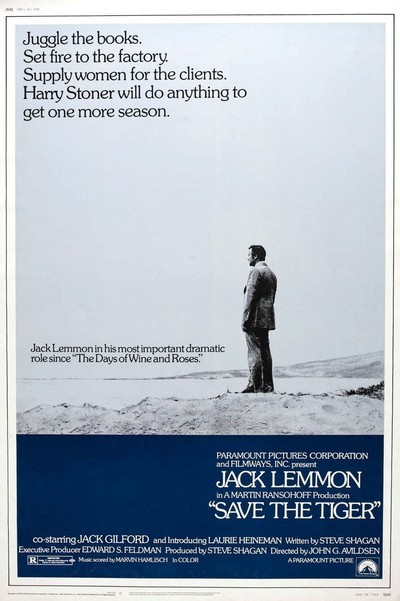
‘Save the tiger’ is about saving the self of Harry Stoner, a successful businessman who has everything till yesterday and now struggles with nightmares of losing it all. And when someone digs into the well of horrors, he sure finds his lost dreams from childhood, tucked deep in the trappings of his exterior world. So begins the journey of Harry Stoner (with a nightmare shaking him up in sweats just like Mr.Campbell wants it) into his deep recesses of his mind and soul, and his desperate attempts to save his business. As often happens in any good story/script, the inner and external journeys juxtapose which each other and so does the motive for his actions. For instance, while he is nonchalant about fixing up his client with a high end prostitute, and employing a professional arsonist to scrounge the insurance money, we get to see his motivation of doing such things.
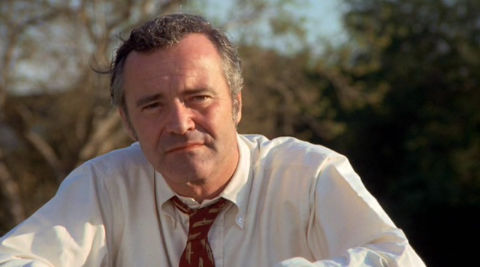
Harry Stoner was Cuban Pete, an immigrant who wanted American dream and got it. And there is no way he could lose it now. Especially, not in the dreary middle age…where one is sized up first and then his resume read. There are beautiful dialogues about what’s important to him..”wanted to meet a payroll, instead of a pay-cheque” and ‘..god dammit, I live the American dream, don’t try to sell it to me.”
In a way the movie is about the road to damnation, if one could call it that way. Every reveal of plot and his character, makes you feel sorry for him, yet one gets to guess the real end, just like in a good tragedy film. Real tragedy is not death but lack of redemption. Harry Stoner knows it all along and so do we. There is no saving an extinct species, and definitely not this tiger. But life moves on and Cuban Pete survives to see another day, even if his young dreams of playing basket ball or a being in a band or asking that girl out…or next to impossible now.
Casting Jack Lemmon is a master stroke. Many have seen his comic antics and in this film he doesn’t anything different, an actor is an actor whether he is in a comic role or in a serious role. He is still his sublime self, giving a performance drawing from his own insecurities and success. But the script allows shining his motive in several scenes. For instance, in one poignant scene, his character breaks down after a neck message (like the one in ‘The Odd Couple’ which had a different effect) tearing his words through eyes..”if only, I had one dream…”. He truly deserved the Oscar for his performance.
‘Save the Tiger’ is a must watch for anyone who would like to see real characters or if you are a writer, make you characters real and their journeys appealing. In life there is no happy ending, only an irony or tragedy. But the legacy lives on, beyond one’s death, physical or metaphorical.
Tailpiece:
My father attempted a small and sweet short story based on a childhood missed dream, and used humour to good effect. ‘Sweet Nonsense’, it was called and link below.