Category Archives: 1-By Laksh

All these articles are from Laksh’s desk

Then we set his hair on fire


This book is about insights. Insights that lead to a zillion of ideas. Even when these ideas take different forms–a TV commercial is just one of them–one can still see the insight shining through.

And where does an insight fit in the overall scheme of things? RAISE–Research, Analyse, Insight, Strategy and Execution.

Phil Dusenberry gets to the point quickly and then reinforces the point in the subsequent chapters. While at it, he presents a slice of life from his illustrious career propped with real anectodes and management wisdom.

An adman all his life, Phil pays brief lip service to the science of advertising, describing the kind of background research that underlies great ad campaigns. He makes a strong case for research that is grounded in the customer reality. Data is just a means and not the end. Hence, research need not be an expensive and long drawn affair, sometimes it could be as simple as a trip to the restaurant or a movie or a chat with the target consumers. But he admits a greater faith in gut instinct sometimes overriding research.

He picks up the universal problems of any business–parity, moving the needle, launching, competition, mission and image–and presents his experiences with his clients like HBO, Mars, Cingular, Pizza Hut, Fedex, Pepsi and Ronald Reagen.

While the book is not about advertising, he offers interesting episodes involving Michael Jackson and Don Johnson. He also recounts how BBDO staged a pro bono campaign for New York City shortly after the 9-11 terrorist attacks, using celebrities such as Henry Kissinger, Robert DeNiro, Billy Crystal, Ben Stiller, and Barbara Walters to illustrate the power of the dreams that draw so many young people to the city, even today.

Finally, he presents a process to nurture and protect insights.

His sign off note? When you are armed with a powerful insight, the ideas never stop flowing.

Note: The cover design is a little misleading. You do get a feeling that you are in for a Archimedes-kind-of-serendepity throughout and the insights that followed. Instead the book outlines several other ways that lead to business-changing insights.

Decoding Ron Howard

Ron Howard, the actor, had a great outing in ‘American Graffiti’. In the movie, he plays a confused teenager who gets into a mess when he takes his girl friend for granted. He sure did mend his ways in the real life:) It is a fascinating contrast to see Ron Howard, the director, respect moviegoer’s sensibilities and dish out a sumptous fare, every now and then.

With films spanning across the genres, he has etched a name for himself in the Hollywood. Most of his films though centred on family ties and the emotions that go with them, he still manages to offer a different treatment for each film. In ‘Parenthood’ he takes on Steve Martin and makes him deliver a Chaplinesque performance.  In ‘Apollo 13’ and ‘The Beautiful Mind’ he deals with two different battles–one waged in the outer space and the other in a mathematician’s mind.

You could call his liking for the human angle as his stamp. And, this stamp is obvious even in a thriller like ‘Ransom’ and  in the bio pic ‘The Cinderella Man’, where the protagonists resort to desperate and unconventional means to save their families.

Ron Howard now attempts the biggest film–and estimated budget of US$125 million–of his career, based on the best seller ‘The Da Vinci Code’.  The novel, though hugely successful, feeds very little on the relationships or family values. It would be interesting to see how he handles this extremely successful novel. Will he be true to the novel and visualize only the controversial (so called!) discoveries and the intermittent thrills, which are the main reasons for the success of the novel. Or will he steer himself through the controversies and focus on the plot, which is ain’t much in the novel. Or will he tinker with the original and play with the following of 40 million+ people who had bought the book.

Yup! It is a ‘beautiful’ problem for a creative mind:)
Let’s hope Ron Howard cracks this one.

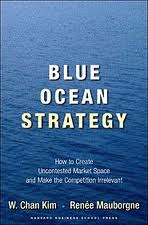
The blue ocean strategy


When a book is titled “Blue Ocean Strategy: How to Create Uncontested Market Space and Make Competition Irrelevant  “, it is bound to attract attention 🙂

Who would like to get his hands red anyway?:-) Here’s how to get blue from Chan Kim and Renee Mauborgne.

The authors take a blue ocean metaphor to competitor-free markets that innovative companies can navigate. Unlike “red oceans,” which are well explored and crowded with competitors, “blue oceans” represent “untapped market space” and the “opportunity for highly profitable growth.”

The authors make a case for pursuing a blue ocean strategy (Although 14% of new product launches are blue ocean launches they contribute 38% to revenue impact and 81% to profit impact out of all launches)

The book outlines the following steps of the Blue Ocean Strategy:

1. Reconstruct market boundaries. (Strategically examine your industry’s key competitive drivers. )
2. Focus on the big picture, not the numbers
3. Reach beyond existing demand.
4. Get the strategic sequence right.
5. Overcome key organizational hurdles.(Cognitive,Resource,Motivational and Political hurdles)
6. Build execution into strategy.(Sustainability and Renewal)