
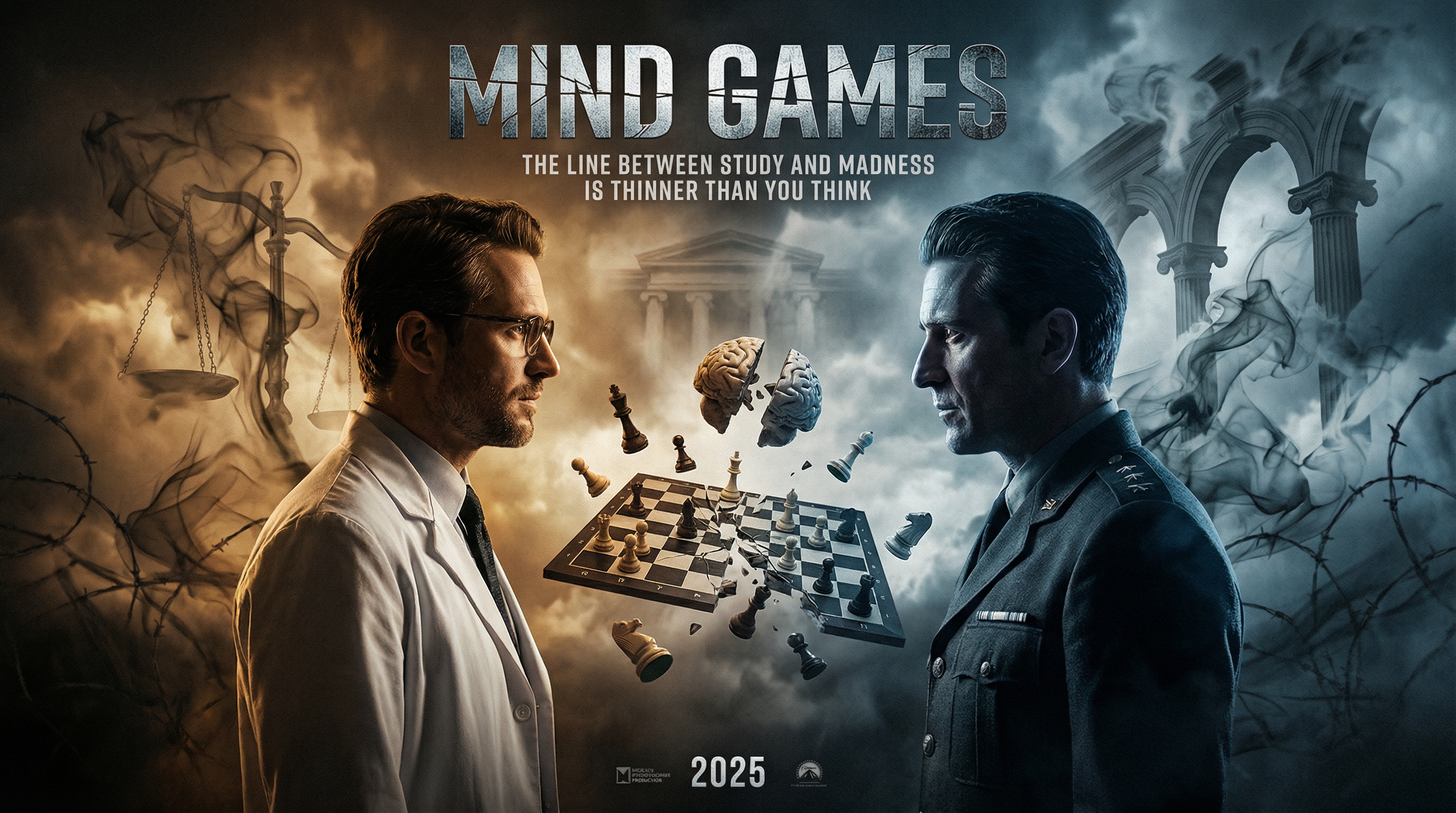
Evil doesn’t arrive shouting. It comes wearing a charming smile.
That unsettling truth sits at the heart of James Vanderbilt’s Nuremberg, a film that strips away comforting illusions about the nature of atrocity. Eighty years after the most consequential trials of the 20th century, this psychological thriller poses an uncomfortable question to contemporary audiences: not “Could we recognize another Hitler?” but “Could we recognize the patterns that enable authoritarianism before it’s too late?”
Russell Crowe Delivers a Career-Defining Performance
Russell Crowe dominates every frame as Hermann Göring, Hitler’s second-in-command, in what critics have called “a masterclass in subtle, nuanced acting—absolutely electrifying”. His Göring is equal parts monstrous and magnetic, a man who understands performance as power.
RogerEbert.com’s Matt Zoller Seitz captures why Crowe’s work transcends typical historical drama: “Like Gene Hackman in his greatest ’80s and ’90s performances, Crowe has such a regular-guy energy that on those rare occasions when Göring is thwarted or disappointed and we get a glimpse of his capacity for overwhelming violence, it somehow comes as an unsettling surprise”. That “regular-guy energy” is precisely the point—Crowe makes Göring simultaneously charismatic and terrifying, embodying the film’s thesis that history’s greatest monsters often hide behind ordinary faces.
Rami Malek’s portrayal of psychiatrist Douglas Kelley has divided critics more sharply, with some finding his performance compelling while others, like The Guardian’s Peter Bradshaw, dismissed it as “deeply silly”. Yet this friction mirrors the film’s central tension: Kelley’s intellectual ambition versus his growing moral horror.
A Psychological Chess Match in History’s Shadow
The film’s brilliance lies not in courtroom theatrics but in the intimate cat-and-mouse dynamic between Kelley and Göring. What begins as psychiatric evaluation transforms into something far more dangerous—a “battle of intellect and manipulation between Kelley and Göring, two men driven by ego, curiosity, and a dangerous desire for control”.
Director Vanderbilt stages this confrontation with precision, creating “courtroom scenes that bristle with energy, dialogue that snaps with a rhythm reminiscent of Aaron Sorkin, and moral tension that rarely lets up”. The visual texture—smoky interrogation rooms, measured silences, the bureaucratic weight of justice finding its footing—evokes classic Hollywood while maintaining a distinctly modern psychological edge.
Critics Divided, Audiences Captivated
Nuremberg has generated a fascinating reception split. Professional critics awarded it a 72% approval rating on Rotten Tomatoes, while audiences embraced it overwhelmingly at 96%. This gap suggests that while the film may lack the artistic sophistication some critics demand, it succeeds magnificently at its primary mission: making history emotionally resonant.
| Metric | Result |
|---|---|
| Rotten Tomatoes (Critics) | 72% [rottentomatoes] |
| Rotten Tomatoes (Audience) | 96% [rottentomatoes] |
| Box Office (Worldwide) | $39.5 million [the-numbers] |
| Oscar Shortlists | Best Original Score, Best Makeup & Hairstyling [facebook] |
| Golden Globe Nominations | 3 [goldenglobes] |
The film has earned recognition beyond commercial success, winning the Audience Choice Award at Heartland International Film Festival and the Ateneo Guipuzcoano Award at San Sebastián. It’s now shortlisted in two Academy Award categories for the 98th Oscars.
Why This Film Matters Now
Nuremberg arrives at a moment when Holocaust denial and World War II revisionism are “more mainstream than ever,” according to critics observing the cultural landscape. The film’s most powerful message isn’t about recognizing obvious villains—it’s about understanding the psychological patterns that enable authoritarianism before catastrophe.
Kelley’s real-life conclusion—that Nazi leaders were “not extraordinary monsters but rather ordinary individuals”—remains the film’s most disturbing revelation. If these men were psychiatrically normal, then the capacity for such evil exists in any society under the right conditions. As one reviewer noted, Nuremberg “is a haunting reminder that the spectacle of justice can sometimes mirror the performance of guilt”.
The tragic epilogue, only briefly addressed on screen, haunts the narrative: Kelley himself died by suicide in 1958, using the same method—cyanide—that Göring employed to cheat the hangman. The psychiatrist who studied evil became, in death, eerily connected to his subject.
The Verdict
Nuremberg succeeds not as flawless cinema but as necessary cultural intervention. Despite occasional pacing issues and the critic-audience divide, it accomplishes something vital: forcing viewers to confront how power corrupts and how ordinary people become instruments of extraordinary evil. Peter Travers perhaps said it best: “What to do when a great actor is stuck in a not-so-great movie? You bite the bullet and watch anyway if the actor in question is Russell Crowe”.
For audiences seeking meaningful historical drama with contemporary urgency, Nuremberg delivers. It reminds us that “never again” demands constant vigilance—not complacent certainty that we’d recognize evil if we saw it.
Rating: ★★★½ out of ★★★★★