“In my experience, the more you know about something, the less you fear it.” – from the film The Martian
There is a scene in The Martian where Mark Watney survives not by writing strategies in a PowerPoint deck, but by literally getting his hands dirty—growing potatoes in Martian soil, hacking equipment, and fixing things one bolt at a time. That line about knowing more and fearing less captures something essential about being hands on: proximity to the work gives both control and clarity.
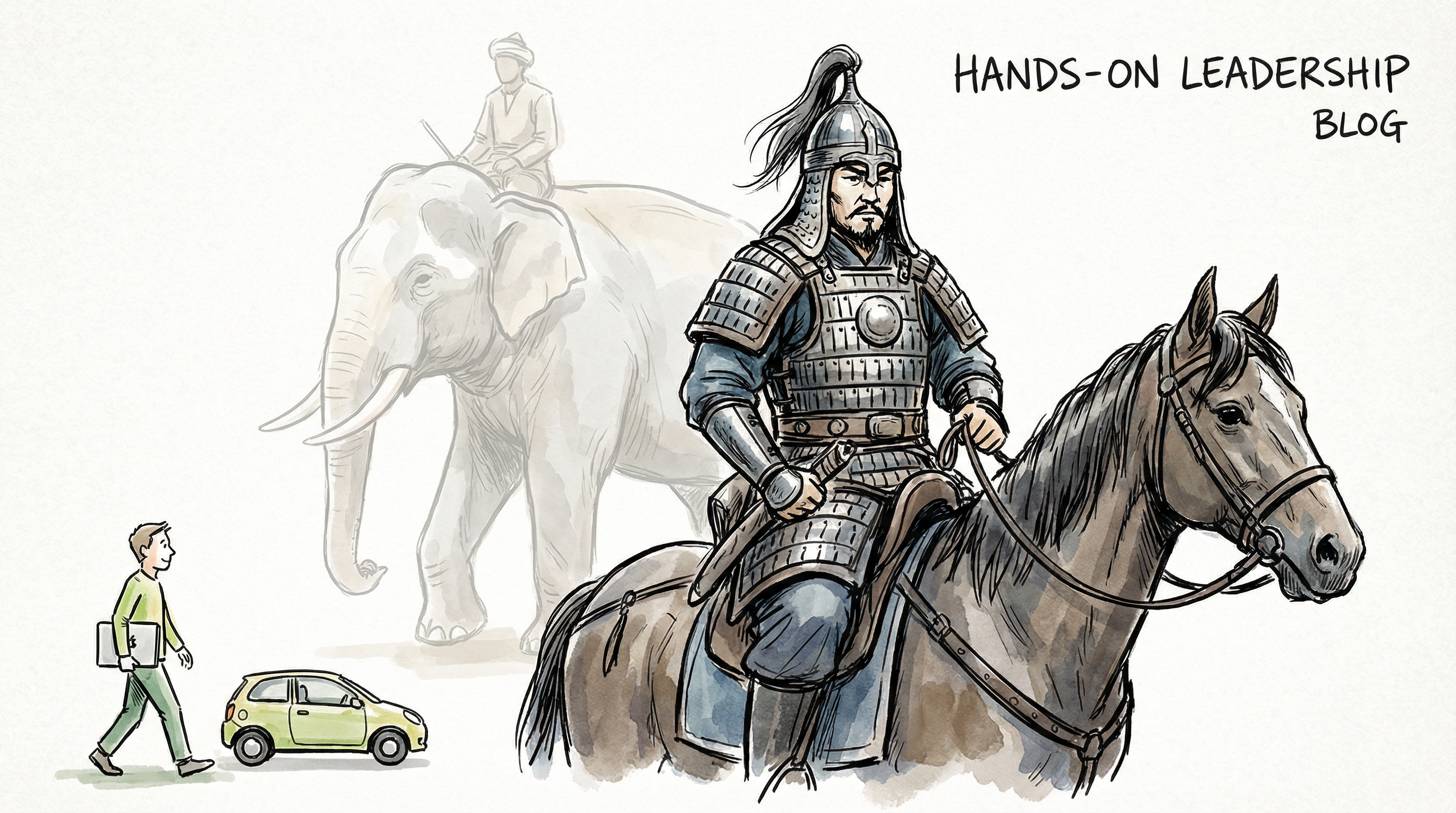
An ex–Income Tax officer, a long-standing RSS member who was helping me find clients in my early startup days, once shared an anecdote about Babur that stayed with me. He told me that an RSS article had described how Babur preferred horses over war elephants, seeing elephants as powerful but harder to control because they depended on someone else to handle them, while cavalry gave him more direct, agile command in battle. This interpretation fits Babur’s campaigns in India, where he relied heavily on fast cavalry and firearms rather than elephant corps, and it offers a vivid metaphor for how we choose our tools and roles in modern work.
He made this point while watching me being driven around by my driver at a time when I was actually struggling for work, with more free time than assignments. I still have a driver, but that moment poked a hole in my comfort zone. It forced me to ask a difficult question: was I building a life of horses I could ride, or elephants that always needed someone else to move?
Since then, I have tried to be deliberately hands on in every role. As a project manager, that meant writing code myself, not just tracking timelines and updating status reports. As a digital cinema head, it meant standing inside theatres during installations, understanding how projectors, servers, and sound systems actually came together to create the experience on screen. As a digital head, it meant personally uploading videos and posting on social media instead of only approving campaigns from a distance. And now, it means writing code again—this time with AI applications as my “horses,” responsive tools that move where I nudge them, instead of “elephants” that someone else has to prod into motion.
There is a catch, though. Being hands on can slowly turn into being trapped in the weeds: replying to every email, touching every file, sitting in every meeting. You feel productive and in control, but the bigger picture—market shifts, long-term risks, strategic bets—starts to blur. The same closeness that gives confidence can also shrink your field of vision if you never step back.
So the balance, for me, is this: hands on is still the way to go, but not at the expense of perspective. The goal is to stay close enough to the work that you understand its texture and constraints, yet far enough back that you can see the whole battlefield and choose where to charge. Babur may have preferred horses to elephants, but he still needed a vantage point from which to see his entire army and the shape of the enemy line.
That is the leadership posture worth aiming for: one hand on the reins, the other pointing toward where everyone needs to go.