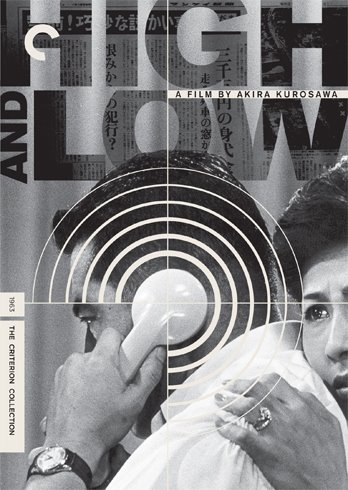
High and Low (1963) is another masterpiece from Akira Kurosawa. It is about a businessperson who has to pay a huge ransom and stake everything he has built so far.
The movie has three parts, with a Prologue and Epilogue.
- Prologue: The set-up of rich vs. poor (right from the titles), Mr.Gondo’s (Toshiro Mifune) entry and his hilltop villa, his nature, his beliefs and value systems, and the point where he has to take some bold steps to revive his professional fortunes. (Here we get to see an aggressive and successful businessperson who is all for doing what is necessary to win in a war. There is a lovely scene of wife (Kyōko Kagawa) chiding Mr.Gondo about his change of heart after success.)
- Part 1: The inciting incident that of kidnap, his mental turmoil, his relationship with his wife and kid, the importance of them in his life, and finally his good nature forcing him to pay the ransom to save his driver’s child. (Here we get to see a mellowed Mr.Gondo, who empathizes with a fellow worker, as he himself came up the hard way and gives in to the feelings of his wife and kid.)
- Part 2: Here we get to see the process of paying the ransom and the start of downward progression in Mr.Gondo’s life.(The other characters from police department–Tatsuya Nakadai as Inspector Tokura, Kenjiro Ishiyama as Chief Detective ‘Bos’n’ Taguchi– introduced in Part 1 start getting their due in terms of story progression.)
- Part 3: The investigation based on the video footage and clues from driver’s child, all lead to seizing the culprit (Tsutomu Yamazaki). (Here we get to see the police characters driving the show and a master class in direction from the great Akira Kurosawa)
- Epilogue: Here we get to see the showdown between Mr.Gondo (who is now starting all over again, working at a different firm) and the kidnapper (who is awaiting his death sentence) and the rich vs. poor theme.
Akira Kurosawa’s masterful direction is all in its splendor and there are several videos and articles on the internet about the story telling and shot making. (A few mentioned below in related links).
In summary, High and Low is not a typical feel good movie even though the plot and characters reach their logical conclusion (Mr.Gondo gets back his ransom, the culprit is hanged, the police solve the case, the kids unite etc). The fact that Mr.Gondo doesn’t win his company back or the epilogue in which the kidnapper tries to justify his crime, gives us a feeling that the director wanted the grays to be intact instead of a plain vanilla, happy-ever-after ending. It is as if he is telling us, that the two main characters are the not the same after this crisis and their lives are changed forever. While one will be dead soon, the other is back to square one, inspite of all the goodwill he earned from the public due to his noble act. This again is a reflection of the writer’s perspective, that no matter what the world’s representation of you might be, one has to face the harsh reality and move ahead.
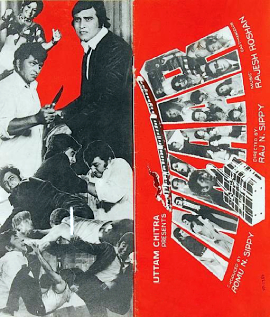
In contrast, Inkaar (1977) goes for a happy conclusion, where in all the characters get what they want and result in predictable outcomes. The grays are tossed out of the window for a wider appeal. The police character becomes the main hero (Vinod Khanna) while the businessperson (Dr.Shriram Lagoo) becomes a character actor. In addition, the main criminal (Amjad Khan) is an ex-worker in the factory and a mad-killer on loose, who dies in the end. Therefore, the hero gets the girl, the businessperson saves his house from auction in time, the kids are reunited, and the wife is no better than she was earlier, the driver even more faithful than before.
Having said that Raj.N.Sippy’s Inkaar still is a different commercial film in its times and does a decent job, with able support from music and sound department (Rajesh Roshan, Robin Chatterjee and Mangesh Desai). It isn’t a magnificent seven of Seven samurai, or A Fistfull of dollars of Yojimbo, but manages to weave it in a form palatable to the audiences in 70s and movie aficionados of all time.
Tailpiece: The scene in The Fugitive (1993) where Tommy Lee Jones spots an overhead train in a sound tape, is a straight lift from the trolley-sound scene in High and Low.
Related Links
High and Low Analysis
High and Low: Full Movie on Internet Archive
High and Low Review
The Morality of High and Low
Blocking moments in High and Low
Akira Kurosawa’s High and Low — What Makes This Movie Great?
‘Unsung hero, Pope of sound’: A documentary resurrects legendary mixing engineer Mangesh Desai.
Robin Chatterjee music composer