Most people assume creativity belongs only to experts. But a silent category exists between amateurs and full-fledged professionals—the borderline professionals. These are individuals who have the desire to create, and just enough basic skill to understand what they want, yet they struggle to execute.
Today, AI changes that equation.
The Ancient Framework That Explains Modern AI
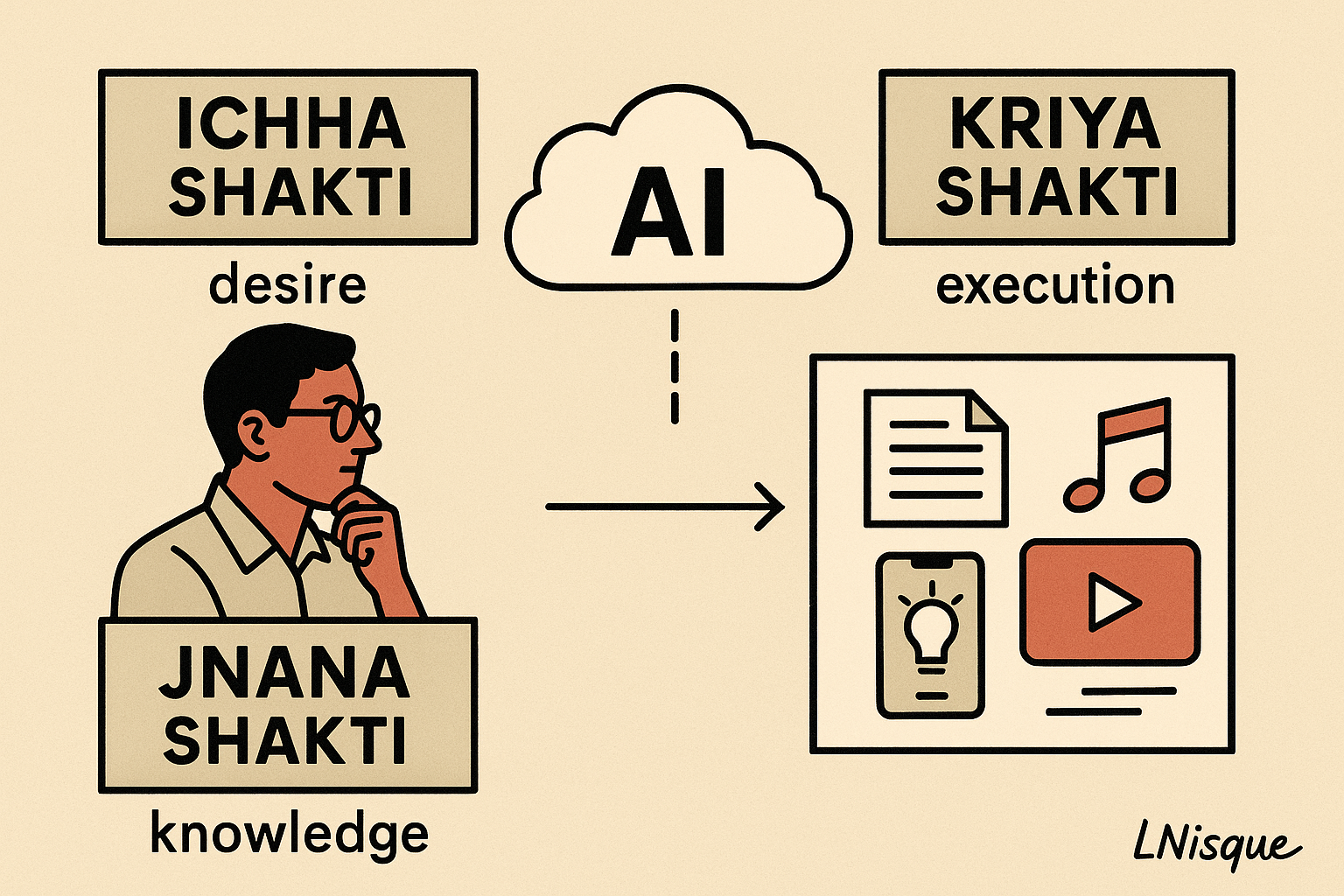
In the Lalita Sahasranama, creation is rooted in three forces:
Ichha Shakti — the deep desire or will
Jnana Shakti — the knowledge or understanding
Kriya Shakti — the power to execute
In my book Directing Business, I highlighted how these three powers capture the entire arc of creation. Most people possess the first, many have some version of the second, but very few have the third.
This is where AI steps in—not as a replacement for human skill, but as the missing Kriya Shakti that unlocks execution.
Who Are Borderline Professionals?
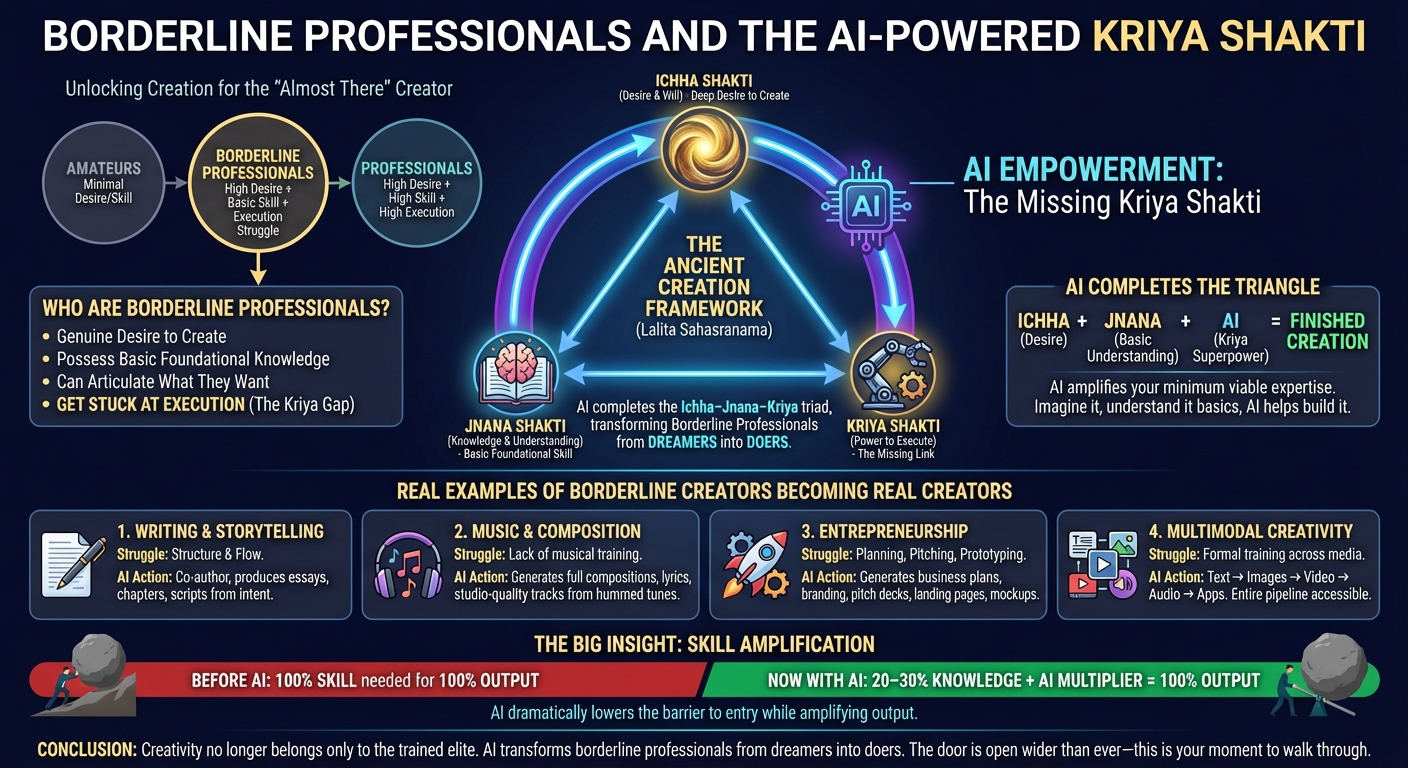
Borderline professionals are not amateurs. They are not novices. They are people who:
Have a genuine desire to create
Possess basic foundational knowledge
Can articulate what they want
But get stuck when it’s time to execute
They often sit on ideas for years—songs they wanted to compose, books they wanted to write, companies they wanted to start, designs they always imagined but never completed.
Their limitation is almost always Kriya Shakti—the ability to translate intent and knowledge into a finished creation.
AI Completes the Creation Triangle
If you possess:
Ichha (desire)
Jnana (basic understanding)
AI now gives you:
Kriya (execution superpower)
This shifts the creative world in a fundamental way. AI does not magically inject expertise into you. Instead, it amplifies your minimum viable expertise.
In other words: If you can imagine it and understand it at a basic level, AI can help you build it.
Real Examples of Borderline Creators Becoming Real Creators
1. Writing & Storytelling
People who always wanted to write but struggled with structure or flow can now produce full essays, chapters, and scripts. AI becomes the co-author that takes their intent and shapes it into polished work.
2. Music & Composition
A person who can hum a tune or grasp rhythm but lacks musical training can now generate full compositions, lyrics, and studio-quality tracks.
3. Entrepreneurship
Someone with a startup idea but no experience in planning, pitching, or prototyping can now generate:
business plans
branding
pitch decks
landing pages
even early product mockups
In short, AI provides the scaffolding for company creation.
4. Multimodal Creativity
Text → Images → Video → Audio → Apps With modern multimodal AI, the entire pipeline of creativity becomes accessible—even if the individual has never been trained formally.
The Big Insight: Skill Is Not Dead—It Is Amplified
You still need some Jnana Shakti—some grasp of your domain. AI cannot replace absolute ignorance.
But the amount of knowledge needed to start has dramatically dropped.
Earlier, you needed 100% skill to get 100% output. Now, even with 20–30% knowledge, AI multiplies your ability to produce a finished work.
This is the true empowerment.
Why This Is the Best Time for Borderline Professionals
For the first time in history:
You don’t need a studio to compose.
You don’t need a publisher to write.
You don’t need a team to launch a startup.
You don’t need a design degree to create visuals.
You don’t need a production crew to make videos.
If you have deep desire (Ichha) and basic understanding (Jnana), AI gives you Kriya at a never-before scale.
This makes today the most powerful era for borderline professionals—those who were always “almost there,” waiting for a catalyst.
Conclusion
Creativity no longer belongs only to the trained elite. It belongs to anyone with the will to create and the willingness to learn just enough to guide AI.
AI completes the Ichha–Jnana–Kriya triad. It transforms borderline professionals from dreamers into doers, and from doers into creators.
The door is open wider than ever. And if you’ve always stood just outside it—this is your moment to walk through.
Infographic based on this article (using Nana Banana Pro)
Some traditions carry management secrets hidden inside rituals. The Kanne Swami custom from the Ayyappa pilgrimage is one of them. A structure so human that even the best corporate handbooks can’t quite touch it.
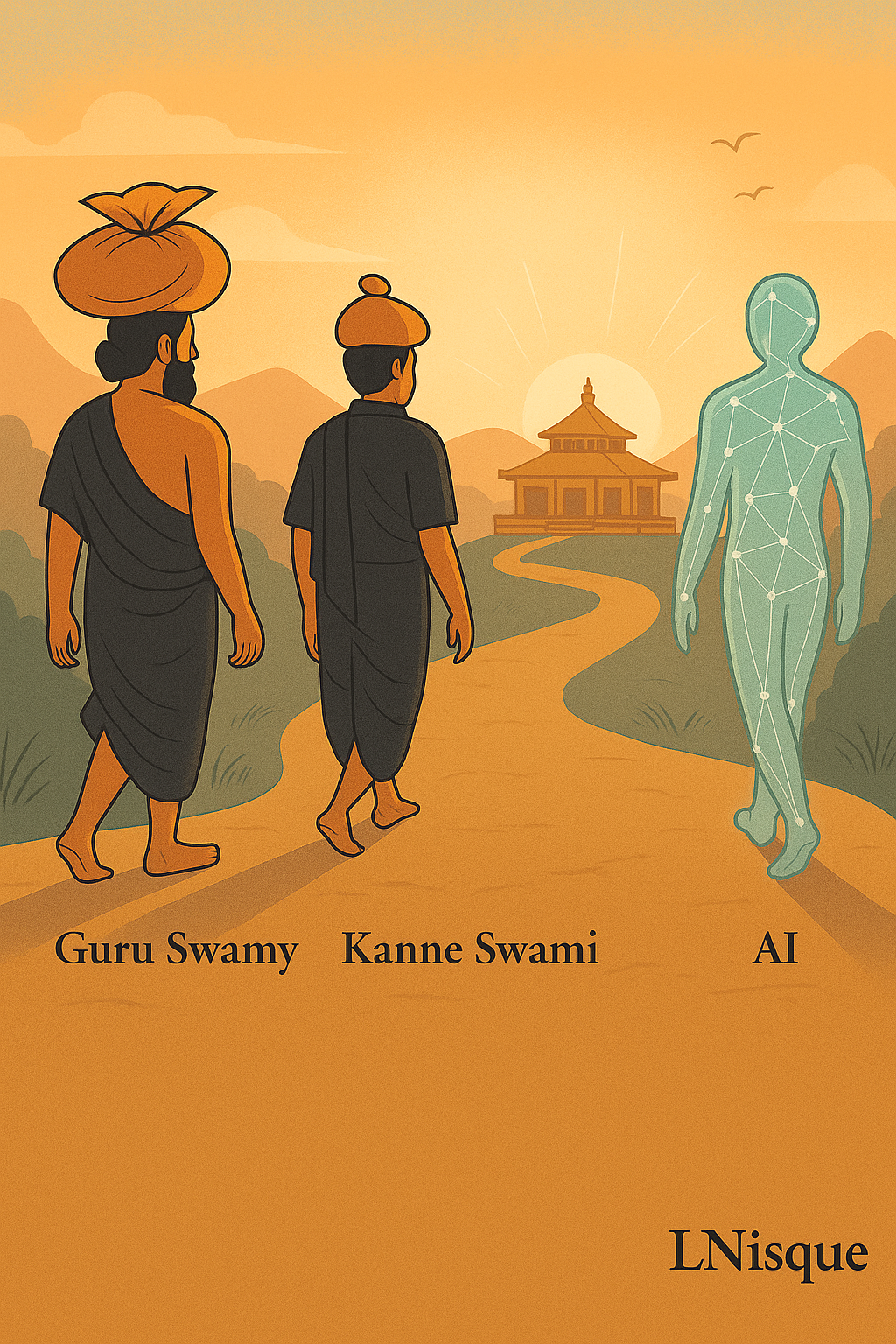
Every first-time pilgrim, the Kanne Swami, walks under the care of a Guru Swamy. Someone who has done the journey before. Someone who remembers the fear, the fatigue, the feeling of not knowing what lies beyond the next hill. The Guru doesn’t instruct from a distance. He walks beside the novice. Watches. Corrects. Encourages.
It’s mentorship without bureaucracy. Discipline without coldness. And care that doesn’t require an app.
Now imagine a company doing that.
A workplace that feels like a pilgrimage
Picture a new hire on their first day. They’ve cleared interviews, signed forms, logged in, smiled through the icebreaker round. Then what? Usually, silence.
An inbox full of welcome messages that mean well but sound rehearsed. A manager too busy to explain what “ownership” really means. A team that helps politely but never deeply.
What if that person was treated as a Kanne Swami? Guided with sincerity, not policy. Paired with someone who feels responsible for their initiation, not just their output.
A Guru Swamy at work would not be another “buddy” from HR. He or she would be a custodian of learning. The person who ensures that the first 41 days of the new member’s journey feel grounded, ethical, and alive.
Every culture that survives more than a century has some version of this. The Japanese senpai–kohai system. The guild apprenticeships of Europe. And here in India, the Guru–Śiṣya bond. The Ayyappa tradition simply gave it ritual clarity.
The modern company can too.
What ancient India already understood about leadership
Our texts and customs weren’t management manuals, but they carried psychological precision. The Guru–Śiṣya paramparā wasn’t just about transferring knowledge. It was about transmitting restraint, intuition, and self-control. The mentor watched how the student moved through frustration. The real lesson wasn’t the mantra; it was how to stay still when the world tested you.
Sevā bhāva taught that service purifies ego. A true guide serves the learner’s growth, not his own reputation. Atithi Devo Bhava reminded communities that newcomers bring divine potential. Even the Gītā quietly handed managers a code: Karmanye vadhikaraste ma phaleshu kadachana. Do your duty, but let go of the reward.
That line, taken seriously, can clean entire boardrooms.
We keep calling this philosophy. It’s actually process design. A cultural operating system, written in poetry.
The science caught up later
Psychology took two thousand years to name what the sages practiced daily. Amy Edmondson called it psychological safety. Google made it famous through Project Aristotle. Every study since then says the same thing. Teams thrive when people can speak without fear.
Fear is what ruins most first-time experiences. The first code deployment. The first client call. The first on-air appearance. One mistake, and it haunts you. A Guru Swamy neutralizes that fear. Not by removing risk, but by standing nearby.
Even AI systems—predictive ones, at least—run on something similar: feedback loops and safety nets. A team that encourages early vulnerability behaves like a well-trained model that’s constantly improving through gentle correction.
Funny how science ends up rediscovering faith with spreadsheets.
Translating pilgrimage into management practice
Let’s turn this into structure. Every time someone in your company does something for the first time, they’re a Kanne Swami.
A new hire. A first-time team lead. A developer pushing production code. A salesperson pitching a global client. Even an executive leading their first crisis.
Each deserves a guide. Someone with enough scar tissue to teach through calm.
The company can formalize this with small rituals, not heavy frameworks.
The 41-Day Frame: The first six weeks are sacred. They include orientation, shadowing, and reflection. The Guru ensures rhythm, not just routine.
The Two-Pouch Method: Inspired by the Irumudi the pilgrim carries. One pouch for learning goals. The other for contributions made during the journey.
The Safety Phrase: A simple, pre-agreed sentence any member can use to pause action when things feel wrong. Something human like, “Hold. Let’s rethink.” It must be honored instantly.
Completion Rite: After 41 days, both the guide and the learner sit together to reflect. The learner thanks, but the guide doesn’t take credit. The circle closes quietly.
Small, human mechanics. Yet they carry deep order.
Rituals aren’t weakness
In fact, they create accountability without paperwork. Every religion, military, and school that works well has rituals because rituals bypass bureaucracy. They create shared meaning fast.
A prayer, a salute, a morning sync-up—all function the same way: alignment through rhythm. Corporate life tried to replace ritual with tools, but tools can’t carry reverence.
So when someone becomes a Guru Swamy inside an organization, give them that dignity. Not a badge. Not a slide deck. A quiet recognition that they are guardians of culture.
And culture, as Peter Drucker warned, still eats strategy for breakfast.
What movies already taught us about guidance
We’ve seen this pattern in cinema again and again.
In Chak De! India, the coach isn’t training hockey players. He’s rebuilding belief. He doesn’t reward obedience; he rewards trust. In 3 Idiots, learning flows sideways—friend to friend, not top-down. Humor becomes pedagogy. In Super 30, the teacher’s power lies in hunger shared with students, not distance. Even Guru (2007) hides mentorship in ambition. Behind the swagger of business growth stands a quiet influence, a voice that asks harder questions.
Movies get it because stories remember what systems forget: that transformation is personal before it becomes organizational.
Bringing AI into the circle
Now the modern twist. What happens when you bring AI into this human equation?
AI can’t bless you, but it can remember you. It can keep a record of learnings, patterns, hesitations, blind spots. It can nudge both the mentor and the learner gently: “You missed two check-ins.” or “You’ve asked fewer questions this week.”
AI can play the role of the silent observer—the third pilgrim. It never sleeps, never forgets, and can hold mirrors without judgment.
Think of it as the keeper of the pilgrimage diary. The Guru Swamy guides through emotion. The Kanne Swami learns through experience. AI preserves their journey for the next generation.
And when done right, it doesn’t replace the bond. It deepens it. Because now the wisdom stays even after both have moved on.
This is what intelligent mentorship could look like. A trinity of presence: Human, Learner, Machine. Each aware, each humble.
Where the system breaks (and how to keep it alive)
Of course, rituals decay fast in corporations. Titles creep in. Ego returns. Mentorship becomes KPI. The sacred becomes symbolic.
That’s where vigilance matters. A Guru Swamy cannot be the learner’s boss. He or she must hold space, not authority.
Feedback must travel both ways. If the guide talks too much, the system fails. If the learner flatters too much, it fails again. Honesty is the only incense worth burning.
And every six months, rotate roles. Let learners become guides. Let guides return to learning. The cycle keeps humility fresh.
Because once people start saying “I’m done learning,” decline has already started, even if numbers still look fine.
The invisible outcomes
Companies that design this consciously will notice strange results. Meetings get quieter, but deeper. Attrition drops, not because of perks, but because belonging becomes visible. People start describing their managers as “protective,” not “demanding.” Errors reduce. Reflection increases.
All this without new software, slogans, or all-hands pep talks. Just a reintroduction of old-world care into high-speed business.
The future might actually belong to organizations that treat onboarding as initiation, not information download.
The AI parallel, again
There’s another way to see this. Large Language Models, at their core, learn like disciples. They absorb examples, refine responses through correction, and evolve through fine-tuning. Their growth depends on human supervision, alignment, and calibration.
Isn’t that what mentorship really is? Fine-tuning a human through feedback until their internal model aligns with shared values.
Now imagine combining that principle consciously. Each Guru Swamy in a company could have an AI co-pilot that records learnings, tracks questions asked by past Kanne Swamis, and generates a “wisdom log” for new ones.
The AI doesn’t command. It curates. A digital archive of lessons from countless pilgrimages across projects, departments, and years.
That’s not science fiction. It’s good documentation with a soul.
The paradox of progress
Technology races forward. Human depth often lags.
In a rush to automate, we risk forgetting the warmth that makes structure meaningful. A Kanne Swami framework doesn’t slow progress. It gives progress roots. And roots are what stop speed from turning into chaos.
AI can predict, suggest, summarize. But it can’t bless effort, can’t feel another’s struggle, can’t see pride in someone’s first small win. For that, you still need the human beside you.
Progress without mentorship is noise. Progress with care becomes tradition.
What success looks like when done right
A few years into such a system, your company would look different. Not in its products, but in its posture.
You’d hear stories like: “She was my first Guru Swamy here.” Or, “He taught me how to pause before responding.”
You’d notice people quoting lessons instead of policies. Meetings would start later but end faster. Trust would feel less like a word on posters and more like an atmosphere in the hallway.
That’s the test. When behavior travels through imitation, not enforcement, you’ve created culture.
Returning to the mountain
In the end, the pilgrimage to Sabarimala is physical, emotional, communal. Everyone carries the Irumudi, walks barefoot, sings the same chant, and reaches the same temple. Yet every person’s journey is different.
Organizations could learn from that. Equality in rules. Diversity in experience. Shared rhythm. Personal meaning.
Because when a team walks together that way, success stops being a race. It becomes a yatra.
And maybe that’s the secret we’ve forgotten in the age of dashboards and deadlines. That a journey, whether to a temple or to market leadership, feels complete only when someone wiser walks beside you, reminding you to breathe, to focus, to keep faith.
The last vow
Treat every newcomer as sacred responsibility, not replaceable labor. Let AI hold the checklist. Let humans hold the promise.
Because true leadership isn’t measured by how far you go. It’s measured by how many you take with you.
In a world obsessed with success, we are taught to fear failure—to see it as an end, a mark of shame, a final verdict on our worth. But what if our most profound moments of growth are not found on the winner’s podium, but in the depths of our most spectacular falls? This is the startling philosophy of Akella Raghavendra, an educator and mentor who describes the two biggest setbacks of his life—failing his final civil services exam and a debilitating accident that left him bedridden—as his “sweetest moments.”
His story is that of a padi lechina keratam—a wave that crashes only to rise again, stronger and with greater purpose. It is a masterclass in resilience, a powerful testament to the idea that adversity is not an obstacle to be avoided but a crucible in which our true purpose is forged. This journey reveals how we can reframe our greatest disappointments, find strength in unexpected places, and turn the raw material of failure into a foundation for a more meaningful life. It reminds us of a fundamental truth about perspective:
“It’s only after we’ve lost everything that we’re free to do anything.” – Fight Club
Let’s explore the arc of a man who had to lose his dream to discover his destiny.
1. The Dream That Wasn’t Meant to Be
Youthful ambition is a powerful catalyst. It gives us a direction, a North Star to navigate the chaotic early years of our careers. Even when that star leads us to a dead end, the journey itself imparts invaluable lessons. For Akella Raghavendra, this journey began in his tenth-grade year when he set his sights on one of three prestigious paths: becoming an IAS officer, a journalist, or working in cinema.
He poured himself into the first of these dreams, dedicating four years to preparing for the grueling Indian Administrative Service (IAS) exams. His hard work paid off, carrying him all the way to the final interview stage in 1999. But his ambition was cut short just shy of the finish line—he missed the mark by a mere 12 marks. Faced with this setback, he pivoted to his second goal, joining the renowned Eenadu School of Journalism. Yet, after three years in the field, a difficult truth emerged. He realized he wasn’t suited for the profession, acknowledging that he lacked the necessary public relations skills to truly thrive. This period of searching led him to a profound self-awareness, a principle that would guide his future endeavors.
“My strength is knowing my weakness. I know what I cannot do better than what I can do.”
This honest self-assessment closed the door on his initial ambitions but, unknowingly, cleared the path for him to stumble upon his true calling.
2. Stumbling Into Destiny
Life’s most significant opportunities often emerge not from meticulous plans but from the quiet hum of happy accidents. While our carefully constructed blueprints may crumble, destiny has a way of revealing itself in the rubble. For Raghavendra, this revelation came in a form he never anticipated. The study notes he had diligently prepared for his own IAS attempt were published as a series of books by Vijetha Competitions, a popular magazine for aspirants.
Though he had moved on to a career in journalism, his work began to take on a life of its own. In a pivotal turn of events, successful candidates who had used his books started crediting him by name in their post-result interviews. Soon, coaching centers took notice and began inviting him to deliver guest lectures. He stepped into a classroom for the first time, not as a student, but as a guide. In that moment, everything clicked.
“The first day I taught a class, my friend, I knew why I was born. I realized, ‘Oh, so this is what I am meant to do.'”
It was a moment of profound clarity, where the accumulated knowledge from a “failed” dream found its true purpose. He hadn’t just found a new job; he had discovered his reason for being, a feeling that echoes the timeless wisdom on finding one’s path.
“Your focus determines your reality.” – Qui-Gon Jinn, Star Wars: The Phantom Menace
However, this newfound purpose would soon be tested by a series of trials that would demand more resilience than he could have ever imagined.
3. Forged in Fire: The “Sweetest” Setbacks
Profound adversity has a unique way of shaping character. It strips away the non-essential, clarifies our values, and reveals a depth of strength we never knew we possessed. For Raghavendra, setbacks were not obstacles to be overcome but crucibles that forged his identity. He identifies two major crises as his life’s “sweetest moments,” viewing them not as curses but as gifts.
The Accident (2002): Just four days before his birthday, a severe accident left him bedridden for six months. In the hospital, distraught by his condition, a doctor offered him a life-altering perspective. She told him that based on his injuries, he should have lost his eyes. “Your eyes were supposed to be lost,” she said, “you are lucky to have only broken a leg.” This reframing transformed his perception of the event from a tragedy into a fortunate escape.
The Career Collapse (2007-08): Years later, after establishing a successful coaching career, the chairman of the Andhra Pradesh Public Service Commission (APPSC) made a sweeping change: he removed optional subjects from the exam syllabus. These subjects were the very core of what Raghavendra taught. In his own words, the decision “cut the branch he was sitting on.” This forced him into a period of professional exile, which he refers to as his agnathavasam (అజ్ఞాతవాసం). The term, drawn from the Mahabharata, refers to the year the Pandava princes had to live in incognito exile—a period of hidden struggle essential for their future victory.
He believes these periods of forced inactivity were gifts from nature. They gave him the time and space for deep self-reflection, forcing him to reinvent himself and broaden his skills. He learned to embrace a philosophy of turning pain into power, beautifully captured in a line by the legendary Telugu lyricist Veturi.
“Wounds must become songs.” (గాయాలే గేయాలై పలకాలి / Gaayale geyalai palakali)
His resilience framework is also built on a startlingly counterintuitive principle: gratitude for his enemies. He believes that friends offer comfort, but adversaries provide the friction necessary for growth. They keep him alert, reveal strengths he never knew he had, and ignite a powerful drive (kasi) to work harder. For him, “betrayals and taunts are the foundational sources for accolades” (చీత్కారాలే… సత్కారాలు పొందడానికి ఆది మూలాలు). During these difficult times, he leaned on two other foundational pillars for support: mentorship and literature.
4. The Anchors in the Storm: Mentorship and Literature
During life’s inevitable storms, having intellectual and emotional anchors is not a luxury but a strategic necessity. They provide the stability needed to navigate uncertainty and the wisdom to see beyond the immediate crisis. For Raghavendra, these anchors were a revered mentor and the timeless solace of Telugu literature.
4.1. The Guru’s Words
In 2001, in a moment of serendipity, Raghavendra secured a rare interview with the legendary lyricist Sirivennela Seetharama Sastry, who would become his guru. The meeting was only possible because a colleague’s brother, the film director V.N. Aditya, put in a good word for him. During his periods of struggle, Sastry offered him advice that was both simple and profound, cutting through the fog of self-doubt and confusion with clarifying force.
“You are fighting a war for yourself. If you do it, you gain; if you don’t, you lose. So stop the confusion and just get to work.”
This no-nonsense wisdom helped Raghavendra reframe his struggles not as victimhood but as a personal battle he was uniquely equipped to win. His admiration for Sastry was so deep that he later named his daughter Sirivennela and authored a book analyzing the philosophical depth of his mentor’s songs.
4.2. The Poet’s Solace
When faced with business betrayals and severe financial hardship, Raghavendra found his ultimate refuge in the pages of Telugu literature. During periods of intense pain, when he felt backstabbed by those he trusted, poetry became his primary emotional survival mechanism. He believes that classical texts offer a unique form of companionship, providing solace and perspective that transcends the need for external validation. Engaging with literature, he argues, is a powerful tool for personal development.
Improved memory and pronunciation, as the intricate meters and sounds of poetry train the mind.
Increased self-confidence, stemming from a mastery of language and a connection to a rich intellectual tradition.
A deeper connection to culture and history, providing a sense of belonging and perspective.
The strength to endure hardship, as the stories and philosophies within the texts offer timeless lessons in resilience.
“Words are, in my not-so-humble opinion, our most inexhaustible source of magic.” – Albus Dumbledore, Harry Potter
Armed with the wisdom of his mentor and the strength drawn from literature, Raghavendra developed a professional philosophy that was as unique as his personal journey.
5. Redefining Success: A Counterintuitive Coaching Philosophy
The world of competitive exam coaching is a high-stakes, high-pressure industry often driven by aggressive marketing and the promise of guaranteed success. Akella Raghavendra’s approach stands in stark contrast to this conventional wisdom, prioritizing integrity and the student’s long-term well-being over commercial metrics. Each of his principles is a direct lesson from his own life.
Knowledge Over Ranks: His core belief is that sincere preparation yields one of two positive outcomes: you either become an IAS officer, or you become a knowledgeable citizen equipped to contribute to society in other meaningful ways. Having seen his own IAS knowledge become the foundation for a new career, he knows firsthand that sincere effort is never wasted.
Honesty in Advertising: In a striking departure from industry norms, he has never used photographs or testimonials of his successful students in marketing materials. He believes this practice creates false promises and refuses to sell a dream he himself was denied.
A Focus on the Fallen: On the day exam results are announced, his first priority is not to celebrate the winners but to support those who didn’t make the list. Having known the sting of falling short himself, his first instinct is to comfort those who share that experience. He releases a video specifically for the students who failed, offering them encouragement and perspective.
The Self-Declaration Form: Before joining his institute, every student is required to sign a unique self-declaration form. In it, they explicitly acknowledge that Raghavendra does not promise a rank and that their success is ultimately dependent on their own hard work. This reflects his own hard-won understanding that true growth comes from self-reliance, not external guarantees.
This ethical framework redefines success not as a rank, but as the sincere pursuit of knowledge and personal growth. It’s a philosophy that extends beyond the classroom into his broader message for navigating the complexities of modern life.
6. The Final Lesson: Staying Human in a Digital World
In an age of overwhelming technology and information overload, the challenge is no longer just about succeeding, but about staying grounded and maintaining our humanity. Raghavendra believes that as we become more technologically connected, we risk becoming more personally disconnected—from ourselves, from each other, and from the simple principles that define a well-lived life. He offers three powerful recommendations for parents and children alike to navigate this new world.
Disconnect to Reconnect: He advocates for practicing a “Silent Sunday” or dedicating regular, intentional time away from all technology. This digital detox is essential for fostering self-reflection, encouraging genuine human connection, and quieting the external noise so we can hear our own inner voice.
Find a Mentor: With an infinite sea of information at our fingertips, the need for a trusted guide has never been greater. A mentor or coach can help navigate the overwhelming choices, filter the noise, and provide the personalized wisdom that algorithms cannot offer.
Practice Being Human: He deconstructs “humanity” into a series of simple, conscious acts that separate us from our primal instincts. This includes offering a smile to a stranger, using refined and respectful language, and understanding the appropriate context for our behavior—whether it’s our dress, our etiquette, or our communication. It is in these small, daily choices that we affirm our humanity.
His final piece of advice is a poignant reminder of this ongoing effort, drawing from a Telugu rendering of a verse by the poet Ghalib that speaks volumes about the human condition.
“Everything is not easily achieved; how difficult it is for a man to be human.”
In the end, Akella Raghavendra’s story is not just about bouncing back from failure. It is about falling with grace, rising with purpose, and learning that the sweetest victories are often found on the other side of our greatest defeats.