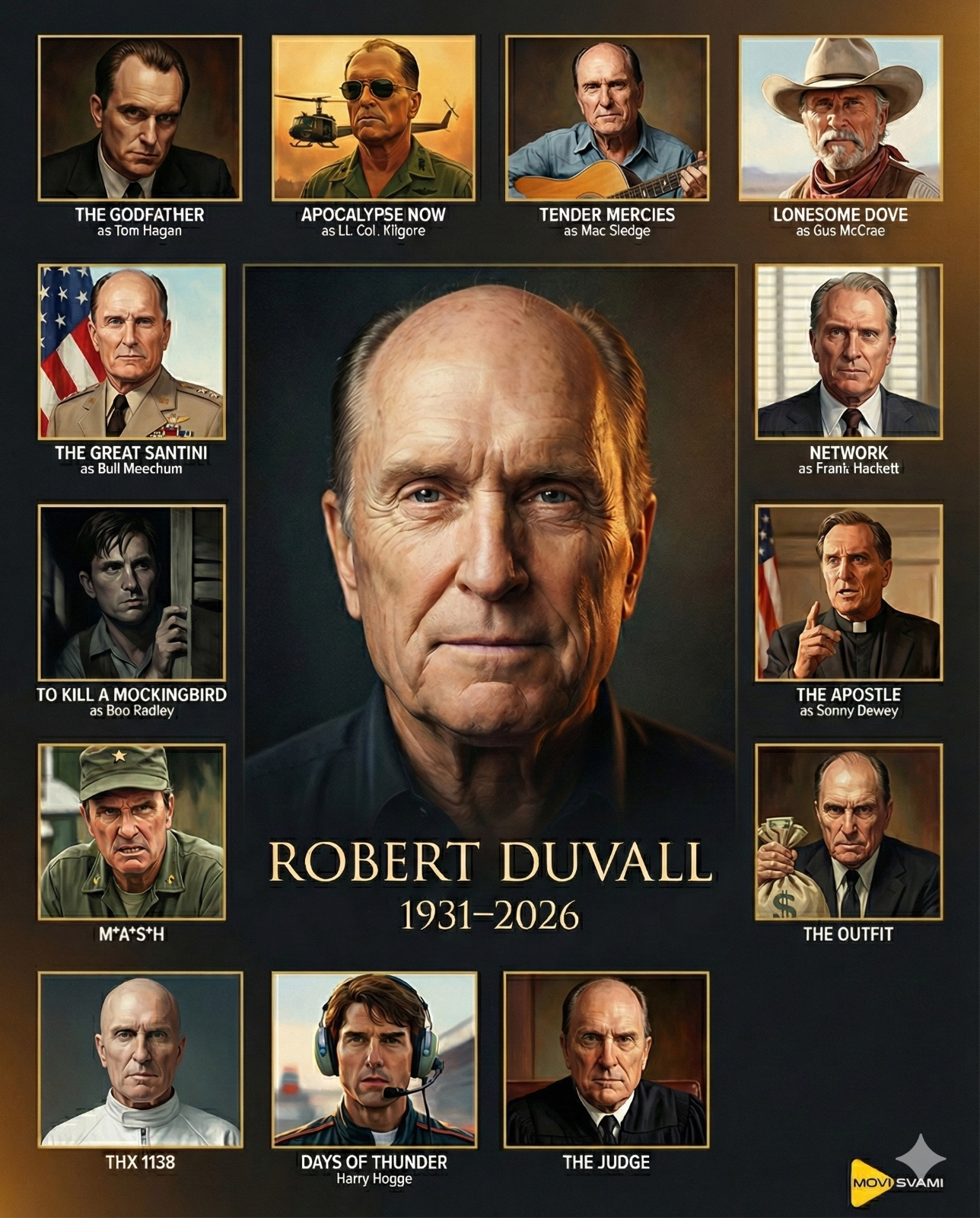
How do you play a man of supreme intelligence while everyone around you is shouting? Robert Duvall answered that question before most actors even understood it was being asked.
Picture the scene. The Corleone dining table. Michael has just returned from the war, still an outsider to the family business. Sonny bellows. Vito deliberates in shadows. And there, slightly to the side, watching with the eyes of someone who already knows how this ends — is Tom Hagen. The family’s consigliere. Not a Corleone by blood, but perhaps the most Corleone of them all in mind.
Tom Hagen does not raise his voice. He does not threaten. He is a lawyer, yes, but more than that — he is a man who understands that the most dangerous power in any room is the power that doesn’t need to announce itself. He absorbs information, calculates quietly, and when he speaks, the room goes still.
The scene that crystallises all of this happens not at the Corleone table, but in Hollywood. Hagen has been dispatched to persuade movie mogul Jack Woltz to cast Johnny Fontane in a war picture. At their first meeting, Woltz explodes — ethnic slurs, threats, bluster. Hagen barely blinks. He says he is a lawyer. He has not threatened anyone. He handles one client. He will wait for the call. And as he leaves, almost as an afterthought: “By the way, I admire your pictures very much.”
Woltz has Hagen checked out. Whatever comes back in that background check changes everything — suddenly the studio boss is a gracious host, walking Hagen around his magnificent estate, showing off his prize racehorse, pouring the finest wine. And it is during this newly civil stroll that Woltz, now eager to please, asks why Hagen didn’t simply name his boss from the start. Duvall delivers the response with complete stillness: “I don’t like to use his name unless it’s really necessary.”
Seven words. No threat. No elaboration. No raised eyebrow. Just a quiet statement of protocol from a man who understands that the Corleone name is not a card to be played — it is a weight, and you place it on the table only when the table needs to feel it. Woltz understands instantly that he has been managed, not merely visited. That is the line of a consigliere. That is Robert Duvall.
That was Robert Duvall. Not just in The Godfather, but across six extraordinary decades of cinema — a career that ended peacefully on February 15, 2026, when the great actor died at his farm in Middleburg, Virginia, at the age of 95. His wife Luciana, in a statement that carries the weight of his entire life’s work, wrote: “His passion for his craft was matched only by his deep love for characters. For each of his many roles, Bob gave everything to his characters and to the truth of the human spirit they represented.”
The truth of the human spirit. That was always his territory.
The Beginning: A Ghost Named Boo
Robert Duvall arrived on film the way Tom Hagen moved through rooms — without announcing himself, and yet impossible to forget.
His debut in To Kill a Mockingbird (1962) is, in retrospect, almost mythologically perfect as an entrance. He plays Boo Radley — the reclusive neighbor whispered about throughout the film, feared by the children, misunderstood by the town. Duvall appears for only a handful of minutes. He has no dialogue whatsoever. And yet, when he finally steps into the light, face pale and blinking, meeting the terrified eyes of young Scout with nothing but gentle wonder — it is one of cinema’s most quietly devastating moments.
Gregory Peck has just been magnificent as Atticus Finch. The courtroom scene is fresh in our memory. And yet it is the mute boy-man on the porch who stays with you. That should have told us everything about what kind of actor Robert Duvall was going to be. The actor who could outshine a legend without a single word.
The Actor Who Never Needed a Costume
There is a school of acting that announces itself. You know it when you see it — the dramatic weight gain, the prosthetic nose, the accent so thick you could cut it. These are not invalid choices. Some of the greatest performances in cinema history were built this way. But Robert Duvall belonged to a different tradition entirely, and understanding that tradition is the key to understanding why his work still feels so alive.
Duvall transformed through subtraction, not addition. A slight stoop of the shoulders for Boo Radley. A particular stillness of the hands for Tom Hagen. A specific way of carrying exhaustion in the body for Mac Sledge — not trembling hands or a red nose to signal the years of drinking, but the particular fatigue of a man who has been quietly at war with himself for a very long time. When asked about playing alcoholism in Tender Mercies, he was clear: he did not want to announce it through external device. The condition had to live in the accumulated weight of small things, in how a man rises from a chair, in how he receives good news as though not quite trusting it yet.
This is more difficult than it sounds. Physical transformation gives an actor somewhere to hide — the audience meets the character through the artifice, and the gap between actor and role is obvious and acknowledged. Duvall offered no such gap. He showed up, and the character was simply there. Watch him across his career and you will notice that he rarely looks dramatically different from film to film — and yet Earl Macklin in The Outfit could not possibly be confused with Harry Hogge in Days of Thunder, who could not be confused with Jerome Facher in A Civil Action. The differences are all interior, expressed through the body’s smallest vocabulary: where the eyes rest, when the jaw tightens, how much of the room a man chooses to occupy. He once said that acting, at its deepest level, is about listening — and you can see that in every role. Duvall’s characters are always receiving the world around them, processing it, responding from somewhere true. That is not a technique. That is a philosophy.
The Consigliere: Intelligence in a Suit
The Godfather (1972) is, by most measures, the greatest American film ever made. It is populated by giants — Brando, Pacino, Keaton, Caan. Every performance is heightened, mythic, operatic. And in the middle of all that operatic fire, Robert Duvall plays Tom Hagen like a still pond.
Tom Hagen is one of cinema’s great intellectual characters, and the difficulty of playing such a character is rarely appreciated. The audience knows he is brilliant — we see the evidence constantly — but how do you perform intelligence without performing it? How do you play a man who is always three steps ahead, without telegraphing those three steps to the audience?
Duvall’s answer was restraint so complete it became its own kind of power. Watch his eyes in the scene where Vito Corleone is shot. The entire apparatus of Hagen’s mind is visible — grief, calculation, threat assessment, loyalty — and none of it breaks the surface of his face. He is a lawyer. He is a fixer. He is a man who has traded his own will for the function of keeping a family’s empire intact. Duvall plays all of that without a single moment of self-pity or theatrical display.
This is what management consultants and business strategists spend careers trying to teach — the discipline of the consigliere, the art of counsel without ego. Robert Duvall lived it onscreen so completely that forty years later, when people want to illustrate what measured intelligence looks like under pressure, they reach for Tom Hagen.
He earned his first Academy Award nomination for this role. It would not be his last.
The Preacher, the Director, the Whole Show: The Apostle (1997)
If Tom Hagen represents Duvall at his most controlled, then Sonny Dewey — the Pentecostal preacher of The Apostle — represents the other side of his genius. This is Duvall not just performing but creating. He wrote the screenplay. He directed the film. He financed much of it himself when Hollywood wasn’t interested. And then he stood in front of the camera and unleashed one of the most electrifying performances of his career.
Sonny Dewey is a man of God who has done a terrible thing. He has struck his rival with a baseball bat and left him dying. Now he is on the run, reinventing himself as “The Apostle E.F.,” building a new church in rural Louisiana among people who don’t know his story. Is he a fraud? Is he redeemed? Is he both simultaneously?
Duvall refuses to answer those questions. He plays Sonny with the full complexity of a man who believes in his own salvation even while committing acts that might not deserve it. The preaching scenes are extraordinary — Duvall had spent years studying Pentecostal revivalism, attending services, absorbing the rhythms and fire of that tradition — and what you witness on screen is not an actor doing research. It is a man who has found something true inside an alien world and brought it back whole.
The Academy nominated him for Best Actor. He should have won. His willingness to risk everything on this passion project — financially, creatively, artistically — is the kind of courage that defines a career.
Speed, Noise, and the Steady Voice: Days of Thunder (1990)
Here is a film not often mentioned in the first breath of Duvall’s legacy, and perhaps that is fair — Days of Thunder is a Tom Cruise vehicle, a NASCAR action picture built around speed and spectacle. But watch what Duvall does as Harry Hogge, the legendary crew chief who shapes the young, reckless Cole Trickle into a real driver.
In a film full of roaring engines and dramatic crashes, Duvall is the engine you hear least and trust most. Harry Hogge is the voice of expertise — a man who has forgotten more about racing than his young protégé will ever know. Duvall brings to the role the same quality he brought to Tom Hagen: the authority of a man who has nothing to prove, and therefore no reason to be loud about it.
There is a particular kind of mentor that Duvall played throughout his career — the older man who has already walked the road, who knows where the dangerous curves are, who chooses when to warn and when to let the young one find out for themselves. Harry Hogge is that mentor. And even in a blockbuster designed to make audiences feel the adrenaline of 200mph racing, Duvall finds the human truth at the still center.
The Man Against the Machine: The Outfit (1973)
I will confess here: The Outfit is one of my personal favourites. Not just among Duvall’s early work — among any crime film of that era.
Directed by John Flynn and based on a Richard Stark novel, this lean neo-noir casts Duvall as Earl Macklin, a man who walks out of prison to discover that the mob organization known as The Outfit has murdered his brother. His brother’s crime? Robbing a bank that happened to be an Outfit front. Macklin’s response is not panic or grief — it is arithmetic. He calculates exactly what The Outfit owes him for the trouble, and then he proceeds to collect it, business by business, robbery by robbery, with the methodical patience of a man who has already decided how this ends.
This is Duvall in a mode that doesn’t get discussed enough — as a leading man of pure physical economy, carrying an entire film on the quiet authority of his presence. Earl Macklin is not a complex character in the literary sense. He has a code, he follows it, and he is very good at what he does. Duvall plays him with something close to a professional’s indifference — not cold, exactly, but operating at a temperature below sentiment. Opposite the late Robert Ryan as the mob patriarch Mailer, the film crackles with a generational tension: two men who understand each other perfectly, which is precisely why they cannot coexist.
Quentin Tarantino devoted a chapter to this film in his 2022 book Cinema Speculation, and Roger Ebert gave it three and a half stars, calling it “a classy action picture, very well directed and acted.” It has found devoted admirers in every decade since, and watching it you understand why. It is a film made without waste — like its leading man.
The Law, the Court, and the Weight of Guilt: A Civil Action (1998)
Jan Schlichtmann — played by John Travolta in A Civil Action — is the kind of lawyer who makes noise. He is performative, charismatic, hungry for both justice and glory. And across the courtroom from him sits Jerome Facher, played by Robert Duvall, a Harvard Law professor who treats the whole theater of litigation as mildly amusing.
Duvall won the Screen Actors Guild Award for this role, and watching the film you understand immediately why. Facher is the Cheshire Cat of the legal world — he is there, then not there, then there again, always somehow in control of a situation he appears to be barely attending to. He brings his lunch to court in a paper bag. He seems to take nothing seriously. And he wins, repeatedly, against a more passionate opponent, because he understands that the law is not about passion. It is about procedure, patience, and the willingness to outlast the other side.
This is perhaps the most unsentimental performance in a film that tempts its audience toward sentiment at every turn. Duvall refuses the temptation entirely. Jerome Facher is not a villain. He is not particularly admirable. He is a brilliant man doing his job within a system that rewards brilliance over justice. Duvall plays that with complete moral neutrality, and the result is one of the more disturbing performances in American legal cinema — disturbing precisely because there is nothing to condemn.
Father and Son: The Judge (2014)
In The Judge, Robert Downey Jr. plays Hank Palmer, a slick Chicago defense attorney summoned home when his estranged father — a small-town judge — is charged with murder. Duvall plays Judge Joseph Palmer, and the film is, at its core, a movie about what fathers and sons can never quite say to each other.
Duvall was 83 when he made this film. He earned his seventh Oscar nomination for it. And what he does with Judge Palmer — a man of absolute rectitude confronting both mortality and a specific accusation that threatens to undo his entire life’s meaning — is the kind of acting that requires not just technique but lived experience. There is a scene involving illness and dignity that is almost unbearable to watch, not because it is melodramatic, but because it is so specific and so completely without self-pity that it feels like something witnessed rather than performed.
The tension between Palmer and his son is the architecture of the film, and Duvall builds his side of it with a craftsman’s precision — placing each brick of stubbornness and pride and unexpressed love exactly where it needs to go so that when the walls finally come down, you feel the entire weight of what they held.
The Three Peaks: Apocalypse Now, Tender Mercies, The Great Santini
No tribute to Robert Duvall can end without acknowledging what may be the three greatest performances in a career full of great performances.
In Apocalypse Now (1979), Lt. Colonel Kilgore is the opposite of Tom Hagen — he is grandiosity incarnate, a man so possessed by his own mythology that he orders an airstrike to create surfing conditions and finds this perfectly rational. Duvall plays him not as a villain but as a man of complete internal consistency, and that is what makes him terrifying. Kilgore is not broken. Kilgore is working exactly as designed. The famous line — “I love the smell of napalm in the morning” — is not delivered as a punchline. It is delivered as testimony. Duvall earned his second Oscar nomination here, and the performance entered the permanent vocabulary of American cinema.
Tender Mercies (1983) won him the Oscar, and watching Mac Sledge — the washed-up country singer trying to reassemble a life around sobriety, a new wife, and a God he’s not sure deserves his trust — you understand what the Academy was recognizing. This is acting so quiet it barely breathes. Mac Sledge is not a man who explains himself. He does not make speeches about redemption. He shows up to the next day, and the next, and slowly, incrementally, you watch a human being choose to continue existing. Duvall did his own singing. Of course he did.
And The Great Santini (1979) — where he plays Marine Lt. Colonel Bull Meechum, the blustering military father who doesn’t know any language for love except dominance — is the performance that established him as a leading man on his own terms, earning his third Oscar nomination. Bull Meechum is a man the audience simultaneously wants to condemn and understand, and Duvall gives you both without resolving the tension. That unresolved tension is the whole point. Some fathers are like this. Some families live inside this storm. Cinema owes it to them not to clean it up.
What Duvall Leaves Behind
Robert Duvall’s family, in announcing his death, asked that those who wish to honor his memory do so by “watching a great film, telling a good story around a table with friends, or taking a drive in the countryside to appreciate the world’s beauty.” There is something deeply characteristic about this request. No ceremony. No monument. Just the thing itself — stories, shared, among people who care about each other.
He was one of the last survivors of the New Hollywood generation that also included Dustin Hoffman and Gene Hackman, his former roommates in a small New York apartment where three young actors who would reshape American cinema were trying to make rent. He came from a military family, served in the Korean War, studied under the legendary Sanford Meisner, and made his first film at the age of 31. He kept working until he was 91. He earned seven Oscar nominations and won once, though any honest accounting of his body of work suggests the number should have been higher.
But awards were never quite the point with Robert Duvall. The point was the character, the truth, the human spirit in its full and unedited complexity. Tom Hagen keeping his counsel. Boo Radley stepping into the light. Sonny Dewey preaching like a man who believes every word even while knowing what he has done. Mac Sledge choosing the next morning. Judge Palmer measuring his life against his legacy.
In Sanskrit, there is a concept — dhruva — meaning the fixed, the unwavering, the pole star that everything else navigates by. Robert Duvall was that for American cinema. While styles changed, while stars came and went, while Hollywood reinvented itself in cycles of spectacle and austerity, he remained — working, committed, unshowy, true.
He was 95. He died at home, surrounded by love.
Watch a great film tonight in his honor. He earned it.
Lakshmi Narayana is the founder of Directing Business Advisory and author of “Directing Business: Movies and Management Lessons for Dreamers.” He writes at the intersection of cinema, leadership, and the art of human judgment.