(Spoilers ahead)
Ever wondered if there were somebody out there who knew everything about you and connected at a different level? Yeah, you might feel like the completed couple in the elevator scene from ‘Jerry Maguire’. If you do, then beware. There is very good chance that he could either be a phony Phil from ‘Groundhog Day‘ or a scary Joe from ‘You’.
By the way, ‘You’ was in the news (or a PR plant) recently about how it received a lukewarm response on a TV channel, yet garnered just the opposite reaction aka standing (sitting) ovation from the audiences of Netflix. Viewed by 40 million accounts and accumulated a zillion views? Let’s leave these zeroes aside and look at the content of ‘You’, the recent Netflix TV series.
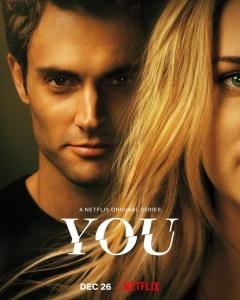
It’s about Joe, a criminal (and mentally deranged) disguised as a softie, a no-body book store manager, who is just getting over his recent break-up and hoping to find his true love yet again. And much to the misfortune of Beck, he finds her. In no time, he makes it a point to know everything about her. His tactics are simple, just get her smart phone and hack into her life. And whatever little is left out of the puzzle; fill it in through physical surveillance and following her. Creepy as hell!
What really hooks you on to the TV series is the smart writing and terrific portrayal of Penn Badgley. He reminds you of the skinny Robert De Niro in The Godfather II and delivers a knock out performance. (He even dresses up in overalls in the book store just like De Niro in the grocery store). He is brilliant in every scene that brings out the contrasting shades of the character…let it be his filial affection towards Pac or the absolute conviction for his behaviour towards Beck and her friends or the justification for his heinous acts or simply his shallow intellect. So, at the end of the every episode or atleast at the end of the season 1, you don’t want him to get caught or killed and you secrely goad him to go on, much like our beloved Walter White from ‘The Breaking Bad’. Speaking of which, Joe does remind you of the Chemistry Teacher turned Meth Don, when he expertly disposes of bodies and shows affinity towards cellars.
A few decades back Kamal Haasan starred in a psychological thriller ‘Sigappu Rojakkal’, in which he potrayed a handsome killer who buries the body of his victims in his backyard and grows a rose garden over them. (Pretty gruesome scenes, yet very enjoyable, thanks to a super score from Ilayaraja). The character aspect of wooing the girls would come out natural to Kamal with his looks and star persona, while the criminal aspect might have required some effort from him. But for someone like Penn Badgley, both are very difficult. The predicament is very similar to that of Robert De Niro, who had to convince the audience that he was the younger version of the most powerful don, when he had neither the persona of Marlon Brando or identification of any kind in the minds of the audience. Both Robert De Niro and Penn Badgley had to bring out something that isn’t there at their physical level and this is what great acting is all about. It’s the same with avuncular Bryan Cranston who transformed into Walter White. Class acting is one good reason to watch ‘You’.
‘You’ also is a good example of how to set up a premise and build on it without much fuss. It doesn’t go overboard with production design, limits itself to a few settings and focuses on the characters and their interplay. Your hero is a stalker for C****sake, so why take it beyond the bedroom, the closets and the cellars? The logic fits right in. But there are some interesting examples of creativity, like the theme parties in the book store or the various scenes in the cellar or the getaway of Peach Salinger.
You don’t want ‘You’ to end and Candace makes sure of it throughout and the end of the Season 1. Candace is ‘You’s equivalent of ’Rose bud’. Phil in ‘Groundhog Day’ changes his ways and wins over his girl, to live happily ever after. But no chance for Joe to redeem himself that soon, Netflix will cook a few seasons first.
Tailpiece: When my father was getting ready to play a professional killer role in a TV serial, one of his friends apparently asked how a medium built and rather soft looking person like my father would fit that role. Then a writer friend of his chipped in, saying that it is the portrayal that counts, not the physicality. He then went on to quote the example of the famous killer Charles Shobraj who looked anything but menacing and his external demeanour belied his inner demons.
Related Links
Netflix says its viewership is huge. The key words there are “Netflix says.”


