
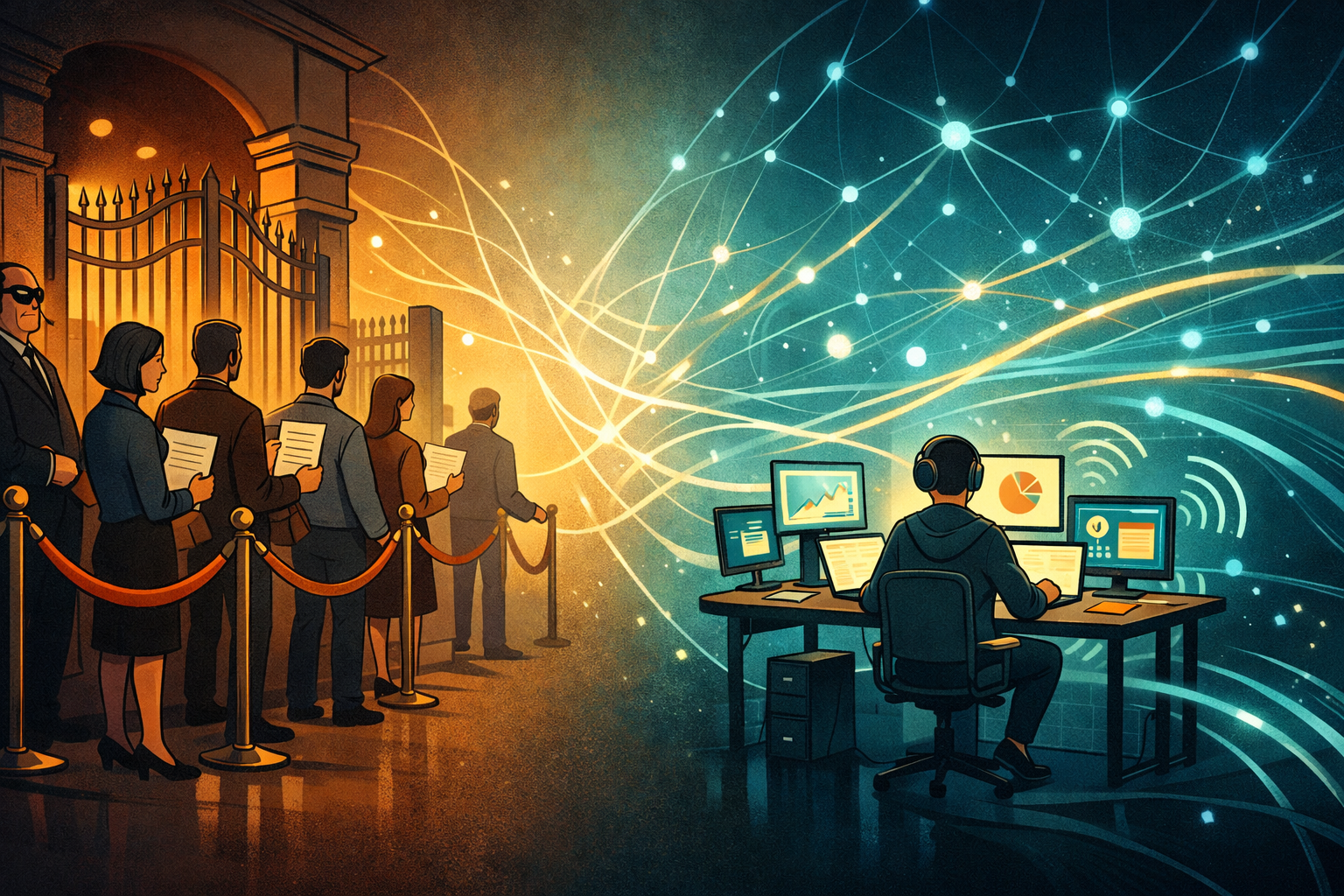
There was a time when growth was simple to understand.
You studied, you qualified, and you got in.
A school. A company. A network. A club.
Every step in life felt like moving from one gated space to another. You were either inside or outside. And the journey was about crossing those gates—one after the other.
Education moved you from the “uneducated” to the “educated.”
A degree moved you into the job market.
A brand name—say Harvard University—could open doors that were otherwise invisible.
This wasn’t accidental. It was structural.
Progress, as we knew it, was built on a simple pattern:
Exclusion → Qualification → Inclusion → Signaling
And society rewarded those who moved through these gates efficiently.
The Deeper Pattern: Even Philosophy Followed It
Interestingly, this wasn’t just about careers.
Even in traditional Indian thought, life itself was structured into phases—the Ashrama system:
- Brahmacharya (learning)
- Grihastha (building and contributing)
- Vanaprastha (gradual withdrawal)
- Sannyasa (renunciation)
Each phase represented a transition. A movement. A shift in identity.
While not rigidly enforced, the underlying idea was clear:
growth happens in stages, and each stage carries its own form of recognition.
Whether in corporate life or spiritual life, the pattern held.
Then Came AI—and Something Broke
What AI is doing is not just technological.
It is quietly dismantling the foundations of this model.
1. Time is no longer the same gatekeeper
What used to take years can now happen in weeks—or even days.
Learning, prototyping, building—these cycles are collapsing.
A person can move from idea to execution faster than ever before.
2. Knowledge is no longer scarce
Earlier, knowledge lived in institutions, books, or experts.
Today, it lives in conversations.
AI has turned knowledge into something you can interact with, not just consume.
You don’t “enter” the educated club the same way anymore.
3. Institutions are no longer the only validators
Degrees, titles, affiliations—they still matter.
But they are no longer the only signals.
A strong body of work, a sharp insight, a useful tool—these can travel faster and farther than a certificate.
From Clubs to Flows
If the old world was about entering clubs, the new world is about participating in flows.
There are no fixed gates. Only continuous movement.
Access → Experimentation → Output → Recognition → Repeat
You don’t wait to be included.
You build, share, and get noticed.
And then you do it again.
The Inversion That Changes Everything
In the old model:
Identity → Access → Output
You were someone first. Then you got access. Then you produced.
In the new model:
Output → Identity → Access
You create first.
Your work defines you.
And access follows.
This is a profound shift.
Ashrams, Reimagined
If we revisit the Ashrama idea through this lens, something interesting happens.
They are no longer stages.
They become modes.
On any given day, you might:
- Learn something new (Brahmacharya)
- Build something useful (Grihastha)
- Reflect on your work (Vanaprastha)
- Let go of what doesn’t matter (Sannyasa)
All at once.
Growth is no longer sequential. It is simultaneous.
What Still Remains
Not everything disappears.
We still have:
- Recognition
- Reputation
- Inclusion and exclusion
But the basis has shifted:
- From degrees to demonstrations
- From titles to artifacts
- From tenure to velocity
- From institutions to platforms
So What Should One Do?
If the gates are fading, the question is no longer:
“Which club should I enter?”
The better question is:
“What can I build that creates value—and attracts attention?”
Because in this world:
- Your work is your signal
- Your output is your identity
- Your consistency is your leverage
Closing Thought
In The Social Network, the protagonist doesn’t try to get into the right club.
He builds one.
And suddenly, everyone else wants in.
That, perhaps, is the real shift of the AI era.
From seeking inclusion… to designing inclusion.
🔑 Key Takeaways
- Growth is moving from gated progression → continuous flow
- AI compresses time, access, and execution
- Output is becoming the primary signal
- Life stages are becoming parallel modes
- The real leverage lies in building, not waiting