“In my experience, the more you know about something, the less you fear it.” – from the film The Martian
There is a scene in The Martian where Mark Watney survives not by writing strategies in a PowerPoint deck, but by literally getting his hands dirty—growing potatoes in Martian soil, hacking equipment, and fixing things one bolt at a time. That line about knowing more and fearing less captures something essential about being hands on: proximity to the work gives both control and clarity.
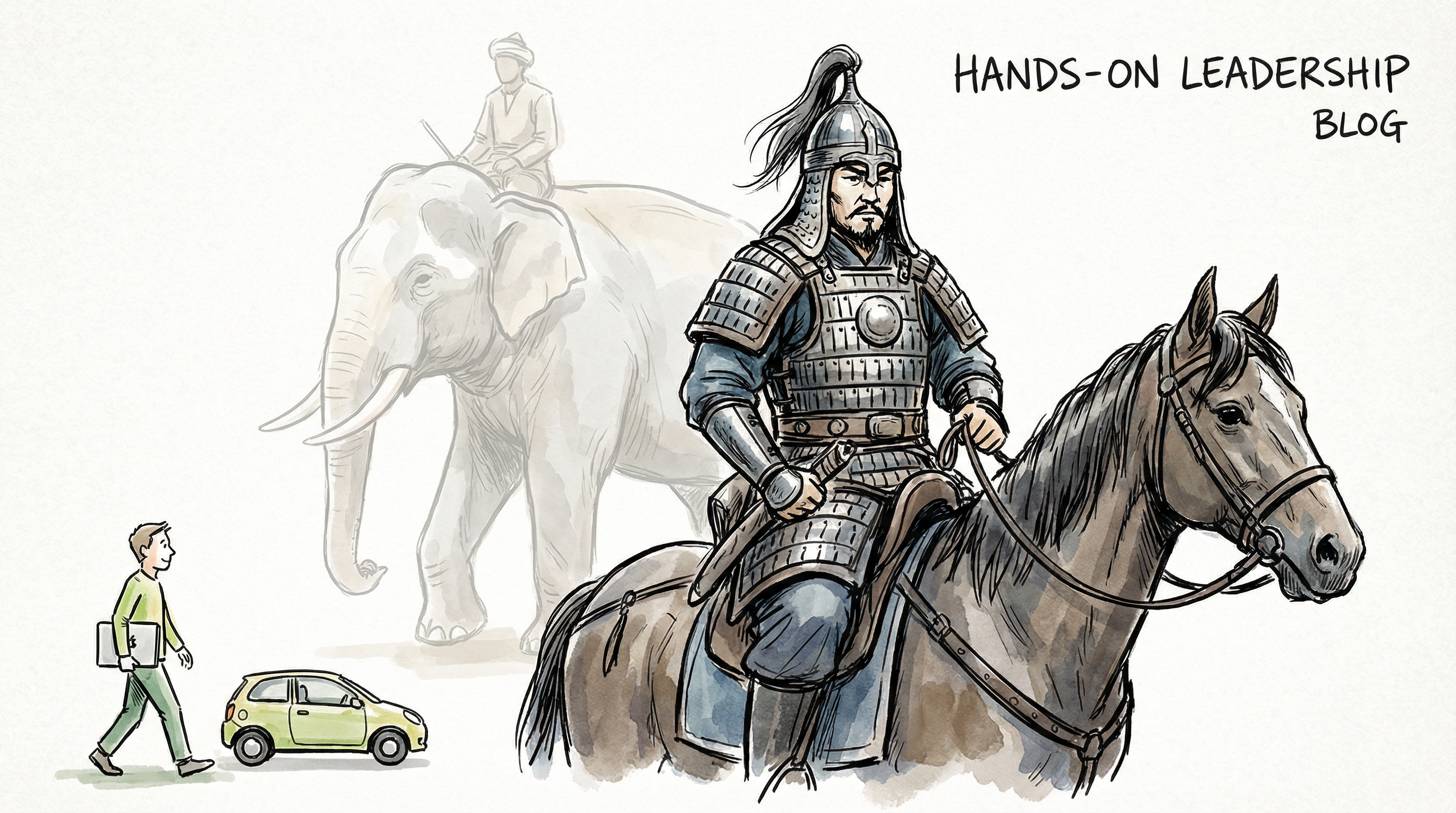
An ex–Income Tax officer, a long-standing RSS member who was helping me find clients in my early startup days, once shared an anecdote about Babur that stayed with me. He told me that an RSS article had described how Babur preferred horses over war elephants, seeing elephants as powerful but harder to control because they depended on someone else to handle them, while cavalry gave him more direct, agile command in battle. This interpretation fits Babur’s campaigns in India, where he relied heavily on fast cavalry and firearms rather than elephant corps, and it offers a vivid metaphor for how we choose our tools and roles in modern work.
He made this point while watching me being driven around by my driver at a time when I was actually struggling for work, with more free time than assignments. I still have a driver, but that moment poked a hole in my comfort zone. It forced me to ask a difficult question: was I building a life of horses I could ride, or elephants that always needed someone else to move?
Since then, I have tried to be deliberately hands on in every role. As a project manager, that meant writing code myself, not just tracking timelines and updating status reports. As a digital cinema head, it meant standing inside theatres during installations, understanding how projectors, servers, and sound systems actually came together to create the experience on screen. As a digital head, it meant personally uploading videos and posting on social media instead of only approving campaigns from a distance. And now, it means writing code again—this time with AI applications as my “horses,” responsive tools that move where I nudge them, instead of “elephants” that someone else has to prod into motion.
There is a catch, though. Being hands on can slowly turn into being trapped in the weeds: replying to every email, touching every file, sitting in every meeting. You feel productive and in control, but the bigger picture—market shifts, long-term risks, strategic bets—starts to blur. The same closeness that gives confidence can also shrink your field of vision if you never step back.
So the balance, for me, is this: hands on is still the way to go, but not at the expense of perspective. The goal is to stay close enough to the work that you understand its texture and constraints, yet far enough back that you can see the whole battlefield and choose where to charge. Babur may have preferred horses to elephants, but he still needed a vantage point from which to see his entire army and the shape of the enemy line.
That is the leadership posture worth aiming for: one hand on the reins, the other pointing toward where everyone needs to go.
In a world obsessed with hustle culture, social-media validation, and endless striving, true fulfillment often feels just out of reach. What if the secret isn’t in acquiring new goals but in letting go of old attachments? What if suffering—rather than something to avoid—holds the key to meaning?
Drawing on the wisdom of Harvard’s Arthur C. Brooks, Jordan Peterson, and Holocaust survivor Viktor Frankl, this post explores a counterintuitive truth:
Happiness isn’t a destination. It’s the byproduct of a meaningful life.
The Trap of Endless Wanting: Arthur C. Brooks’ Reverse Bucket List
Arthur C. Brooks, Harvard professor and co-author of Build the Life You Want, discovered that achieving every milestone on his bucket list didn’t deliver lasting satisfaction. He describes reaching his 50s with career prestige, financial stability, and global recognition—yet feeling surprisingly empty.
Why? Because the brain is engineered for survival, not sustained bliss. Every achievement quickly becomes the new baseline, fueling the “hedonic treadmill.”
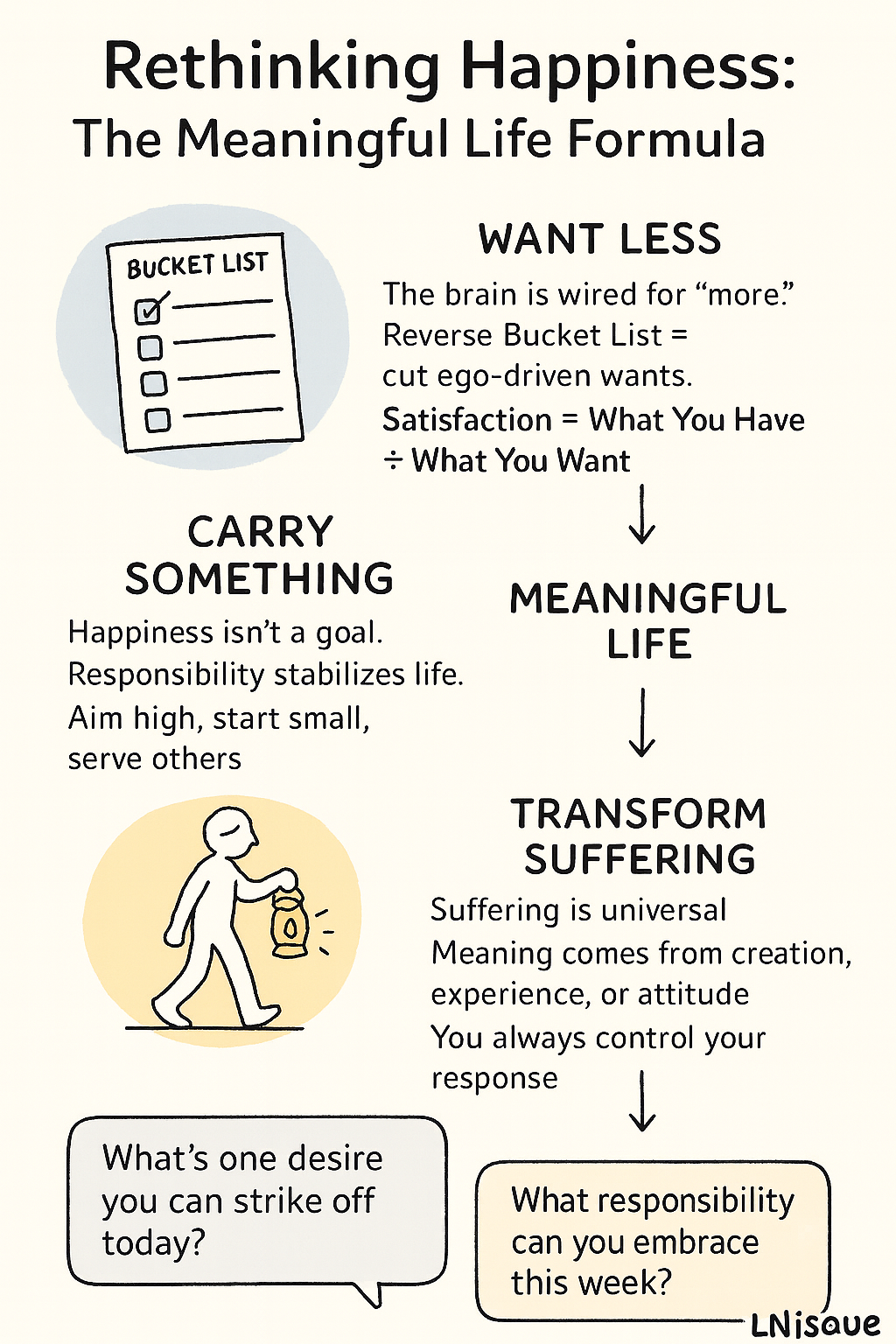
Brooks proposes a simple antidote: the reverse bucket list.
Instead of writing down what you want next, you list the desires that are controlling you—especially those tied to ego, comparison, and status. Then you cross them out.
His formula explains why this works: Satisfaction = (What You Have) / (What You Want) Reduce the denominator, and satisfaction increases.
How to Make One
Sit quietly and list 5–10 ego-driven wants.
Strike through each, saying: “This no longer owns me.”
Refocus on Brooks’ four stable pillars: purpose, family, friendship, and meaningful work.
As Brooks puts it: “Intention is fine, but attachment is bad.”
The Four False Idols: Modern Substitutes for Fulfillment
Brooks draws from St. Thomas Aquinas to identify four distractions that distort our pursuit of happiness: money, power, pleasure, and fame. They appear promising because they satisfy old evolutionary drives—but they ultimately leave us emptier.
Idol
Core Drive
Pitfall
Detachment Tip
Money
Security
Endless comparison
Practice daily gratitude.
Power
Control
Resentment & fear
Empower others.
Pleasure
Escape
Short-lived highs
Pair pleasure with purpose.
Fame
Validation
External identity
Limit metrics & comparison.
Identifying your dominant idol is the first step toward loosening its grip.
Jordan Peterson: Why Happiness Cannot Be the Goal
If Brooks offers gentle tools for detachment, Jordan Peterson offers stark realism:
“Life is suffering.”
In 12 Rules for Life, Peterson argues that happiness is too unstable to serve as a life’s aim. Pain lasts longer than pleasure, chaos is guaranteed, and the brain evolved to prioritize survival over joy.
What sustains us is not momentary happiness but responsibility.
Peterson’s philosophy condenses into six practical principles:
Aim high at something noble.
Take responsibility—begin with manageable order (“clean your room”).
Confront suffering instead of avoiding it.
Tell the truth, including uncomfortable truths about yourself.
Serve others to escape self-absorption.
Commit to the good, even when the world feels irrational.
A bridge to Frankl
Peterson’s core insight mirrors an older philosophical truth: Suffering is universal—and meaning is what transforms it.
This sets the stage for Viktor Frankl.
Viktor Frankl: Meaning as Humanity’s Lifeline
Viktor Frankl, Jewish psychiatrist and Auschwitz survivor, developed logotherapy, a system built on the idea that humans are driven not by pleasure (Freud) or power (Adler), but by meaning.
In Man’s Search for Meaning, Frankl observes that those who endured the camps were often those who held onto a purpose—future work, a loved one, or a belief worth suffering for.
Frankl identifies three sources of meaning:
Creation — contributing or building something.
Experience — love, beauty, nature, art.
Attitude — choosing your response to suffering.
One of his most influential tools is paradoxical intention, a technique where you intentionally exaggerate the fear or symptom causing anxiety. By leaning into it, the fear loses its power.
Simplified Example
Insomnia: attempting to stay awake rather than trying to force sleep, which removes pressure and allows sleep to return naturally.
Frankl also emphasizes dereflection (shifting attention away from the self) and Socratic dialogue (questioning your beliefs to uncover deeper meaning). These tools help people navigate grief, trauma, and existential despair with dignity and agency.
A Unified Path Forward
Together, Brooks, Peterson, and Frankl offer a three-step blueprint for a meaningful life:
1. Want less. Detach from ego-driven desires (Brooks).
2. Carry something. Take responsibility for something that matters (Peterson).
3. Transform suffering. Choose your attitude and meaning (Frankl).
The world in 2025 may feel chaotic, but meaning is always available. Frankl survived unimaginable suffering by envisioning a future rooted in purpose. We cannot choose our circumstances, but we can always choose our response.
Your Turn: A Simple Reflection to Begin Today
Take a moment and answer:
1. What’s one desire you can strike off your reverse bucket list today?
2. What’s one responsibility you can embrace this week that moves you toward meaning?
Share your reflection below—your insight may help someone else begin their journey too.
Introduction: Ancient Wisdom for Modern Leadership
In an era defined by volatility, ambiguity, and profound ethical complexity, modern leaders are often left searching for a stable foundation upon which to build resilient teams and sustainable organizations. The conventional playbooks, focused solely on short-term outcomes and external metrics, frequently fall short. It is in this environment that turning to timeless wisdom is not a retreat from the contemporary world, but a strategic move toward a more powerful and sustainable form of engagement.
This manual is built on the premise that the ancient philosophy of Karma Yoga, a core tenet of the Bhagavad Gita, offers a remarkably relevant framework for today’s leadership challenges. Karma Yoga is not about renouncing professional life or retreating from ambition. Rather, it is a sophisticated system for engaging with the world more effectively. It provides a path to purposeful action, mental equanimity, and profound influence, grounded in a deeper understanding of our role and responsibilities.
The objective of this manual is to translate these profound principles into a practical and actionable guide. It is designed for leaders who seek not just to succeed, but to lead with integrity, to build resilience in themselves and their teams, and to elevate their impact from mere management to true stewardship.
——————————————————————————–
1. The Foundational Principle: The Inevitability of Action
For any individual in a position of leadership, action is the fundamental state of existence. It is a continuous and unavoidable reality. Every decision made, every email sent, every conversation held—and even the conscious choice to refrain from these—constitutes an action with tangible consequences. The notion of true “inaction” is an illusion.
The core teaching of Karma Yoga begins with this powerful realization. The mind and body are in a state of perpetual activity; there is no moment of genuine inactivity. Even a thought is a form of action, setting in motion a cascade of internal and external events. This understanding is the bedrock of conscious leadership.
“To think is to act. In my body, every cell is active and mind is never inactive. Action is therefore an unavoidable reality of our existence.”
The implication for a leader is profound and clarifying. Since action is constant, the critical choice is not whether to act, but how to act. The primary responsibility of a leader, therefore, is to bring deliberate awareness and clear intention to this continuous stream of actions. This shift in perspective moves the focus from anxiously deciding what to do next to consciously deciding how to be in every moment of doing.
If action is indeed inevitable, what quality of action leads to the most effective, ethical, and sustainable outcomes?
2. The Art of Selfless Action: Redefining Success with Nishkama Karma
The conventional model of leadership is often fueled by a deep-seated attachment to results. This attachment—to profit margins, to promotions, to praise, to a specific vision of success—is a primary source of anxiety, burnout, and compromised ethics. Nishkama Karma, or the principle of selfless action, presents a powerful alternative that redefines success and liberates the leader from this volatile cycle.
The principle of Nishkama Karma is the practice of performing one’s duty with absolute excellence while relinquishing attachment to the outcomes. This does not mean acting without self-interest, but rather acting without being psychologically enslaved to the outcomes of your actions. The focus shifts entirely from the “fruit” to the quality of the action itself. The core operational instruction is to act asakttah—to perform one’s duties with full commitment, but without attachment.
This approach is not a passive acceptance of fate; it is a strategic framework for peak performance and mental clarity.
Outcome-Attached Leader
Process-Oriented Karma Yogi Leader
Focus: Primarily on personal gain, recognition, and specific results.
Focus: On the quality, integrity, and excellence of the action itself.
Emotional State: Experiences high anxiety, fear of failure, and emotional volatility tied to outcomes.
Emotional State: Maintains equanimity and mental clarity, leading to better decision-making under pressure.
Decision-Making: Prone to short-term thinking and ethical compromises to secure a desired result.
Decision-Making: Able to make objective, long-term strategic choices based on principles and duties.
Outcome Vs Process
The organizational benefit of this approach is immense. When a leader demonstrates equanimity in the face of both success and failure—because they are detached from the “fruits”—they signal to the entire organization that the process of striving, learning, and acting with integrity is what is truly valued. This cultivates a culture of deep psychological safety. It removes the existential threat associated with failure and creates the conditions for genuine innovation, empowering teams to perform at their best without the paralyzing fear of being punished for an undesirable outcome.
This raises a deeper question: if the leader’s focus is on the action itself, not the results, then who is truly the agent of that action?
3. Deconstructing Agency: The Leader as a Conscious Instrument
A primary pitfall in leadership is the trap of the ego, or ahankara—the persistent feeling that “I am the doer.” This belief, while seemingly a source of strength, is actually a cause of great fragility and burnout. Understanding the true source of action is the key to developing profound humility and unshakeable resilience.
This philosophy does not advocate for “no action,” which is an impossibility. Instead, it guides the leader to realize their true nature as “actionless awareness”—a state of pure consciousness that witnesses action without being entangled by it. This true Self is the Atma. The actions themselves are carried out by prakriti—the dynamic field of nature and organizational life. The ego’s fundamental error is to claim authorship, to falsely believe, “I alone achieved this,” or “I alone am to blame for this failure.”
Think of the Self as the silent, unshakeable movie screen, while prakriti (the organizational dynamics, market forces, and team actions) is the movie being projected upon it. The ego’s mistake is believing it is the movie, experiencing every twist and turn as a personal crisis. The Karma Yogi learns to identify with the screen—aware, present, and unaffected.
This is not an abstract concept but a practical diagnostic tool, because prakriti operates through three constituent forces or gunas:
Sattva: The quality of clarity, balance, harmony, and purpose.
Rajas: The quality of action, ambition, passion, and agitation.
Tamas: The quality of inertia, obscurity, resistance, and confusion.
A leader who understands this framework can analyze challenges not in personal terms, but as an interplay of these forces within their team, their market, and themselves. This mindset shift offers powerful benefits:
Reduced Burnout: By depersonalizing failures and successes, the leader avoids the emotional exhaustion that comes from carrying the entire weight of the organization. Setbacks are seen as systemic data, not personal indictments.
Enhanced Collaboration: This mindset fosters a deep appreciation for the contributions of every team member and the complex interplay of the gunas. Outcomes are understood as a collective result, dismantling the silos created by ego.
Greater Humility: It grounds the leader, preventing the arrogance that can accompany success and the despair that often follows setbacks. This humility makes them more approachable, open to feedback, and ultimately, more effective.
This internal understanding of agency is the foundation for maintaining external balance, regardless of the outcome.
4. The Leader as an Exemplar: The Duty of Setting the Standard (Lokasangraha)
A leader’s influence extends far beyond their direct reports or official duties. Every action, decision, and emotional response is observed, interpreted, and often emulated, creating the cultural blueprint for the entire organization. This immense power comes with a profound and non-negotiable responsibility.
The principle of lokasangraha teaches that a leader (shresthudu) has a sacred duty to act with impeccable integrity for the welfare and stability of the collective. The ancient wisdom states, “what a great person does, others follow.” A leader’s actions set the standard for what is acceptable, what is valued, and what is condemned within the culture. This is the essence of leading by example.
Imagine a company facing a significant crisis. One leader, driven by ahankara (ego) and Kama (the desire to protect their status), chooses a path of secrecy and blame. This action teaches the organization that self-preservation trumps integrity. Another leader, practicing Nishkama Karma, is detached from the personal outcome of the crisis. Having mastered Krodha(anger), they do not need to find a scapegoat. They choose radical transparency and public accountability, setting a powerful precedent that honesty, courage, and collective responsibility are the organization’s true north. The first leader weakens the system; the second strengthens it for generations to come.
This duty is absolute. Even a leader who may feel they have earned the right to be “above the rules” must adhere to the highest standards. Their every move is under a microscope, and any deviation is seen as permission for others to do the same. This responsibility is not a burden but a potent tool for shaping a healthy, ethical, and high-performing culture. To uphold these external standards, however, a leader must first win the critical battles within.
5. Mastering the Inner World: Conquering the Twin Obstacles of Desire and Anger
The most critical battleground for any leader is their own internal landscape. Brilliant strategies and talented teams can all be undone if a leader’s judgment is clouded by internal turmoil. To act with clarity and wisdom, a leader must first learn to master the powerful forces within their own mind.
Karma Yoga identifies two primary enemies of wise leadership, born from the agitated state of rajas guna: desire (Kama) and anger (Krodha). The source texts do not treat these lightly; they are described with grave intensity. Kama is mahasana (all-devouring) and mahapatma (a great sinner)—an insatiable fire that consumes clarity, hijacks purpose, and envelops wisdom like smoke covers a flame.
In a modern leadership context, these forces manifest in predictable ways:
Desire (Kama): This is the ravenous craving for a specific outcome, an attachment to status, or an unchecked need for recognition. It leads to biased decisions, favoritism, and a willingness to take unethical shortcuts to secure a coveted result.
Anger (Krodha): This is the destructive frustration that erupts when desires are thwarted. It appears as impatience, the creation of a blame culture, and communication that erodes trust. Anger is the toxic byproduct of unfulfilled attachment.
To master these forces, the philosophy offers a clear operational schematic—an internal chain of command for self-regulation:
The Self (Atma) is supreme, the silent witness.
The Intellect (buddhi) is its chief executive, capable of discernment.
The Mind is the restless manager, subordinate to the intellect.
The Senses are field agents, reporting to the mind.
The undisciplined leader allows the senses and mind to run the show, reacting impulsively to every stimulus. The Karma Yogi leader uses their buddhi to establish clear command. They observe the rise of desire or anger not as a directive for action, but as data from the field. This pause allows the intellect to intervene, choosing a response aligned with duty and principle, not impulse.
This internal mastery is the final piece of the puzzle, enabling a leader to perform effective, selfless, and influential action in the world, free from the distortions of ego.
——————————————————————————–
Conclusion: Leading as Action in Awareness
The path of the Karma Yogi Leader is a transformative journey from reactive management to conscious stewardship. It is built on a series of profound yet practical principles: recognizing that action is inevitable, which places the focus on the quality of our engagement; understanding that true power lies in detachment from results, which frees us to act with clarity and courage; deconstructing the ego’s illusion of being the “doer,” which fosters humility and resilience; accepting the solemn duty to lead by example, which shapes an ethical culture; and finally, mastering the inner world, which is the ultimate foundation for wise leadership.
This framework is not a restrictive doctrine but a liberating path. It offers leaders a way to navigate complexity with a steady mind, to inspire teams with authentic integrity, and to build organizations that are not only successful but also sources of human flourishing. It is the art of leading as a form of conscious action in a state of profound awareness.