Forget What You Know About GTM: 5 Insights on Why Your Next Hire is an Engineer and Your Best Tool is a Whiteboard

In an era of rapid technological advancement, Go-To-Market (GTM) strategy has become more complex and strategically important than ever. The rise of AI is not just creating new tools; it’s forcing a fundamental re-architecture of how companies find, win, and retain customers. To navigate this new landscape, leaders are looking for proven, practical insights.

Jean Grosser is one of the world’s most respected GTM leaders. As COO at Vercel and the former Chief Product Officer at Stripe, where she built their early sales team from the ground up, she has a unique vantage point on what works. This article distills five principles from her recent conversation on Lenny’s Podcast that form the foundation of a new GTM playbook—one where AI-driven leverage and human-centered experience are not competing forces, but two sides of the same coin.

1. The “Go-To-Market Engineer” is Here, and They Have 10x Leverage

A new, high-leverage role is emerging that combines deep technical prowess with a GTM mindset: the Go-To-Market Engineer. This role is responsible for using AI and code to re-architect core GTM workflows, unlocking massive efficiency gains.

At Vercel, this is not a theoretical concept. The company’s first GTM engineers were drawn from its technical sales team—former front-end developers who had transitioned into sales engineering. One of these engineers, spending only about 30% of their time over six weeks, built an AI “lead agent.” The results were immediate and profound: the agent enabled one Sales Development Representative (SDR) to do the work of ten. The company reduced its inbound team from 10 people to a single person who now functions as a quality assurance manager for the AI agent. The ROI is staggering: an annual cost of $1,000 to run the agent, replacing over a million dollars in salary—a 99%+ reduction in cost.

This case study demonstrates not only the incredible leverage AI offers, but also the speed at which it can be deployed to solve core GTM challenges.

“before we did that move I mean the other thing that’s just incredible about this is the person who built the lead agent was a single GTM engineer he spent maybe 25 30% on his time of his time on this uh it was 6 weeks before we felt confident going from 10 to one so it wasn’t like this was a multi-quarter process it actually moved super quickly”

2. Think of Go-To-Market as a Product

As technical differentiation between products narrows, the experience of being sold to is becoming a primary factor that drives buying decisions. Grosser argues that the most effective GTM strategies are designed like a product, focusing on creating a customer journey filled with unique, human, and personalized experiences rather than flat, transactional interactions.

Grosser’s time at Stripe provides a masterclass in this product-led GTM approach. Instead of running a typical “discovery” call where a salesperson quizzes the potential customer, the first meeting was designed as a collaborative whiteboarding session. The customer would be invited to draw their payments architecture. This simple shift provided Stripe with deep insights, but more importantly, the customer left the very first meeting with a valuable, tangible asset they co-created—an architectural diagram they often hadn’t created themselves.

This approach transforms the sales process from an extractive one (getting information) to a value-creating one at every single touchpoint.

“we buy a lot of things because of how we feel about them… the experience that you have of being sold to will increasingly actually differentiate a company and drive buying decisions if products are only different at the margin”

3. Your Customers Are Buying to Reduce Risk, Not Just to Gain Upside

A common mistake, especially for founders, is to get excited about selling the “art of the possible”—the grand future vision of what their product can enable. While this message resonates with other founders and visionaries, it’s not what drives most buying decisions. Grosser shared a counter-intuitive but critical statistic: “80% of customers buy to avoid pain or reduce risk as opposed to… increase upside.”

Enterprise customers, in particular, are motivated by de-risking their operations. They are trying to avoid the pain of missing revenue targets, being outcompeted, or suffering brand damage. A sales message focused on providing certainty and mitigating these risks is often far more powerful than one focused on potential future gains.

This psychological insight is a direct challenge to the visionary founder’s default pitch and a crucial reminder of what truly motivates the enterprise buyer.

“80% of customers buy to avoid pain or reduce risk as opposed to increase upside which is a good thing for startup founders to understand we all love to talk about the art of the possible… but that’s often really a sale that’s going to resonate with another founder”

4. AI Can Tell You Why You’re Really Losing Deals

Human perception is often flawed, especially when it comes to understanding why a deal was lost. Vercel’s internal “Dealbot” provides a powerful case study in using AI to find the ground truth. This custom agent analyzes Gong transcripts, emails, and Slack messages to deconstruct sales opportunities.

In one powerful example, an account executive reported that a major deal was lost on price. After the Dealbot analyzed all communications, however, it came to a different conclusion. The AI determined the real reason was an “inability to demonstrate value.” It found that the salesperson never truly connected with the economic buyer and, crucially, that “when you talked to somebody about ROI and total cost of ownership it was clear from their reaction that they didn’t really buy your math.” The insight shifted from a generic excuse to a highly actionable critique: our ROI models are not credible. The tool has since evolved from a retrospective “Lostbot” to a real-time “Dealbot” that feeds insights into Slack channels, helping reps course-correct mid-process.

This highlights a critical truth: human perception is biased, but data-driven AI can provide the objective feedback needed to debug a failing sales process.

“the biggest loss that quarter uh according to the account executive was lost on price and when you ran the agent over every Slack interaction every email every gong call it said actually you lost because you never really got in touch with economic buyer… so really the reason we lost was an inability to demonstrate value”

5. The Calculus on Build vs. Buy for GTM Tooling Is Changing

The key learning from Vercel’s experience building powerful internal AI agents is that it’s “not that hard” and “not that expensive.” This insight challenges the traditional “buy over build” mentality for GTM software.

The evidence is compelling: the initial “Lostbot” was created in just two days, and the more complex “Lead Agent” took one person only six weeks of part-time work. Grosser believes the real value—the “alpha”—lies in building your own agents. The reason is that your company’s “own esoteric context, your content, your workflow is really key to unlocking the power of the agent.” Custom-built tools can be precisely tailored to your unique data and processes in a way that off-the-shelf software cannot.

This approach signals a potential sea change in how companies source GTM technology, prioritizing bespoke advantage over off-the-shelf convenience.

“I think one of our learnings is that it’s not that hard to build these agents and they aren’t that expensive either… I think there’s real value in experimenting with your own internal agent development… because you may find that it’s meaningfully easier than you think and you get returns pretty quickly”

Conclusion

The principles of Go-To-Market are undergoing a paradigm shift. The five takeaways from Jean Grosser are not isolated tactics but interconnected pillars of a new, cohesive strategy. It creates a powerful feedback loop: the GTM Engineer (1) builds custom AI tools (5) that surface objective truths humans miss (4). This frees up the team’s capacity to move beyond transactional sales and instead design memorable, value-added experiences (2) that provide the certainty and risk reduction modern customers crave (3).

This new model is defined by the intelligent application of AI, a product-centric approach to the customer journey, and a deep understanding of the psychology that drives modern buyers. It leaves us with a critical question to consider: As AI agents become increasingly capable co-workers on our sales teams, what uniquely human skills will become the most valuable differentiators in the future of Go-To-Market?

Reference: Lenny’s Podcast–>https://www.youtube.com/watch?v=RmnWHz8HD74
Engaged, Then Drifting Away: Watching Dude in the OTT Age

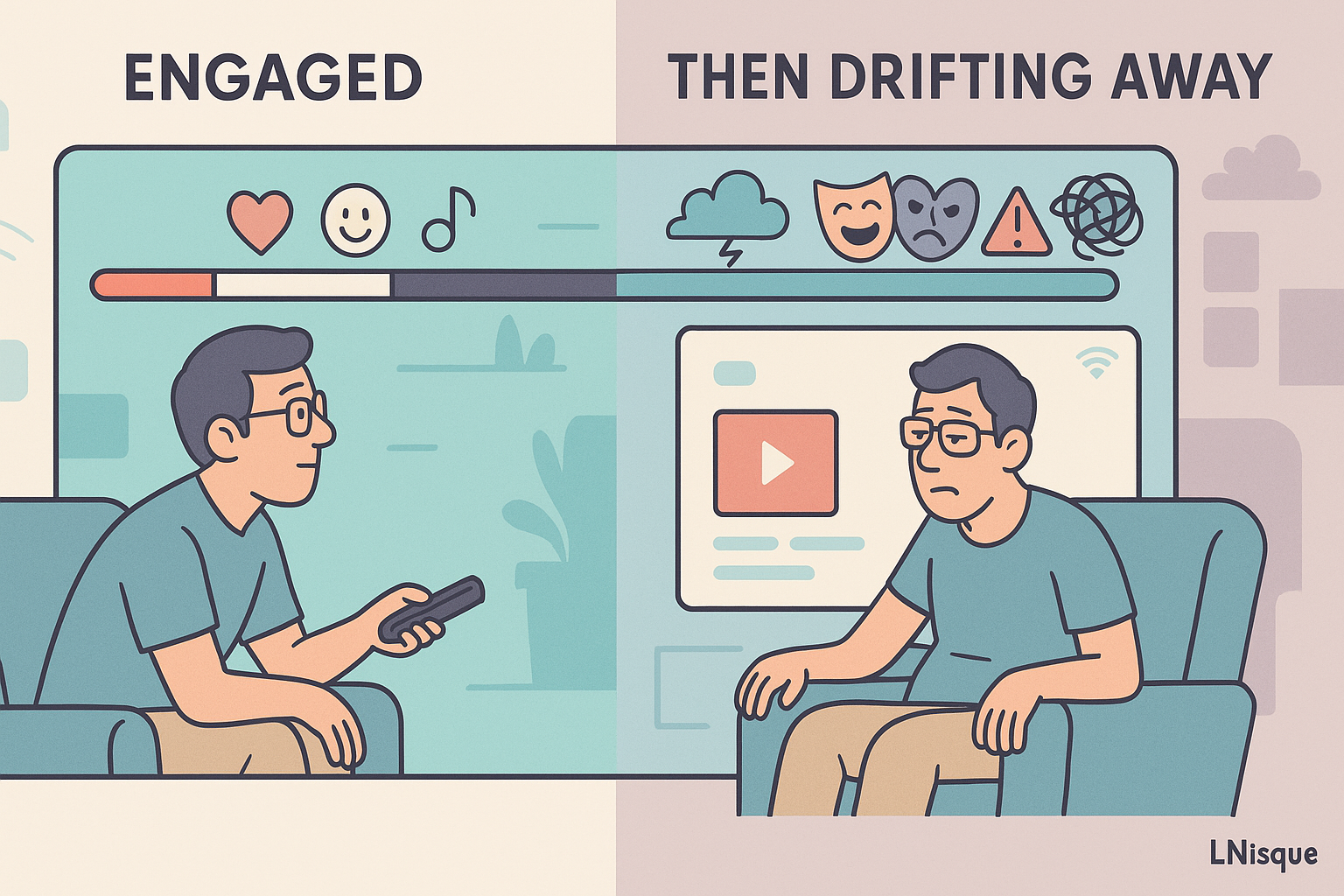
image by author and ChatGPT

I watched Dude on Netflix, got fully pulled in, and then slowly drifted away. The first half felt fresh and familiar; the second half drowned in twists and moral weight. This is less a review and more a look at what Dude reveals about where mainstream South Indian cinema stands in the OTT age.


I watched Dude on Netflix and realised my own reaction mirrored the film’s treatment of its characters — I leaned in, got involved, and then slowly drifted away.

For a good stretch, I was engaged. The energy felt contemporary, the situations recognisable, the performances easy to invest in. And then the film started doing what a lot of mainstream South Indian cinema does when it runs out of discipline but still wants an emotional high:

  • inconsistent characterisation,
  • unnecessary twists,
  • a dragging second half,
  • and a slightly helpless attempt to force a denouement before the runtime expires.

This post is less a formal “review” and more a reflection: why did Dude hook me initially and then lose me, and what does that say about where our cinema is right now?


Where Dude Worked for Me

To be fair, Dude gets several things right in the first half.

  • The world feels familiar. The college/youth environment, the conversations, the casual banter — this is not the old template of cardboard classmates waiting for a hero entry. It feels closer to the people you actually know.
  • Pradeep Ranganathan’s presence helps. He has that “I’ve met this guy in real life” quality. As a slightly confused, overthinking protagonist, he fits the part without trying too hard to be a “mass hero.”
  • The humour is loose, not forced. The film doesn’t rely only on punch dialogues. There are stretches where the interactions feel like natural extensions of how urban youth talk today.
  • The music is sticky. You can see why the songs travelled independently. They carry mood, they add momentum, and they are clearly engineered for a reel-first world.

At this stage, I was perfectly willing to accept the usual commercial liberties.

Mainstream South Indian cinema has always had an unwritten deal with the audience:

You give me energy and emotion; I’ll forgive your shortcuts with logic, probability, and geography.

For a while, Dude honours that contract.


Where It Started Losing Me

The slip happens when the film tries to scale up from “relatable youth rom-com” to “heavy social drama” — and wants to cover love, guilt, abortion, family honour and redemption in the same breath.

That’s when the cracks start to show.

1. Characterisation that bends to the plot

I don’t mind a story taking liberties with events. But I do mind when it takes liberties with core motivations.

Several key decisions in the second half feel like this:

  • A character behaves in one way in a scene, and almost the opposite way a little later, without enough inner transition.
  • Pivotal choices feel less like “this is who they are” and more like “this is what the screenplay needs right now.”

This is where I felt the inconsistent characterisation most strongly.
It’s as if the film updates its people like software patches: “From this point onwards, this character will now behave like X.”

When the stakes are low and the tone is light, audiences forgive this.
But once the story moves into serious territory, it stops feeling like masala and starts feeling like emotional laziness.


2. Twists that dilute, not deepen

Commercial South Indian cinema loves escalation. The standard ladder is: small problem → bigger problem → massive problem → only-our-hero-can-fix-it resolution.

When done well, this creates that “whistle and clap” experience.

In Dude, the escalations started to resemble a staircase that never quite reaches a landing:

  • Secret relationship
  • Consequences of that relationship
  • Family pressure and moral panic
  • High-stakes decisions
  • Rescue attempts, staged and real
  • Fresh resets and new beginnings

By themselves, none of these elements are new. We’ve seen them across decades.

The problem is how quickly they stack up and how little time is spent letting any one of them truly sink in. After a point, I found myself no longer asking “Why are they doing this?” and only tracking “Okay, what next?”

That’s not engagement; that’s survival.


3. Runtime vs. emotional bandwidth

There is a specific late-second-half sensation which many of us recognise now: you can feel the film is running out of time, but it still has too many unresolved threads.

That’s exactly how Dude felt in its final portions:

  • Scenes that needed silence and processing are rushed.
  • Scenes that could have been handled in a couple of beats are stretched out for extra drama.
  • The ending feels less like the natural consequence of everything and more like a set of fixes assembled under deadline.

This is where I sensed the “helpless effort to push things towards a denouement” most clearly. The film doesn’t so much land as scramble to a halt.


The Mainstream South Indian “Liberties” – And Why They’re Not Enough Anymore

To be clear, none of this is unique to Dude. It is operating within a well-established grammar.

Mainstream South Indian cinema has traditionally thrived on:

  • Big emotional spikes rather than consistent arcs
  • Convenient coincidences and plot armour
  • Song placements as shortcuts for developing relationships
  • Tonal shifting — comedy, melodrama, social message and “hero moments” in the same film

By these standards, Dude actually delivers:

  • It has high-energy moments.
  • It attempts to touch on socially loaded themes.
  • It offers enough drama to make a single-theatre audience feel they “got their money’s worth.”
  • The box office response shows it connected commercially.

So why did I, and many like me, feel engaged initially and then drift away?

I suspect the answer lies not only in the film, but in how our viewing habits have evolved.


When OTT Discipline Meets Theatrical Liberty

Most of us who watch Dude on Netflix are straddling two worlds:

  1. We grew up on mainstream South Indian cinema, with all its liberties and excesses.
  2. We now binge finely crafted shows and films from everywhere, where character consistency and structural discipline are much tighter.

That creates a new internal benchmark, even if we don’t consciously articulate it.

When a film looks and sounds contemporary, and positions itself close to our lives:

  • We stop accepting soap-opera logic so easily.
  • We expect serious themes like guilt, abortion, or honour to be treated with more nuance.
  • We notice when characters are moved like chess pieces instead of behaving like people.

It’s not that we have suddenly become “anti-masala.”
We still enjoy heightened emotion and big moments.

But:

The emotional math has to add up.
The liberties can no longer hide thin writing.

In that sense, Dude feels like a transition product of its time — ambitious in intent, familiar in craft, and caught between two audience expectations.


My Simple Test While Watching

Lately, I unconsciously apply one simple test to films like this:

Do I care more about the people than about the plot?

  • In the first half of Dude, I cared about the people.
  • Somewhere in the second half, that shifted. I caught myself watching the plot, not the characters.

Once that happens, every twist feels like a trick, and every liberty feels like a shortcut.

That, for me, is the real missed opportunity of Dude.
Not that it is “bad” — it clearly works for many viewers — but that it had enough going for it to be much more than a mixed experience.


Key Takeaways (for me)

  • Liberties are acceptable; dishonesty isn’t.
    I can accept cinematic exaggeration, but not when character motivations bend carelessly to fit a twist.
  • More twists ≠ more engagement.
    Emotional investment comes from depth, not volume. When everything is high-stakes, nothing truly feels high-stakes.
  • Our viewing baseline has changed quietly.
    OTT exposure has made audiences more sensitive to inconsistency, even when we still enjoy big, commercial cinema.
  • Dude reflects a larger shift.
    It’s one of many recent films trying to combine instant gratification with “serious” themes, but without always doing the structural hard work that the newer audience silently expects.

Where to Watch

At the time of writing, Dude is available to stream on Netflix.

It’s worth a watch if you’re curious about where mainstream South Indian cinema currently stands — halfway between old masala instincts and new OTT expectations.
The interesting part is not just whether you like it, but when you start to drift away… or if you do at all.


Borderline Professionals and the AI-Powered Kriya Shakti

image by author and ChatGPT

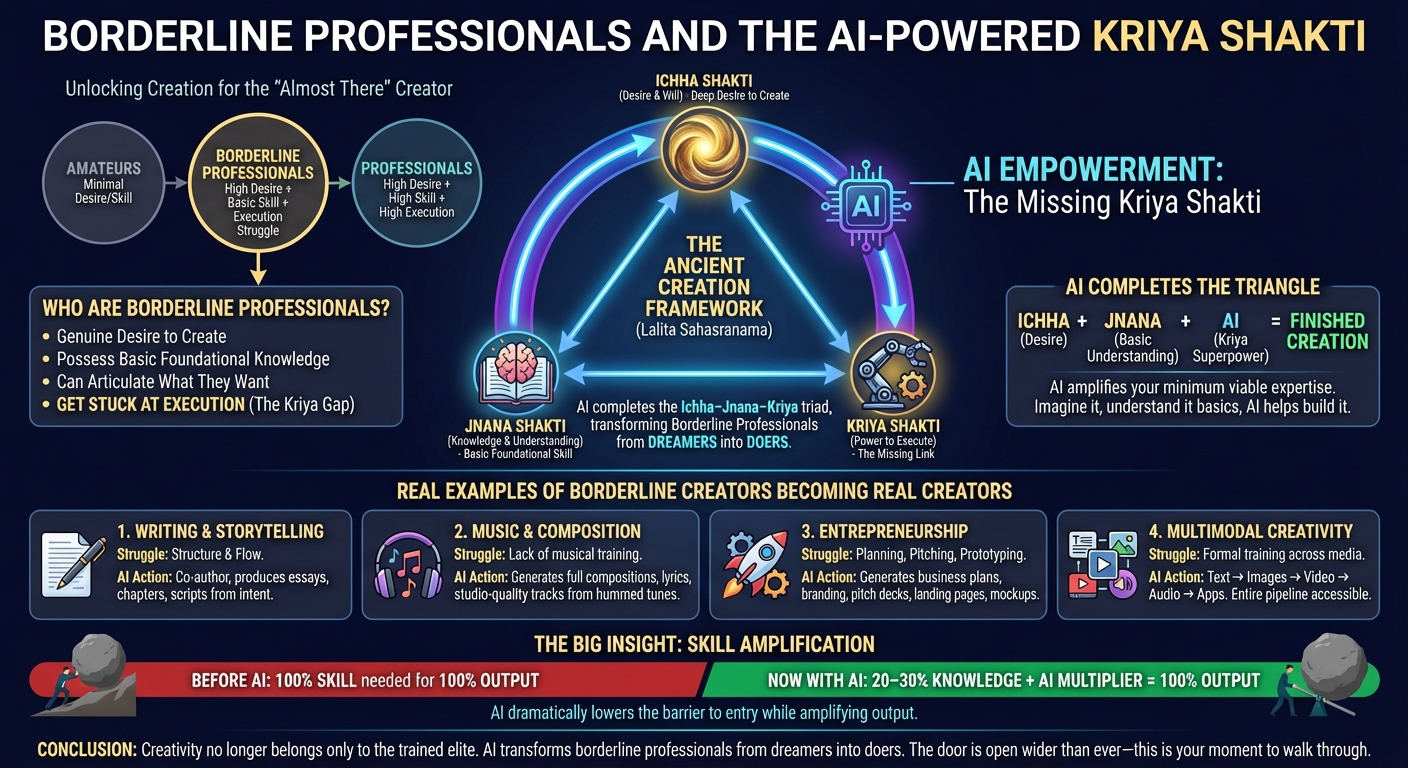
Most people assume creativity belongs only to experts. But a silent category exists between amateurs and full-fledged professionals—the borderline professionals. These are individuals who have the desire to create, and just enough basic skill to understand what they want, yet they struggle to execute.

Today, AI changes that equation.


The Ancient Framework That Explains Modern AI

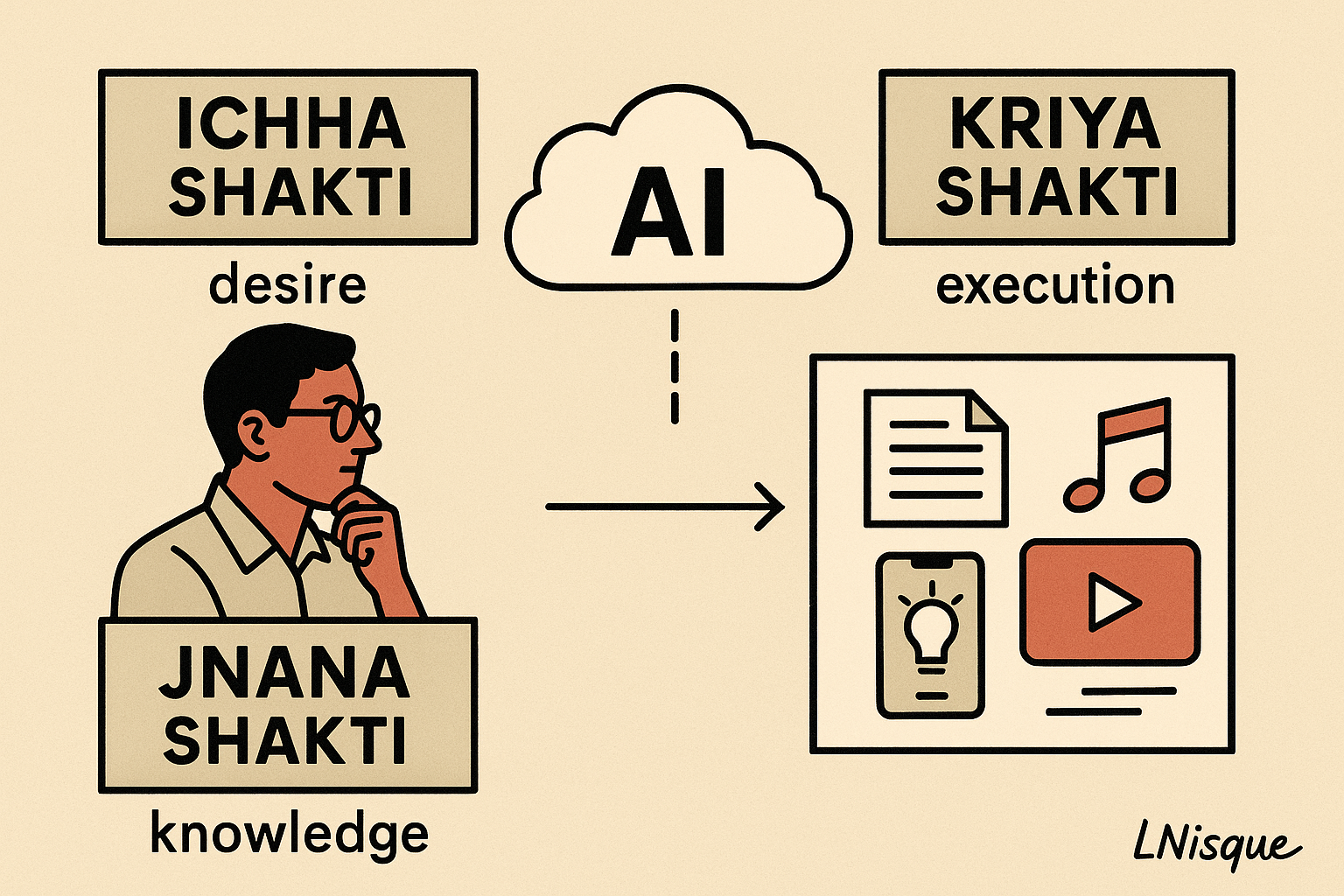
In the Lalita Sahasranama, creation is rooted in three forces:

  1. Ichha Shakti — the deep desire or will
  2. Jnana Shakti — the knowledge or understanding
  3. Kriya Shakti — the power to execute

In my book Directing Business, I highlighted how these three powers capture the entire arc of creation. Most people possess the first, many have some version of the second, but very few have the third.

This is where AI steps in—not as a replacement for human skill, but as the missing Kriya Shakti that unlocks execution.


Who Are Borderline Professionals?

Borderline professionals are not amateurs. They are not novices. They are people who:

  • Have a genuine desire to create
  • Possess basic foundational knowledge
  • Can articulate what they want
  • But get stuck when it’s time to execute

They often sit on ideas for years—songs they wanted to compose, books they wanted to write, companies they wanted to start, designs they always imagined but never completed.

Their limitation is almost always Kriya Shakti—the ability to translate intent and knowledge into a finished creation.


AI Completes the Creation Triangle

If you possess:

  • Ichha (desire)
  • Jnana (basic understanding)

AI now gives you:

  • Kriya (execution superpower)

This shifts the creative world in a fundamental way. AI does not magically inject expertise into you.
Instead, it amplifies your minimum viable expertise.

In other words:
If you can imagine it and understand it at a basic level, AI can help you build it.


Real Examples of Borderline Creators Becoming Real Creators

1. Writing & Storytelling

People who always wanted to write but struggled with structure or flow can now produce full essays, chapters, and scripts. AI becomes the co-author that takes their intent and shapes it into polished work.

2. Music & Composition

A person who can hum a tune or grasp rhythm but lacks musical training can now generate full compositions, lyrics, and studio-quality tracks.

3. Entrepreneurship

Someone with a startup idea but no experience in planning, pitching, or prototyping can now generate:

  • business plans
  • branding
  • pitch decks
  • landing pages
  • even early product mockups

In short, AI provides the scaffolding for company creation.

4. Multimodal Creativity

Text → Images → Video → Audio → Apps
With modern multimodal AI, the entire pipeline of creativity becomes accessible—even if the individual has never been trained formally.


The Big Insight: Skill Is Not Dead—It Is Amplified

You still need some Jnana Shakti—some grasp of your domain. AI cannot replace absolute ignorance.

But the amount of knowledge needed to start has dramatically dropped.

Earlier, you needed 100% skill to get 100% output.
Now, even with 20–30% knowledge, AI multiplies your ability to produce a finished work.

This is the true empowerment.


Why This Is the Best Time for Borderline Professionals

For the first time in history:

  • You don’t need a studio to compose.
  • You don’t need a publisher to write.
  • You don’t need a team to launch a startup.
  • You don’t need a design degree to create visuals.
  • You don’t need a production crew to make videos.

If you have deep desire (Ichha) and basic understanding (Jnana), AI gives you Kriya at a never-before scale.

This makes today the most powerful era for borderline professionals—those who were always “almost there,” waiting for a catalyst.


Conclusion

Creativity no longer belongs only to the trained elite. It belongs to anyone with the will to create and the willingness to learn just enough to guide AI.

AI completes the Ichha–Jnana–Kriya triad.
It transforms borderline professionals from dreamers into doers, and from doers into creators.

The door is open wider than ever.
And if you’ve always stood just outside it—this is your moment to walk through.


Infographic based on this article (using Nana Banana Pro)